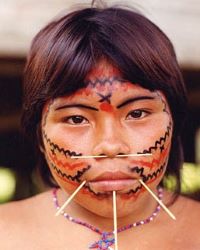

The Yanomam are one of the Indigenous peoples of the Amazon rainforest. In Brazil, they live primarily in the northern part of Amazonas and Roraima states, especially in remote regions along the Brazilian–Venezuelan border. Their territory consists of dense tropical forest cut by rivers and streams, creating both natural protection and isolation. The Yanomam speak languages belonging to the Yanomamic language family, with multiple dialects spoken across widely dispersed villages.
Historically, the Yanomam lived with minimal outside contact, moving villages periodically and maintaining self-sufficient lifeways. Sustained contact with national society increased during the twentieth century through road construction, missionary efforts, and mining interests. These encounters brought dramatic population loss from disease, violence, and social disruption. Although their territory has since been legally recognized in Brazil, outside pressures such as illegal mining, deforestation, and renewed contact continue to shape Yanomam life today.
Yanomam villages are typically composed of extended families living together in large circular communal dwellings known as shabonos. Life revolves around cooperation. Gardening is central, particularly the cultivation of plantains, bananas, manioc, and other crops. Men spend significant time hunting and fishing, while women gather forest foods, process crops, and care for children. Meals are shared, reinforcing interdependence and strong social bonds.
Daily life follows a rhythm shaped by the forest. Children learn by observing adults, gradually taking on responsibilities such as carrying water, tending gardens, or helping in food preparation. Storytelling, visiting neighboring villages, and ritual gatherings provide social interaction and recreation. While some communities now have limited contact with teachers, health workers, or traders, many Yanomam continue to live in ways closely aligned with traditional patterns.
The Yanomam are almost entirely followers of traditional ethnic religions centered on animism and shamanism. Their spiritual worldview teaches that invisible spirit beings inhabit animals, plants, rivers, and the air itself. These spirits are believed to affect health, fertility, weather, and success in hunting. Life is understood as a constant interaction between the visible and invisible worlds.
Shamans play a crucial role as spiritual protectors and healers. Through rituals, chants, and inhaled substances, they seek contact with spirit helpers to combat illness or misfortune. Death is commonly attributed to spiritual attack rather than natural causes. Although Christianity has been introduced to some Yanomam communities through long-term mission presence, many either reject it or blend Christian ideas with existing spirit beliefs. For most Yanomam, trust rests not in Jesus Christ but in managing relationships with the spirit world.
The Yanomam face serious physical and humanitarian challenges. Access to consistent medical care is extremely limited, especially in remote villages. Malaria, respiratory infections, malnutrition, and other preventable illnesses remain ongoing concerns. Clean water and sanitation infrastructure are often lacking, increasing vulnerability to disease.
Education is uneven and frequently provided in Portuguese rather than in Yanomam languages, limiting comprehension and long-term benefit. External threats—including illegal mining and environmental degradation—have harmed food sources, polluted water, and disrupted traditional lifeways. Sustainable health services, culturally appropriate education, and effective protection of Yanomam lands are critical ongoing needs.
Pray that the Yanomam would come to know Jesus Christ as the only Savior with power over all spirits.
Ask the Lord to raise up patient, culturally sensitive workers to live among the Yanomam and share God's word clearly.
Pray for healing, protection, and improved health for Yanomam communities facing disease and exploitation.
Pray that emerging Yanomam believers would grow strong in faith and one day carry the gospel to neighboring unreached peoples.
Scripture Prayers for the Yanomam in Brazil.
https://joshuaproject.net/people_groups/20111/BR
https://en.wikipedia.org/wiki/Yanomami
https://pib.socioambiental.org/en/Povo:Yanomami
https://www.survivalinternational.org/tribes/yanomami
| Profile Source: Joshua Project |