


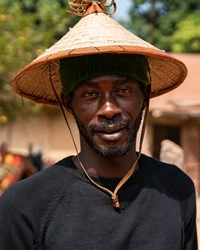

Long before Wolof kingdoms rose to prominence and before Mandinka traders mapped the waterways of West Africa, the Bainouk people were already there. Oral tradition and scholarly consensus alike point to the Bainouk as the original inhabitants of the lower Casamance region in southern Senegal — a people whose roots in this lush, river-threaded landscape stretch back well over a thousand years.
The Samik are one of several dialect subgroups of the broader Bainouk ethnic family, whose other branches include the Gunyaamolo and Gunyuño. All three dialects are considered endangered, pressed to the margins by more dominant regional languages. The Bainouk name itself carries a contested history: Mandinka oral tradition holds that "Bainouk" was a pejorative term coined after the Mandinka defeated them in the late sixteenth century, meaning roughly "those who are chased away." Earlier, the Portuguese had applied the name Banyun as a catch-all for groups controlling trade along the Gambia and Cacheu river corridors — a description that captured the Bainouk's historic commercial and political significance.
At their height, the Bainouk organized themselves into at least five independent states and held considerable power across the Senegambian coast. Their fertile territory and strategic position made them key players in regional trade networks. But successive waves of migration — Serer from the north, Mandinka from the east, Jola from the west — steadily compressed and displaced them. The Bainouk Kingdom, reduced to a vassal of the Kaabu empire, collapsed definitively in the 1830s when their capital was destroyed. Today the Bainouk, including the Samik, survive as a small remnant community, known among their neighbors as the people who came first — and who have been welcoming, and losing ground to, newcomers ever since.
The Casamance is among the greenest and most fertile corners of Senegal, and the Bainouk Samik are deeply tied to its rhythms. Agriculture anchors daily existence, with rice cultivation at its heart — a tradition so ancient in this region that the Bainouk likely passed it on to neighboring peoples who later absorbed much of their territory. Yams, millet, and other crops fill out the diet alongside fish from the region's rivers and coastlines.
The oil palm is both sustenance and livelihood. The Bainouk Samik tap palms to produce palm wine — a mildly fermented drink central to both daily life and ceremonial occasions — and press palm oil for cooking and sale. These products represent one of their main connections to local markets and provide a measure of economic independence in an otherwise subsistence-based economy.
Family structures reflect the pressures of being a small minority in a region dominated by larger groups. Bainouk communities historically prized hospitality and earned a reputation for peaceful coexistence with their neighbors, yet they have also learned to maintain a careful distance. A longstanding social belief — that marrying a Bainouk brings misfortune — has paradoxically protected community boundaries, discouraging intermarriage and slowing absorption into Jola or Mandinka society. Celebrations tend to follow the agricultural cycle, marking planting, harvest, and key life transitions with communal feasting, music, and ritual observance shaped by their traditional spiritual worldview.
The Bainouk Samik maintain their own traditional religious system — a living faith in which spiritual forces are understood to inhabit and govern the world around them. Ancestor spirits are not merely remembered; they are believed to remain present and influential, requiring honor and appeasement through offerings and ceremony. Sacred groves, ritual objects, and the mediation of community elders and specialists provide the pathways through which people seek protection, healing, agricultural blessing, and guidance for the future.
The Kumpo — a masked spirit figure originating among the Bainouk and later adopted by neighboring Jola — embodies the kind of spiritual power the Bainouk trust to emerge from the forest and move through the world. This figure, invoked through masked dance and ceremony, represents the broader Bainouk conviction that unseen forces are real, active, and must be engaged on their own terms. These beliefs are not peripheral; they are the organizing framework through which the Bainouk Samik understand illness, prosperity, and the meaning of community life.
Unusually for the predominantly Muslim context of Senegal, the Bainouk Samik have a Christian presence among them. This is a genuine gift — a foothold for the gospel in a spiritually resistant region. Yet the traditional religious system retains significant hold, and many who identify as Christian may blend that identity with ongoing trust in ancestral spirits and traditional power objects. Salvation, transformation, and eternal life are found only in Jesus Christ, and many among the Samik have yet to meet him in genuine, life-changing faith.
Access to clean water, adequate healthcare, and educational opportunity remains limited for Bainouk Samik communities in the rural Casamance. Their small size and geographic dispersal make it difficult to attract development resources, and the instability that has periodically flared in the broader Casamance region — stemming from a long-running separatist conflict — has added insecurity to an already fragile existence. The Samik dialect's endangered status also threatens to sever younger generations from their own oral tradition, history, and sense of identity.
Spiritually, those who know Christ among the Bainouk Samik need encouragement, grounding in Scripture, and vision to carry the gospel to those still looking to traditional spiritual forces for answers that only Jesus can give. Their small community needs church planters willing to learn the language, earn trust, and persist across the long arc of relational ministry.
Pray for Bainouk Samik believers to grow in bold, grounded faith and to witness to neighbors still trusting in ancestral spirits.
Pray for the power of traditional spiritual practices to be broken, and for the Samik to discover freedom and true protection in Jesus Christ alone.
Pray for clean water, reliable healthcare, and stability in Casamance communities where the Bainouk Samik live.
Pray for the Samik dialect to be preserved and for scripture and gospel resources to be developed in their heart language.
Scripture Prayers for the Bainouk, Samik in Senegal.
https://en.wikipedia.org/wiki/Bainuk_people
https://www.101lasttribes.com/tribes/bainuk.html
https://en.wikipedia.org/wiki/Jola_people
https://www.bouelmogdad.com/en/ethnic-groups-and-religions/
https://treslunasviajes.com/en/the-cultural-traditions-of-casamance-senegal/
| Profile Source: Joshua Project |



