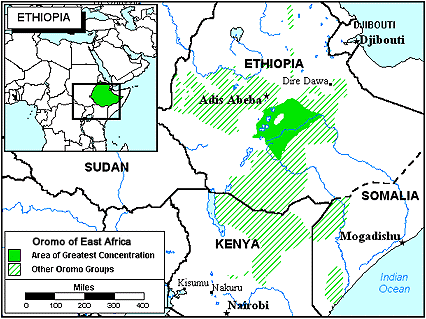

The Oromo are the largest, most widely dispersed people group in Ethiopia. They are composed of approximately a dozen tribal clusters. Nearly all the Oromo speak mutually intelligible dialects of the Oromo language. Oromo identity has historically been grounded in shared institutions, legal norms, and cultural frameworks that linked populations across wide territories. Social organization among the Oromo has traditionally been based on clans (gosa) and lineages, integrated through overarching systems of governance and law. The gadaa system, an age-grade–based political institution, structured leadership, authority, and social responsibility across generations and operated across clan boundaries. This institutional structure supported cohesion across large populations.
Oromo history is rooted in the Horn of Africa.
One of their subgroups is the Arsi Oromo who speak Borana-Arsi-Guji Oromo and live in south-central Ethiopia. Although Oromo subgroups retain similarities in their descent system, they differ considerably in religion, lifestyle, and political organization.
Migrating from the Horn of Africa, the Oromo arrived in Ethiopia four centuries ago. Between the sixteenth and eighteenth centuries, Oromo populations expanded across large areas through migration, political incorporation, alliance formation, and assimilation. These processes occurred within the region and reshaped existing political landscapes. Together with the Amhara and the Tigray, they dominated the government and military classes of the Ethiopian Empire. In the 1700s and 1800s, the Arusi became a prominent force in Abyssinian (Ethiopian) politics. By the eighteenth and nineteenth centuries, Arsi Oromo polities had emerged as significant political and military actors in south-central Ethiopia. They maintained autonomous institutions until incorporation into the Ethiopian state in the late nineteenth century.
Arsi Oromo livelihoods historically combined pastoralism and agriculture. Livestock, especially cattle, carried economic and symbolic significance. Social standing was shaped by age, lineage, reputation, and participation in community institutions. Social organization centered on extended families and local communities governed by customary law (seera). Authority rested with senior men and was regulated through collective decision-making and established norms. Marriage, kinship, and childrearing structured social continuity. Cultural ideals emphasized physical endurance, responsibility, and loyalty to the community. Martial competence was valued in specific historical contexts but was not a universal or formalized requirement for adulthood. In the contemporary period, Arsi Oromo livelihoods have diversified. Rural farming remains central, alongside increasing participation in trade, education, public service, and urban wage labor.
During the nineteenth century, most Arsi Oromo adopted Islam. Earlier religious concepts and ritual practices continued to inform social and moral life. The majority of Arsi Oromo still identify as Sunni Muslim. Religious practice varies in form and intensity and reflects long-standing interaction between Islamic ethics and local cultural norms. Indigenous Oromo religious concepts centered on Waaqaa, understood as a supreme creator associated with moral order and justice. Elements of this worldview persist in attitudes toward social obligation, nature, and communal harmony. Ritual gatherings historically reinforced these values.
A minority of Arsi Oromo are Christian, primarily Protestant, with smaller numbers affiliated with Ethiopian Orthodox Christianity. Religious diversity reflects historical contact, education, and political change.
Arsi Oromos need to have the spiritual hunger it takes to find their way to the cross no matter what the social cost. The Christians among them need to share their faith, even if they face persecution and ridicule.
Pray for the Lord of the harvest to call Arsi Oromos to disciple those who need Christ's mercy.
Pray they will embrace the one sacrifice given on their behalf.
Ask God to raise prayer teams for the Oromo peoples that will pray until something happens!
Scripture Prayers for the Oromo, Arsi in Ethiopia.
https://www.101lasttribes.com/tribes/oromo.html
https://en.wikipedia.org/wiki/Arsi_people
Azernet Silte
| Profile Source: Joshua Project |