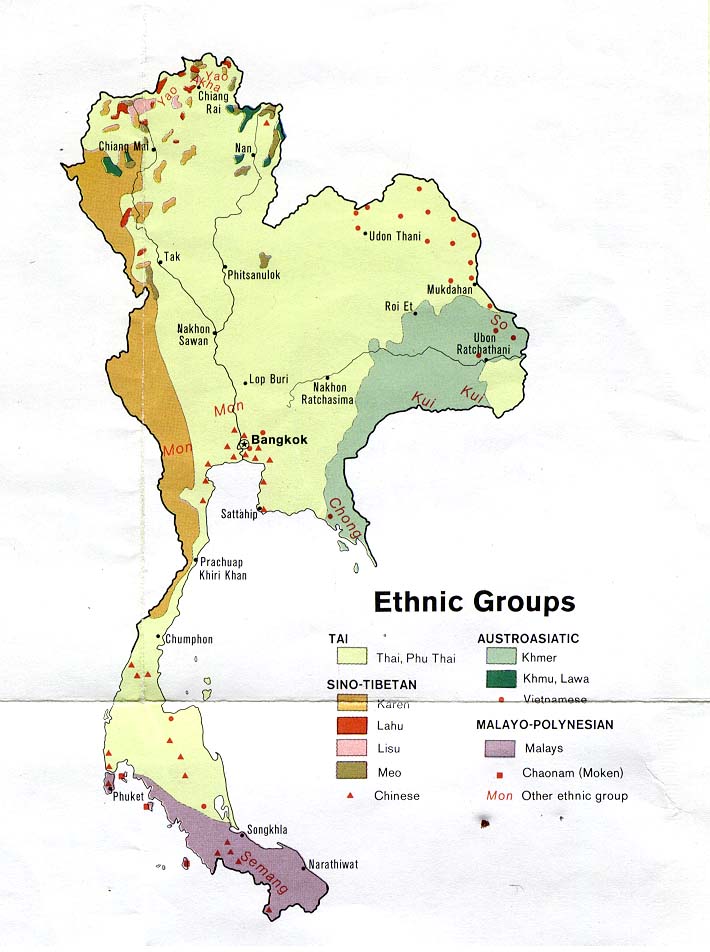

Huay, the name this group calls itself, means "forest stream." The Thais call them Kha Hor, a term that the Huay consider derogatory. Most likely they were taken as slaves or war prisoners from Laos to Thailand in the middle of the nineteenth century. They were well-known for their ability to walk fast through jungles and mountainous areas, so the Thai authorities used them as messengers. They walked so quickly that the Thai gave them the name Kha Hor. The Huay used to speak a language from the Mon-Khmer family, related to the Khmu languages. Over the last few generations, the Huay language has been spoken less, so that today most members of this small group speak a version of Thai that is influenced by Lao dialects, in their homes. The Huay tribe lives in northern Thailand's Nan Province, and they inhabit four main villages (Ban Nam Lieng, Ban Pang Hok, Ban Peen and Ban Huey Kohn) in Thung Chang District, not far from the Thailand-Laos border. About 40 years ago, the Huay moved away from the border area to their present settlements. The Huay living in Ban Nam Lieng, Ban Pang Hok and Ban Huey Kohn villages all share the family name of Taukam, while the Huay of Ban Peen have the name Hoom Doog.
Days begin before dawn with the sound of crowing roosters and wood fires crackling. Families prepare breakfast, which usually consists of rice, eggs, and foraged vegetables. Depending on the season, members head out early to work on terraced hill rice fields or tend to community livestock like pigs and chickens. Many communities practice sustainable rotational farming and follow strict customary rules to protect wildlife and forest resources. Their meals are simple, fresh which are produced from local farms on a rotational basis. Meals consist of sticky rice, vegetables and fish and/or meat that are hunted by the men. Many women spend their days meticulously weaving textiles or crafting traditional jewelry. If they live in villages that engage in community tourism, they also host visitors, demonstrating traditional cooking or guiding forest walks.
As the sun goes down, the entire family gathers on large wooden porches to cook, play cards, and share stories. simple, fresh, and often sourced entirely from the village's rotational farms or the surrounding jungle. The diet is heavily based on sticky rice, locally grown vegetables, and occasionally fish or meat hunted by the men in the community.
Their lives are guided by a blend of Buddhist principles and centuries-old animistic rituals. They believe deeply in spirits, offering sacrifices of rice and flowers at village spirit houses during seasonal changes and festivals Celebrations, such as moon ceremonies or wrist-tying ceremonies for newborns, The Huay outwardly adhere to Buddhism, but are also strongly influenced by their centuries-old animistic rituals. Their spirit house is located near the Buddhist shrine where they offer sacrifices of rice, flowers and, alternatively, chickens or a pig once a year during the Thai New Year (Songkran) festival. They do not have altars for ancestor worship, nor do they practice any agricultural rituals. In former times they built spirit gates just outside their villages. In reaching out of this tribe, one must exercise "cultural protocols" such as not giving candy or toys to children.
Like many tribal groups in Southeast Asia, their livelihood relies on farming and the sustainable gathering of non-timber forest products, requiring equitable access to land and water management.
Due to their highly remote locations near the Thai-Laos border, everyday challenges include accessing nearby hospitals and achieving quality, localized education for their youth.
If considering contributions, one must approach the "headman" and he distributes to local schools as well as community development
Pray for Christian workers and spiritual openness.
Pray that the Holy Spirit softens their hearts and that they would be "adopted" by those who want to see God's Kingdom extended to them.
Pray for their leaders to have the spiritual hunger it takes to embrace Christ no matter what the cost.
Scripture Prayers for the Huay in Thailand.
https://thishumantribe.com/experiences/life-in-a-longneck-village-in-thailand/https://joshuaproject.net/frontier
people-groups.asiaharvest.org/Thailand/Huay.pdf
| Profile Source: Joshua Project |