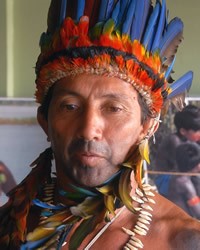

The Tenharim are an Indigenous people living in the Amazon region of Brazil, mainly in the state of Amazonas along the Marmelos and Madeira River regions. They belong to the larger Kagwahiva subgroup of the Tupi linguistic family and are closely related to other Amazonian Indigenous peoples. Traditionally, the Tenharim survived through hunting, fishing, gathering, and agriculture within the rainforest environment.
During the twentieth century, road construction projects such as the Trans-Amazonian Highway brought major disruption to Tenharim territory. Contact with settlers, loggers, miners, and outside diseases caused population decline and social instability. Despite these challenges, the Tenharim have continued preserving their language, ceremonies, and communal identity while defending their land rights and cultural traditions.
Most Tenharim communities live in protected Indigenous territories where family and communal relationships remain central to daily life. Agriculture, fishing, hunting, and gathering forest resources continue providing food and income for many families. Crops such as cassava, bananas, and corn are commonly cultivated in village communities.
Younger generations increasingly interact with Brazilian culture through schools, transportation networks, and technology. Some Tenharim leaders are involved in Indigenous rights advocacy and environmental protection efforts. However, deforestation, illegal economic activity, and cultural pressures continue threatening their traditional way of life.
Healthcare and education remain limited in some remote communities, and economic opportunities are often unstable. Evangelical Christians among the Tenharim can help strengthen families, encourage discipleship among youth, and demonstrate Christ-centered leadership within their villages.
Traditionally, the Tenharim practice an animistic worldview in which spirits influence nature, health, animals, and community life. Ceremonies, chants, oral traditions, and spiritual rituals remain important cultural practices. Shamans traditionally acted as healers and spiritual mediators between the visible and unseen worlds.
Many Tenharim continue respecting ancestral traditions while also interacting with Catholic and Protestant influences introduced through outside contact. In some communities, elements of traditional beliefs and Christianity are mixed together. Spiritual fear and dependence on ritual practices can still shape daily decision-making.
From an evangelical perspective, the Tenharim possess deep spiritual sensitivity but still need strong biblical discipleship centered on Jesus Christ. Indigenous believers who understand Tenharim language and culture are especially important for helping churches grow in biblical maturity and faithful Christian living.
Socially, the Tenharim need continued protection of their Indigenous lands, language, and cultural identity. Outside pressures such as logging, mining, land invasion, and environmental destruction threaten many Amazonian communities. Young people especially need educational opportunities that respect their culture and prepare them for future leadership.
Economically, many Tenharim families depend on subsistence agriculture and limited trade. Sustainable economic development that protects the rainforest and respects Indigenous traditions is essential for long-term stability. Healthcare access and infrastructure improvements are also important needs.
Spiritually, the Tenharim need mature Indigenous churches rooted in Scripture and led by local believers. Continued discipleship, biblical teaching, and leadership development are needed so that Tenharim Christians can become a gospel force among neighboring Indigenous peoples throughout Brazil.
Pray that Tenharim believers would grow strong in biblical faith and become leaders within their communities.
Pray that Indigenous churches among the Tenharim would disciple younger generations with wisdom and love.
Pray that Tenharim Christians would become a gospel witness to Indigenous peoples throughout the Amazon.
Pray for protection of Tenharim land, culture, families, and natural resources from exploitation and violence.
Pray that the gospel would bring healing, reconciliation, peace, and freedom from spiritual fear among the Tenharim people.
Scripture Prayers for the Tenharim in Brazil.
http://pib.socioambiental.org/en/Povo:Tenharim
http://peoplegroups.org/people_groups/pg017118
http://www.ethnologue.com/language/tnh/
http://en.wikipedia.org/wiki/Tenharim_people
| Profile Source: Joshua Project |