


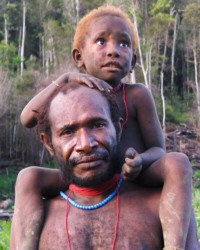

The Nimo people live in parts of Sandaun (West Sepik) Province and adjacent areas, with communities recorded in villages such as Nimo, Wasawai, and several neighboring hamlets. Their language, Nimo (Nimo Wasawai), belongs to the Left May (Arai) family and has been documented in linguistic surveys and descriptive notes that record its relationship to nearby Left May languages. Available linguistic fieldwork and village listings identify Nimo as a small, regionally concentrated language with historical ties to neighboring riverine and forest communities.
Nimo speakers live in village clusters where daily life centers on subsistence gardening, fishing, and forest gathering suited to the local lowland and riverine environment. Gardens produce root crops and other staples; hunting and gathering supplement household diets. Social organization is built around extended kin networks and village leadership, with communal labor for planting, housebuilding, and ceremonial obligations. Tok Pisin is used for wider communication and market exchange, while Nimo remains important in many home and community contexts. Access to formal education and health services varies by village and often requires travel to larger centers.
Documentary sources note the presence of Christian influence in many Left May and nearby Sepik communities, reflected in church activity and mission contacts reported in regional surveys. Where specific community records document religious affiliation, church institutions are part of social life; descriptions of local belief emphasize a mix of introduced Christian practice alongside customary values tied to kinship and land. Reporting focuses on documented patterns rather than inference about private belief.
Nimo communities face needs common to small, remote language communities in Sandaun Province: improved and reliable access to primary and secondary education; consistent basic healthcare and maternal/child services; and infrastructure that reduces isolation and travel time to service centers. Language documentation and community literacy initiatives support intergenerational transmission as younger people engage with Tok Pisin and external opportunities. Sustainable management of garden and forest resources, support for local livelihoods, and culturally grounded development initiatives would strengthen long term resilience and well being.
Pray for Nimo believers to grow in maturity, to be guided by the Holy Spirit in their families, and to be good and accurate influences of Christ to their friends and relatives as they serve as Christian workers.
Pray for improved access to healthcare and for strengthened support for families facing medical challenges.
Pray for expanded educational opportunities for children and youth, and for those in government leadership to make wise and just decisions that benefit remote communities.
Pray for the preservation of the Nimo language and cultural knowledge, and for the sustainable care of their environment and natural resources.
Scripture Prayers for the Nimo in Papua New Guinea.
Ethnologue — Nimo language profile.
Wikipedia — Nimo language overview.
Max Planck Institute / Lingweb — Nimo language notes and location data.
Archive.org — Nimo language materials and documentation listings.
| Profile Source: Joshua Project |



