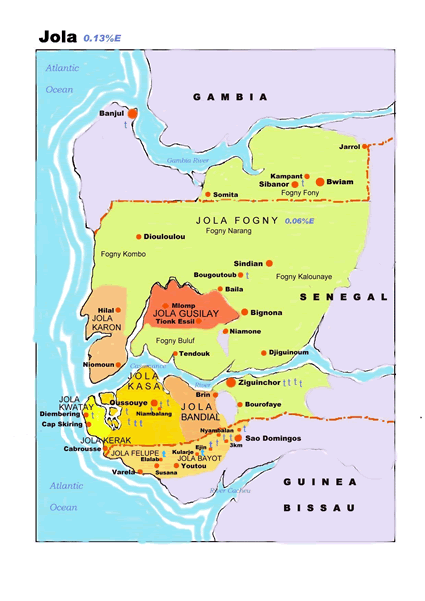
The Falor are a distinct branch of the wider Jola peoples of West Africa. They live primarily in the Thiès Region of western Senegal, northwest of the city of Thiès. Unlike many other Jola groups who are concentrated in the Casamance region, the Falor have maintained a separate identity farther north. They speak Paloor, a language belonging to the Cangin branch of the Niger-Congo language family. Although related historically to neighboring Cangin peoples, centuries of separation have resulted in Paloor becoming a distinct language.
Oral tradition holds that the Falor and other Cangin peoples once shared a common language before gradually developing into separate communities through migration and isolation. Despite living near larger ethnic groups such as the Serer and Wolof, they have preserved their own language and cultural identity across generations.
The Falor are traditionally an agricultural people whose livelihoods depend largely on farming. Families cultivate crops suited to the coastal savanna environment, including millet, groundnuts, maize, and vegetables. Livestock keeping and small-scale trade also contribute to household income, while local markets provide opportunities to exchange goods with neighboring communities.
Community life revolves around extended families, where cooperation between relatives is highly valued. Elders play an important role in preserving traditions and guiding younger generations. Weddings, harvest celebrations, and other communal gatherings strengthen social bonds through music, dance, storytelling, and shared meals. As education and urban employment become more accessible, many younger Falor also interact regularly with Senegal's multilingual society while retaining pride in their ethnic heritage.
Most Falor identify with Islam. Alongside Islamic practice, many also place their trust in traditional spiritual beliefs, including ancestral spirits, sacred rituals, and other unseen spiritual forces believed to influence health, protection, fertility, and daily life. These religious practices continue to shape important decisions for many families.
The gospel has only a limited presence among the Falor. Scripture has not yet been translated into the Paloor language, making access to God's Word in their heart language extremely limited. Although some Christian witness exists, many Falor have never had the opportunity to hear the message of salvation clearly explained in the language they understand best. The Bible teaches that forgiveness of sins and eternal life are found through faith in Jesus Christ alone, not through rituals, spirits, or any other spiritual power.
The Falor would benefit from improved access to healthcare, quality education, and sustainable agricultural support that strengthens rural livelihoods. Continued language development and literacy efforts would also help preserve the Paloor language while expanding educational opportunities.
Spiritually, they need Bible translation, faithful Christian workers, culturally appropriate discipleship resources, and healthy local churches that can communicate the gospel clearly in the Paloor language.
Pray that the Falor will hear the gospel in their own language and place their trust in Jesus Christ.
Pray for the translation of Scripture and other biblical resources into the Paloor language.
Pray for improved healthcare, education, and sustainable livelihoods in Falor communities.
Pray that God will establish strong, Bible-centered churches that faithfully disciple Falor believers.
Scripture Prayers for the Jola, Falor in Senegal.
https://peoplegroups.org/people_groups/pg014234/
https://www.ethnologue.com/language/fap
https://en.wikipedia.org/wiki/Jola_people
https://globalrecordings.net/en/language/fap
| Profile Source: Joshua Project |