Your Life. God's Mission.
The World's Needs.

No matter where you are in life, you can trust God with your future. He's building His Kingdom, and He wants you in on the work of reaching the world. We're glad you're here to learn and explore.
"The heart of the discerning acquires knowledge, for the ears of the wise seek it out."
(Proverbs 18:15)

Start Exploring

Essential Missions Foundations

In Matthew 28:19, Jesus said, "Therefore go and make disciples of all nations..." That word "nations" translates from the Greek ethnē, meaning every distinct people group.

"And this gospel of the kingdom will be preached in the whole world as a testimony to all nations, and then the end will come" (Matthew 24:14).

Jesus couldn't be clearer. Who should get to hear the good news about Him? Everyone. He has no favorites. His followers are meant to work together until every people group has heard and can follow Him. That's the Great Commission.

Thousands of these groups still haven't heard. This page walks through what that means, why it's still true, and the practical next steps from prayer to action. No pressure, just a clear path forward.

People from many different nations and cultures, each a distinct people group

"He is no fool who gives what he cannot keep to gain that which he cannot lose."

Jim Elliot (1927–1956)

Great Commission Progress

So how is the task going? There are people who don't yet follow Jesus in every part of the world, but that doesn't make every people group "unreached." The difference matters, and it shapes where help should go first.

Groups able to reach their own people Groups still needing outside help

Enough to grow on their own

About 57% of all people groups have enough followers of Jesus, churches, and spiritual resources to share the gospel with their own friends, families, and neighbors.

Needing help from outside

4,486 groups don't yet have enough followers of Jesus to reach their own people, and access or response to the gospel is limited. Reaching them takes believers from beyond their own community.

Few or no known believers

Within those, 3,218 Frontier groups have fewer than 1 in 1,000 people who follow Jesus, or no known believers at all.

"How, then, can they call on the one they have not believed in? And how can they believe in the one of whom they have not heard? And how can they hear without someone preaching to them? And how can anyone preach unless they are sent? As it is written: 'How beautiful are the feet of those who bring good news!'"

Romans 10:14–15

This is why Joshua Project exists. Since 1995 we've been researching and highlighting the peoples and places with the least access or response to the gospel, so the church can put its prayer and effort where they're needed most. We don't send missionaries ourselves; we equip the people and agencies who do. Read our story →

Explore the progress for yourself

Global Dashboard

Start with the big picture: global numbers and regional breakdowns in one place, so you can see the scale of the task and how it's changing.

Open the Dashboard →

Global Database

Summary listings by country, region, religion, or progress level. Or build your own list, right down to which groups have the Bible, or parts of it, in their own language.

Ready-Made Lists

Pre-built collections from many perspectives, like the 100 largest unreached groups or the peoples with no Scripture, when you want a head start.

Browse Lists →

Interactive Map

Sometimes a map says it best. See where people groups live and how they cluster, then zoom in for the detail or out for the wider pattern.

Open the Map →

Maps & Infographics

Visual tools that show where the Church is growing and where its presence is still smallest.

Progress Scale

See how far each people group has come toward following Jesus, from no known believers to a thriving church.

Explore the Scale →

Not sure where to begin?

Get your bearings on the Dashboard, narrow things down with Lists or the Database, and open the Map when you want to see how it all fits together. You can also browse every people group, go country by country, or dig through the full resource library.

Unreached and Frontier People Groups

Two terms you'll see all over this site. Here's what each one means, and where the line sits between them.

A dense festival crowd in South Asia, a region that is home to many unreached people groups

Unreached People Groups (UPGs)

Groups where fewer than 2% are evangelical Christians and fewer than 5% identify as Christian at all. There aren't enough local believers to take the gospel to the whole group without outside help.

4,486 groups · 3.6 Billion people

Frontier People Groups (FPGs)

A smaller group within the unreached: the furthest edge. Fewer than 1 in every 1,000 people follows Jesus, with no known movement toward Christ. For most, the gospel isn't yet within reach at all.

3,218 groups · 1.9 Billion people

The Great Imbalance

The global church isn't short on resources. There's money, skilled leaders, and no shortage of people who want to help. But most of it goes to places that already have the gospel. Put simply: the people with the least chance of hearing about Jesus, finding a church, or reading a Bible are the ones receiving the least help.

Keep exploring

Where Is Gospel Access Needed Most?

One region holds the largest concentration of unreached and frontier peoples: a band stretching from North Africa through the Middle East and across Asia. Most of it lies between 10 and 40 degrees north latitude, which is why it's called the 10/40 Window.
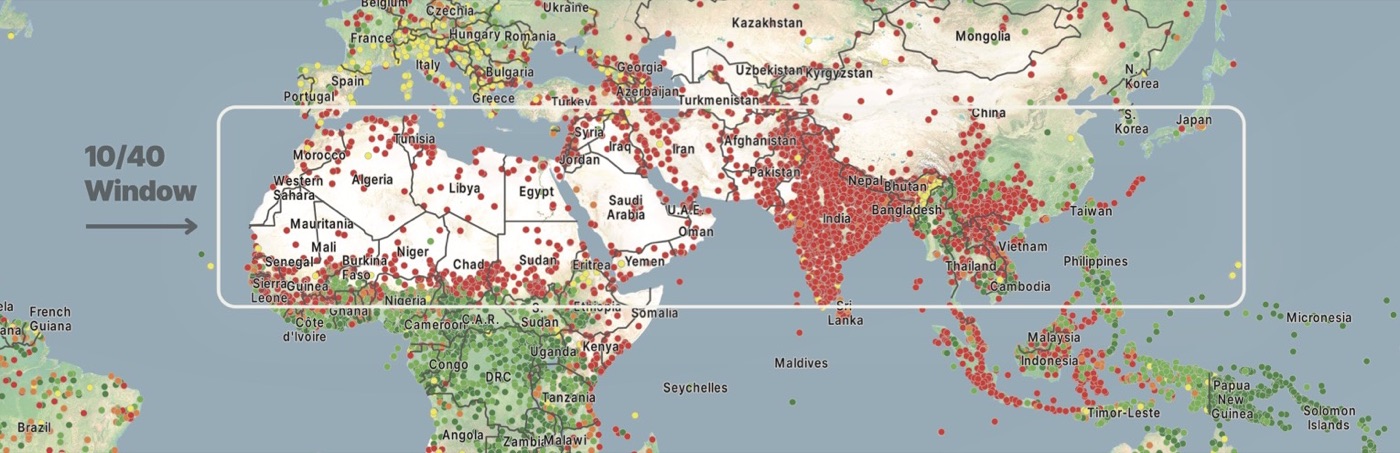
Map of the 10/40 Window, showing dense clusters of unreached people groups from North Africa through the Middle East and across Asia
Each dot is a people group; red dots are unreached. Notice where they cluster. From the full 10/40 Window map (PDF).

The Greatest Need

3.5 Billion

people in Unreached People Groups live inside the window.

A Resource Gap

~3%

of all missionaries serve in this region, home to most of the world's unreached.

Many Complexities

68 countries

holding two-thirds of the world's people: beautiful cultures and growing economies alongside poverty, disaster, and hard political realities.


Keep exploring

Counting People Groups

People move: for work, for safety, for family. Because of migration, one people group might live in its homeland and in a dozen other countries at the same time. That's why we count two ways.

People Groups Across Countries (PGAC)

One global count per people group. However far a group has scattered, PGAC still counts it as one people. It's the best view when you want to take in a whole people at once.

10,432 groups worldwide

People Groups In Countries (PGIC)

A count for every country where a group lives right now. Gujaratis in India and Gujaratis in the UK each count separately. That's the number to use when you care about where people actually are today.

16,436 groups counted by country

Move Forward. You Can Start Today.

"If ten men are carrying a log, nine of them on the little end and one at the heavy end, and you want to help, which end will you lift on?"

William Borden

So, what can you do? More than you might think. Here are four honest places to start. Pick the one that fits where you are.

1

Pray for Unreached People

Prayer is the most important work, and the simplest place to begin. Thousands of people pray for a different unreached people group every day, through our app or by email. Ready to dive in?

2

Learn More About Unreached People

There's so much to discover, and no classroom required. Two free email courses lay the foundation. Pick one below. You can also follow a region you care about: India, Africa, Central Asia, the global diaspora, or Frontier peoples. Or go all in with Perspectives: 15 lessons immersed in God's story of redeeming people from every tribe, tongue, and nation.

3

Connect Through Digital Evangelism

With some 5.5 billion people online, the internet reaches where missionaries can't go. In-person relationships are still the ideal, and online ministry isn't right for every situation. But right now, people in closed countries are hearing about Jesus for the first time, through direct messages, WhatsApp groups, and YouTube channels in their own language. Culture still matters online just as much as in person: language, trust, and the ways honor and shame work all shape how the message lands. Maybe this is a door you could walk through.

4

Research and Apply to Serve

Maybe God has been preparing you to serve cross-culturally for a few weeks, a few months, or years. Every kind of skill is needed, and you can choose to prioritize unreached and frontier peoples. Ask missionaries and pastors you trust which organizations train and send workers well, and use the Mission App to find a team that fits your gifts, availability, and burden.

Start with step one, today

Install the Unreached of the Day app and you'll get a new people group to pray for each morning: a short profile, a few prayer points, and something to learn.

Download App

Missions 101 Email Course

If you'd like to go deeper, two free email courses can help lay a solid foundation. Lessons arrive over a few weeks, short enough to fit around everything else you've got going on.

Missions 101a: Foundations covers the basics: what unreached people groups are, why they matter, and how the church is responding.
Missions 101b: Strategic Engagement picks up from there, walking through real ways to move from praying to doing, from short-term trips to long-term service to digital ministry.

Select Course(s):

Learn about Strategic Regions

Want to follow a particular part of the world? Pick one or more regions below and we'll send you a weekly email: people group profiles, stories from the field, prayer points, and security notes where they matter. Choose whatever's on your heart.

Select Region(s):

Becoming a Missionary

A worker setting out to serve cross-culturally, walking away with a pack and a case

Maybe you've moved past just wondering, and you're starting to seriously ask how God might use you overseas. If so, here are some straight answers to the practical questions: what the paths look like, how long they take, and how to get ready.

Assess Your Season

Missions isn't only for twenty-somethings fresh out of college. People go at every stage of life: career changers, empty nesters, retirees, and young adults alike. Where you are in life doesn't rule you out; it just shapes what kind of serving fits. Your family, finances, health, and skills all factor in.

Types of Service

Short-term (2 weeks - 2 years): Vision trips, summer projects, a gap year. A good way to explore, learn, and test whether this is really your calling.

Mid-term (2-5 years): Language learning, internships, focused projects. A deeper commitment, but with a clear end in sight.

Long-term (5+ years): Church planting, leadership development, specialized ministry. Giving a good chunk of your life to one people or region.

Training & Preparation

Going well takes preparation: cross-cultural training, a solid grounding in Scripture, language learning, whatever skills your role calls for (medical, teaching, business), and a hard look at your own readiness. Most sending agencies walk you through this, but anything you learn ahead of time is time well spent.

Organizations That Send Workers to the Unreached

The organizations below have been sending workers to the unreached for decades. If you're thinking about serving, they're a good place to start a conversation. Click any logo to learn more.

Before you go: a two-minute survey

How familiar were you with the Great Commission before today? Your answers help us make this page more useful for the next explorer.

Take the survey