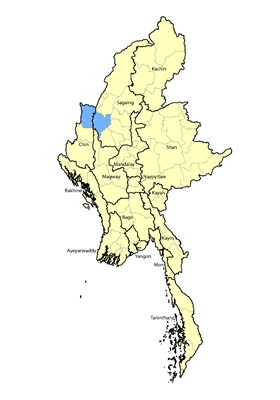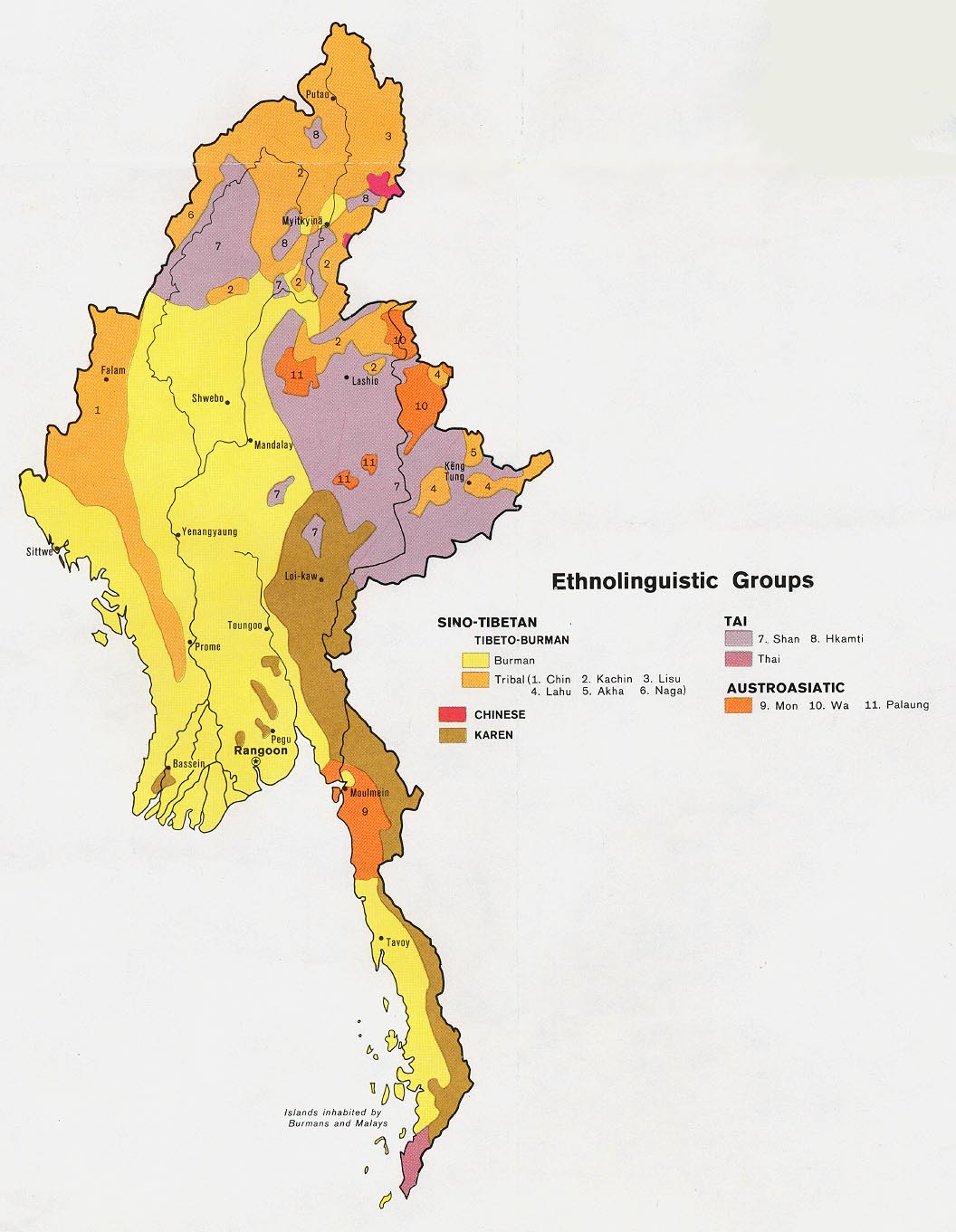

The Zanniat tribe inhabits 39 villages in Falam Township in western Myanmar's Chin State. The center of the Zanniat community is the town of Webula, located just 19 miles (30 km) east of Falam. A small number of Zanniat villages are also found across the state border in the Kale District of Sagaing Region. The Manipuri River, which "flows in a southeasterly direction within the Falam Township, makes a clear natural boundary of Zanniat lands. Zanniat territory is adjacent to Ngawn?tribal land and Tedim Township?in the north.?The land has thick vegetation with fauna."
Some sources suggest that Zanniat families may also live in the Indian state of Mizoram and in the Chittagong Hill Tract area of Bangladesh.
The 1931 census returned 6,677 "Zahnyet" people in Burma. Since that time most scholars have considered the Zanniat to merely be a subgroup of the large Falam Chin language cluster, but the Zanniat proudly retain a distinct history, customs, and dress, while acknowledging their relationship with the larger Chin race. Great complexity is found within the Zanniat communities, with a 1944 source claiming there were 57 Zanniat sub-tribes and clans.
In 1983, researchers with the Summer Institute of Linguistics found that 16,000 people spoke Zanniat in Myanmar but counted it as just one of many dialects of Falam Chin. Today, the Zanniat are recognized as a distinct people group within the wider Falam Chin language cluster. Although Zanniat Christians today read Falam Chin Bibles, their spoken language remains distinct enough to have warranted the production of specific audio resources by the mission group Global Recordings.
The Falam people expanded over many generations by conquering neighboring tribes and making alliances with them. They made a deal with the Shan rulers of Kale, who granted the Zanniat access to dominate the salt trade to much of the country. When they waged war, "The Falam never fought alone but invited their allies to fight with them…. When they subdued the Zanniat rebels, they made the Zanniats carry trade goods from the plains without payment." In 1860, the Zanniat joined forces with the Khualsim tribe to break free from the Falam yoke. After they murdered 80 Falam men who crossed a rope bridge over the Manipuri River, the Falam mobilized a large army, which "overran and utterly laid waste the Zanniat-Khualsim tract. Only those who fled to Burma evaded the death penalty. The result of the rebellion proved disastrous to the Zanniat, who for all purposes became the slaves of the Falam and were forced to carry salt and rice from Burma."
In Chin State the Zanniat area is bordered by seven different Chin tribes, with the Siyin and Ngawn to the north; Bualkhaw, Tapong, Taisun, and Lente to the west; and Khualsim to the south. Although inter-tribal warfare prevailed in the past, today the Zanniat enjoy good relations with neighboring groups, which are now bound together by their common Christian faith.
The gospel reached the Zanniat area in the early 20th century and by the 1931 census, 225 of the 6,677 Zanniat people identified as Christians and the rest as animists. Christian progress was slowed due to the pervasive influence of the Paucinhau cult. By the end of the Second World War, "seven percent of the Falam followed Paucinhau and in the Zanniat area the whole tribe converted.
Although almost all Zanniat people claim to be Christians, the influence of the syncretic Paucinhau faith, which blends traditional Animism with Christianity, has clouded the faith of many people. Since the 1970s, church affiliation among the Zanniat people appears to be evenly divided between Baptists and Catholics. Many people joined the Catholic church because of the strict Baptist prohibition on believers drinking traditional zu (rice beer). The Catholics had no such restrictions. Zanniat believers do not have their own Bible but have used the Falam Chin Scriptures since the New Testament was published in 1951.
Pray for spiritual renewal among Zanniat Christian believers and freedom from syncretism.
Pray for the Lord to bless the work of their hands as they obey biblical principles.
Pray for the Lord to bless them spiritually and physically.
Pray for the believers among them, that they will grow strong in faith and become part of the mission force, carrying the gospel to their own people and beyond.
Scripture Prayers for the Zanniat in Myanmar (Burma).
Asia Harvest, Copyrighted 2026 © Used with permission
| Profile Source: Joshua Project |
| Other PDF Profile |