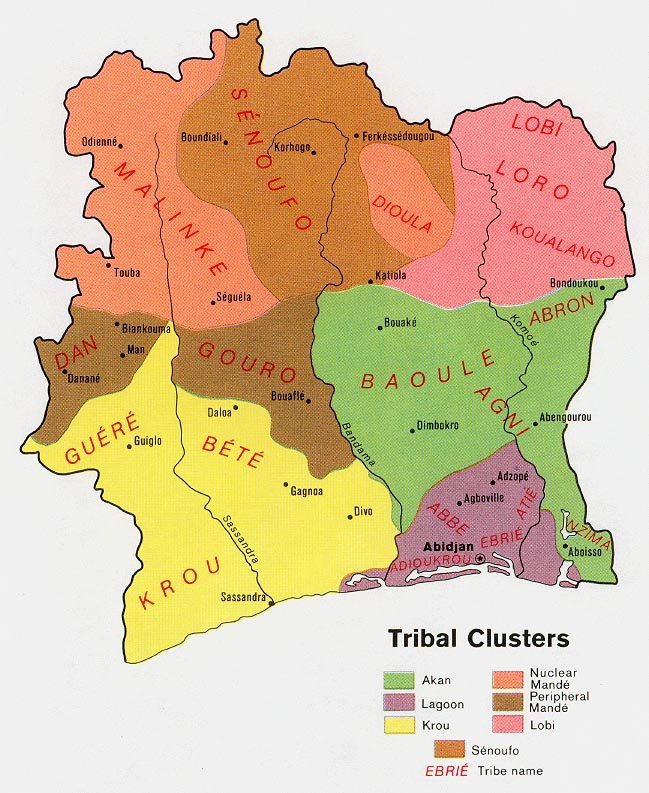

The Western Bete are part of the larger Bete people, an indigenous ethnic group of southwestern Côte d'Ivoire. Historically, they have lived in forested regions, relying on agriculture and hunting for survival. Their society is organized around clans and extended families, with strong traditions of oral history and storytelling. The Bete resisted early colonial influence and maintained their cultural identity through language, music, and ritual practices. Their history includes periods of migration and adaptation to political changes in Côte d'Ivoire.
Most Western Bete are subsistence farmers, cultivating crops such as rice, cassava, plantains, and yams. Cocoa and coffee are important cash crops, providing income for many families. Hunting and fishing supplement their diet. Meals often include starchy staples like cassava and plantains, served with sauces made from palm oil, peanuts, or vegetables. Meat and fish are eaten when available.
Families are typically extended, with strong kinship ties. Elders hold significant authority, and decisions often involve clan consensus. Children are raised collectively, emphasizing respect for traditions.
Festivals and ceremonies are energetic, featuring traditional music, dance, and masks. Drumming and storytelling play central roles in marking life events such as harvests, marriages, and funerals.
The Western Bete traditionally practice animistic beliefs, honoring ancestors and interacting with spiritual forces through rituals and sacrifices. They believe in a supreme creator but rely on intermediaries such as spirits and ancestors for daily concerns. Christianity has made inroads, particularly through Catholic and Protestant missions, but many blend Christian practices with traditional beliefs. Evangelical Christianity is present but not dominant.
Physically, many Western Bete communities lack adequate healthcare, clean water, and educational opportunities. Roads and infrastructure are limited, making access to markets and services difficult. Spiritually, while some identify as Christian, many lack a clear understanding of the gospel and remain deeply tied to traditional spiritual practices. There is a need for discipleship and Bible translation in their heart language.
Pray for improved access to clean water, healthcare, and education in Western Bete villages.
Intercede for freedom from fear of spirits and ancestors, and for hearts to embrace Christ as Lord.
Ask God to raise up local believers who can share the gospel clearly and live out their faith in culturally relevant ways.
Pray for these same Christian believers to make disciples who will make more disciples.
Scripture Prayers for the Bete, Western in Côte d'Ivoire.
PeopleGroups.org: Bete of Côte d'Ivoire
Ethnologue: Bete language
Wikipedia: Bete people
| Profile Source: Joshua Project |