




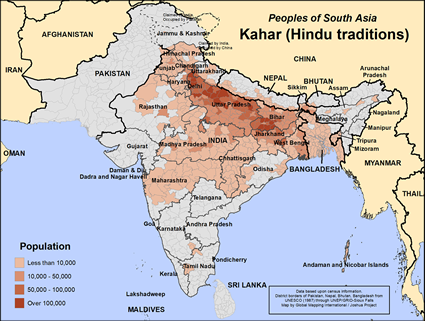
The Kahar are a large Hindu community found mainly in northern and eastern India, especially in Uttar Pradesh, Bihar, West Bengal, Rajasthan, Madhya Pradesh, and neighboring regions. Historically, the Kahar were known primarily as palanquin bearers, water carriers, boatmen, and workers connected with rivers and water transport. Their traditional role became especially important before modern roads and vehicles, when nobles, brides, officials, and wealthy families traveled by palanquin carried on the shoulders of Kahar men.
The name "Kahar" is often associated with carrying loads on the shoulder, and the community developed within India's traditional occupational caste structure. Over centuries, different regional groups performing similar water-related or transport-related labor came to be identified under the broader Kahar identity. Related communities include Dhimar, Jhinwar, Bhoi, and other riverine and laboring groups connected with fishing, ferrying, and water service occupations.
Some historical traditions among the Kahar claim descent from ancient royal or warrior lineages, while other historical sources describe them as among the older populations of the Gangetic plains before later Aryan expansion. Oral tradition, clan identity, caste councils, and family lineage remain important parts of Kahar social life. Even after the decline of palanquin transport during the colonial and modern periods, the Kahar preserved a distinct community identity tied to labor, endurance, and service occupations.
The Kahar are officially classified among the Other Backward Classes in many Indian states. Although modernization ended many traditional occupations, the community remains widespread and socially significant across North India.
Today, many Kahar families work in farming, construction, transportation, fishing, factory labor, market trade, government employment, and urban wage labor. Some still maintain connections to traditional river-based occupations, but modernization and the disappearance of palanquins forced major economic changes within the community. Younger generations increasingly migrate toward towns and cities seeking education and employment opportunities.
Village life usually centers around extended family relationships and close community cooperation. Men commonly work in agriculture, transport, fishing, or labor-intensive jobs, while women manage household responsibilities and often assist with farming or informal economic work. Weddings, religious festivals, and caste gatherings remain important parts of preserving social identity and family ties.
Many Kahar communities still face economic instability, limited educational opportunities, healthcare challenges, and social discrimination connected to caste background. Rural families especially may struggle with land ownership issues, debt pressures, unstable agricultural income, and limited infrastructure.
The Kahar following Hindu traditions practice forms of Hinduism common throughout North India. Religious life commonly includes temple worship, household rituals, pilgrimages, observance of Hindu festivals, and devotion to gods such as Shiva, Durga, Hanuman, Kali, or regional village deities. Many Kahar are especially associated with worship connected to rivers and water because of their historical occupations.
Like many Hindu communities, the Kahar also maintain folk religious beliefs alongside formal temple worship. Belief in astrology, ritual purity, blessings, curses, spirits, sacred rivers, and protective rituals may influence decisions involving marriage, illness, farming, finances, and family wellbeing. In many rural areas, local deities and ancestral customs continue to hold strong influence within community life.
Religious identity is closely tied to family tradition, caste identity, and social belonging. Ritual observance and participation in festivals are often viewed as essential parts of maintaining community honor and spiritual wellbeing.
Very few Kahars have had meaningful exposure to biblical Christianity. Christianity is often viewed as foreign or outside accepted family and caste identity. Social pressure and fear of rejection can make openness to the gospel difficult. The Kahar need to hear clearly that forgiveness of sins and reconciliation with God come through Jesus Christ alone rather than through rituals, caste identity, karma, or religious tradition.
The Kahar remain largely unreached with the gospel, and there are relatively few known believers among them. Their integration into broader Hindu social structures and caste identity creates barriers to Christian witness. Faithful Christian workers are needed who are willing to build long-term relationships, communicate biblical truth respectfully, and demonstrate the love of Christ through humility and practical service.
Practical needs remain significant in many Kahar communities. Economic instability, educational limitations, unstable agricultural income, healthcare shortages, and social discrimination continue to affect many families. Rural communities especially may struggle with poor infrastructure, unemployment, and limited access to stable economic opportunity.
The Kahar need Scripture resources, discipleship materials, and gospel teaching communicated in Hindi, Bhojpuri, Bengali, and other regional languages they understand clearly. Oral Bible storytelling, family-centered ministry, and compassionate community service may all help communicate the gospel effectively. Any believers among them would need encouragement, biblical training, and fellowship support because of social pressure connected to caste and religious identity.
Pray that the Kahar people will hear a clear presentation of the gospel and place their faith in Jesus Christ for salvation.
Pray that God will raise up faithful Christian workers who are willing to serve among the Kahar with wisdom, humility, patience, and compassion.
Pray that the Kahar people will be adopted through the People Group Adoption program so that churches and believers will commit to sustained prayer and future gospel outreach among them.
Pray that any believers among the Kahar will grow strong in biblical truth and boldly share the hope of Christ with their families and communities.
Scripture Prayers for the Kahar (Hindu traditions) in India.
https://en.wikipedia.org/wiki/Kahar
https://en.wikipedia.org/wiki/Dhimar
https://en.banglapedia.org/index.php/Kahar
https://m.thewire.in/article/caste/bihar-caste-survey-the-whos-who-in-the-data-kahar
https://kashyapsjunction.wordpress.com/2016/03/16/kahar-people-groups-of-india/
https://www.sciencedirect.com/science/article/abs/pii/S2214540020301523
| Profile Source: Joshua Project |



