
People-in-Country Profile

Peoples Data Filter:
Print version:
Step 1 - Select a Country:   Send us your updates!
Step 2 - Select a People:  

Di'dinga, Xaroxa of South Sudan

Di

Send us a photo of this people.  [1]

Di
Population [2] Language Religion % Christian % Evangl Online NT Jesus Film Progress
66,000 Didinga Ethnic Religions 18.00 % 12.00 % Not available Not available 3.2  

Di'dinga, Xaroxa of South Sudan

Profile Text
Submit Profile Text:

Introduction / History
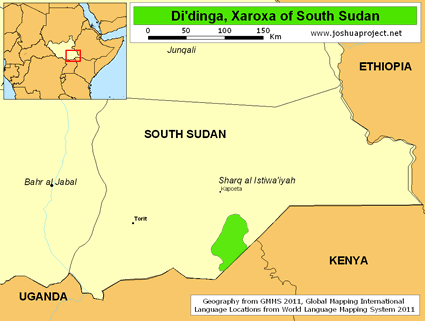
The Didinga occupy the Didinga Hills region in South Sudan. They live in the valleys, on the plateaus and slopes, and on the adjacent plains of the region. Their neighbors include the Topotha, the Boya, and the Dongotona peoples, groups with whom the Didinga have had frequent conflicts due to economic pressures.

The Didinga, Boya, and Murle share a language that distinguishes them from all other groups in South Sudan. Their language, often called the Murle-Didinga language, is also spoken by a group living in southwest Ethiopia. The Didinga claim to have lived in southwest Ethiopia two hundred years ago. During their migration to the Didinga Hills, the Didinga, Murle, and Boya were one group. They lived in harmony in South Sudan until a hunting-party dispute caused the Murle to leave. Later, a famine caused the Boya to withdraw. Today, though the groups have separated, their language remains the same.

What are their lives like?
For many years, the Didinga enjoyed a quiet, rural life. They took great pride in raising cattle and owned large herds that were supervised by the young single Didinga men. However, in 1963, a political disturbance which lasted until 1973 caused many Didinga to leave their cattle behind and to migrate to Uganda. While in Uganda, for the first time in their lives, Didinga were exposed to large-scale farming. Also, their children were introduced to education. These experiences created in the people the desires to make money and to gain knowledge, things which had been unimportant in the Hills.

When they returned to their home in 1973, the people were filled with a new vision for a more advanced life. They hoped to incorporate into their own culture many of the ideas and concepts they had learned in Uganda. They were met, however, with a drastic decrease in the numbers in their herds: clansmen who had remained in the Hills had failed to restock the cattle during the disturbance. Today, many Didinga are still working to enlarge their herds. They purchase cattle either through the exchange of grain or beer, or with money.

At present, farming and the desire for an education are as important to the Didinga as the herding of cattle. The traditional values associated with raising cattle remain embedded in all Didinga. Many still take great pleasure in owning large herds. Their new-found hope for change that was brought back from their temporary migration also remains instilled in their daily lives.

The Didinga use their cattle not only as a means of wealth, but also for their milk that is consumed daily and made into butter. Didinga also consume fresh blood drawn from the necks of cattle with miniature arrows. The Didinga do not fish at all, because the eating of fish is taboo in their culture.

The Didinga live in scattered homesteads, with each clan grouped together. Homes are round with cone-shaped roofs. During certain seasons and during grazing periods, the Didinga also live in rustic camps.

An important aspect of Didinga society is the organization of "age-grades" for boys. Every three to five years, boys who are around eight years old are placed together to form a new "age-grade." These boys work and play together until they are married.

What are their beliefs?
The Didinga have limited exposure to Biblical Christianity. Their traditional beliefs and religious practices include having a tribal rainmaker who is entrusted with performing certain rituals to bring rain. Didinga also worship and sacrifice to spirits and gods and place great importance upon the worship of dead ancestors.

What are their needs?
The Didinga have few Christian resources available to them, and a majority of them have never had an opportunity to hear the Gospel. Scriptures need to be made available in their language and Christian broadcasts need to be aired in their region. Missions works and prayers are the keys to making these needs a reality.

Prayer Points
* Ask the Lord of the harvest to send forth laborers into Didinga.
* Ask the Holy Spirit to grant wisdom and favor to the missions agencies that are presently working among the Didinga.
* Pray that God will reveal Himself to the Didinga through dreams and visions.
* Pray that God will give the Didinga believers boldness to share Christ with their own people.
* Ask God to raise prayer teams who will begin breaking up the soil through worship and intercession.
* Pray that strong local churches will be raised up among the Didinga.
* Pray for completion of Bible translation in this people group's primary language.
* Pray for the availability of the Jesus Film in the primary language of this people.

View Di'dinga, Xaroxa in all countries.

Prayer Links  
PrayerGuard.net
  Submit Update:
Country: South Sudan
Continent: Africa
Region: East and Southern Africa
10/40 Window: No
Location in Country:Southern Sudan, Didinga Hills.
(Source: www.ethnologue.com)
   
  Peoples [3]
Submit Update:
People Name in Country: Di'dinga, Xaroxa
People Name General: Di'dinga
Alternate People Names:
DidingaOi
ToiXaroxa
ROP3 Code: 102599
Joshua Project People ID: 11554
Indigenous: Yes
Population in Country: 66,000
Population all Countries: 66,000
Least-Reached: No
   
 
Affinity Bloc: Sub-Saharan Peoples
People Cluster: Nilotic
People Name General: Di'dinga
Ethnic Code: NAB62y
Ethnic Relationships: Affinity Bloc -> People Cluster -> Peoples Ethnicity Tree
   
 
Language
Submit Update:
Primary Language: Didinga (66,000 Speakers)
Language Code (ISO): did    Ethnologue Listing
Total Languages: 1
   
 
Religion [4]
Submit Update:
Primary Religion: Ethnic Religions
Major Religions:
Buddhism0.00 % 
Christianity18.00 %(Evangelical: 12.00 %)
Ethnic Religions82.00 % 
Hinduism0.00 % 
Islam0.00 % 
Non-Religious0.00 % 
Other / Small0.00 % 
Unknown0.00 % 
Christianity Segments:
Anglican10.00 %
Independent10.00 %
Protestant35.00 %
Orthodox0.00 %
Other Christian0.00 %
Roman Catholic45.00 %
 
(Evangelicals distributed across Christianity segments)
   
 
Progress Indicators [5]
Progress Scale[6] 3.2   Evangelicals >5%
Least-Reached: No
GSEC Status:Level 1   Less than 2% Evangelical. Some evangelical resources available, but no active church planting within past 2 years
 
 
Bible Translation Status
Submit Update:
Bible Portions: 2006
New Testament: None Reported
Complete Bible: None Reported
Possible Bible Sources: Forum of Bible Agencies
 World Bible Finder
 World Christian Resource Directory
 Gospel Go
 
 
Ministry Resources [7]
Submit Link:
Audio RecordingsMegaVoice Audio Bible and Stories
Audio RecordingsGlobal Recordings
 
 
Ministry Activity
Register Ministry Activity:
Description: Register your ministry activity among this people group. Contact the Adopt-A-People Clearinghouse to learn about others that might be focused on this people group.
 
Data Notes
Data Sources


Di'dinga, Xaroxa of South Sudan

Peoples
               
Geographic
Global                 Global
           
  Affinity Bloc             Global  
           
   
People Cluster
       
Region
   
    Nilotic     East and Southern Africa    
     
People-Group-Across-Countries
   
Country
   
      Di'dinga South Sudan    
            People-by-Country (Profile)          
            Di'dinga, Xaroxa of South Sudan          
      Religion Language  
      Ethnic Religions     Didinga  
    Global    
Language
 
    All Religions                              
   
Religion
                             

Direct link:  http://joshuaproject.net/people-profile.php?peo3=11554&rog3=OD