
People-in-Country Profile
Peoples Data Filter:
Printer friendly version:
Step 1 - Select a Country:  
Send us your updates!
Can you provide any of the following for this people?
Step 2 - Select a People:
Thai, Northern of Thailand
Thai, Northern People Photo
View Thai, Northern in all countries.
Submit People Photo:
Peoples
               
Geographic
Global
               
Global
           
 
Affinity Bloc
           
Global


People Cluster
       
Region


People
   
Country


People-by-Country (Profile)


Religion
Language


Global
   
Language


Religion
                             
Thai, Northern of Thailand
 
Profile Text
Submit Profile Text:
Most of the ethnic groups of northeastern Thailand live in villages along the Mekong River and its tributaries. They speak various languages which come from either the Mon Khmer or Tai group. Most of the people are bilingual, speaking both their native language and one of the Tai or Lao languages.

China is the original homeland of most of these tribes. They gradually migrated southward due to pressure by the Chinese. As they traveled, they conquered many peoples along the way. By the tenth century, a large number of them had settled in Thailand.

Northern Thailand is the site of the early Mon kingdom which was founded in the sixth century. In the thirteenth century, the kingdom was conquered by the Thai. In the early part of the nineteenth century, the Thai forced the Mon to leave their homes and relocate in the Mekong River region. Today, these tribes live along both sides of the river. Over the years, they have been absorbed by the dominant cultures of the region, particularly the Lao and the Thai.

What Are Their Lives Like?
The tribal peoples of northeastern Thailand are primarily farmers. They cultivate a wide variety of crops, such as rice, fruit, and vegetables, for both consumption and trade. They are poorer than most of the surrounding ethnic groups and are therefore dependent on the Thai for many goods and services. The villagers frequently meet with the Thai to trade meat and vegetables for necessary items such as clothing and salt.

Over the years, the tribes began adopting the practices of the surrounding peoples, especially the Thai and Lao. This brought on many significant changes within their cultures. For example, they no longer use their traditional farming methods of burning and clearing plots. Instead, they grow wet-rice on terraced plots, which is the agricultural method of the Thai. They also raise their cattle and till their fields much like the Lao. The fields are prepared with plows drawn by buffalo or oxen. In addition, fishing and hunting have become important activities.

Among these tribes, the village is considered the most significant political unit of society. Each village is led by a headman, and each family is led by the father. Rules concerning moral behavior vary from tribe to tribe. For example, the Phuthai and Nyaw only allow marriages within their own people groups; whereas, the other tribes now frequently intermarry with the neighboring ethnic groups.

The village houses are usually made of wood or bamboo. They are built on stilts above the ground, with farmlands adjacent to the residential areas. Domestic fowl, pigs, and goats are allowed to run freely underneath the houses.

Although most of the groups have adapted to the cultural traits of the neighboring peoples, others, such as the Phuthai, retreated into the surrounding hills as other ethnic groups advanced. Nevertheless, all of the tribal communities have been affected by the Thai and Lao cultures. Such things as traditional dress, language, educational methods, housing, and public administration have all changed over the years. Only a few distinctive, cultural characteristics have remained: the famous "round dances" of the Saek women; the distinct silk scarves worn by the So women around a bun of hair at their necks; the hand-woven silk of the Phuthai women, made in unique colorful designs; and the traditional "spirit doctors" of the Nyaw.

What are their beliefs?
Buddhism was introduced into Thailand in 329 B.C. and today, all of these tribes are primarily Buddhist. However, most of them have mixed elements of Buddhism with their traditional animistic beliefs (belief that non-living objects have spirits). For this reason, the people often seek help through supernatural spirits and objects.

Ancestor worship (praying to deceased ancestors for provision and guidance) is also common. The ancestral spirits are thought to cause illnesses if they are not appeased. Families usually have small altars near their homes where sacrifices and offerings are made to the spirits. The people also believe that each village has a "guardian spirit," as well as various spirits that are linked to the elements of nature.

Many of the villagers who have little outside influence are still strongly committed to spirit worship. They rely heavily on "spirit doctors," who supposedly have great healing powers.

What are their needs?
Although all of the tribes in this region have at least one missions agency targeting them, they remain unreached. Only one tribe, the So, have portions of the Scriptures in their language. At the present time, Christian broadcasts are only being aired among the Phuthai.

Bibles and other Christian literature, Christian broadcasts, and additional laborers are desperately needed to effectively penetrate these tribes with the Light of the Gospel. Prayer warriors are also needed to faithfully begin interceding for these precious people.

Prayer Points
Ask God to encourage those living in northeastern Thailand who have given their hearts to Jesus Christ.
Pray that the Holy Spirit will complete the work begun in their hearts through adequate discipleship.
Ask the Lord of the harvest to thrust forth many laborers into the fields of northeastern Thailand.
Pray that the Bible and other Christian literature will soon be made available to each of these tribes.
Pray that God will begin revealing Himself to these precious people through dreams and visions.
Take authority over the spiritual principalities and powers that are keeping these tribes in darkness.
Pray that God will call out prayer teams to break up the soil through worship and intercession.
Ask the Lord to raise up strong local churches among each of these tribes.

View Thai, Northern in all countries.

 
Prayer Links Submit Links:
PrayerGuard.net
Global Prayer Digest: 2006-07-27
Global Prayer Digest: 2009-06-13
 
Web Profile Links Submit Links:
www.everyculture.com/East-Southeast-Asia/index.html
asiaharvest.org/pages/profiles/nonChina/Laos/Tai%2...
asiaharvest.org/pages/profiles/nonChina/Thailand/T...
www.infomekong.com/peoplegroups.htm
www.millionelephants.com/UPGs/taiyuan.html
www.thailandsworld.com/index.cfm?p=74
www.thefellowship.info/Missions/Global-Missions/Pe...
 
Web Resource Links Submit Links:
Audio RecordingsMegaVoice Audio Bible and Stories
Audio RecordingsGlobal Recordings
Film / VideoJesus Film
Film / VideoWorld Christian Videos
Printed MatterNo Frontiers Literature
ScriptureUnbound Bible
ScriptureWorld Scriptures

 
Maps
Submit Map:
Country Map:
Detailed UN Political map
Ethnolinguistic Map:
University of Texas map collection
Linguistic Map:
Ethnologue language map
  
  Submit Update:
Country: Thailand
Continent:
Asia
Region:
Southeast Asia
Yes
Country Details: World Factbook
Population in this Country:
7,183,000
Largest Provinces on file:
Chiang MaiChiang Rai
Kamphaeng PhetLampang
LamphunNan
PhayaoPhrae
SukhothaiTak
Total Provinces on file:10
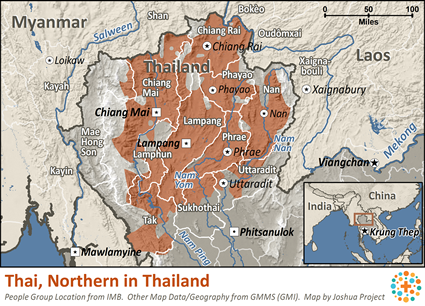
Location within Country:Chiangmai, Chiangrai, Lamphun, Lampang, Maehongson, Hot, Nan, Phayao, Phrae, Uttaradit, Tak provinces.
(Source: www.ethnologue.com)
   
 
People
Submit Update:
People Name in Country: Thai, Northern
People Name General:
Thai, Northern
Alternate People Names:
KammuangKhon Mang
Khon MungKhon Myang
La NyaLan Na
LannaLantai
Lao YuanPayap
Tai NyaTai Nyuan
Tai WangTai Yuan
Western Laotian
People Code: 104960
Population in this Country: 7,183,000
Population in all Countries: 7,194,000
Yes
   
 
Southeast Asian Peoples
Thai
People Name General:
Thai, Northern
MSY49d
Ethnic Relationships:
Affinity Bloc -> People Cluster -> Peoples Ethnicity Tree
   
 
Language
Submit Update:
Primary Language:
Thai, Northern (7,183,000 Speakers)
Language Code (16th): nod    Ethnologue Listing
NOD
Total Languages Spoken:
1
   
 
Religion
Submit Update:
Primary Religion:
Buddhism
Religion Sub-division:Theravada
% Christian Adherents:0.70 %
% Evangelical:0.23 %
   
 
Joshua Project Progress Indicators
Yes
Progress Scale: 1.2     Evangelicals >.01% but <=2%. Christian Adherents <=5%.
Need-Ranking Score: 70        Details
Church Planting Team:Yes (Data from 2002)
100+ Believers:Yes (Data from 2002)
   
 
Other Progress Indicators *
Global Evangelical Status:Level 2   Less than 2% Evangelical. Initial (localized) church planting within past 2 years
Agency Progress (API):Level 3   Multiple agencies involved
Church Progress (CPI):Level 3   Group of churches
 
 
Bible Translation Status
Submit Update:
Bible Portions: 1867-1968
New Testament: 1914
Complete Bible: None Reported
Possible Bible Sources: Forum of Bible Agencies
 World Bible Finder
 World Christian Resource Directory
 
 
Ministry Activity
Register Ministry Activity:
Description: Register your ministry activity among this people group. Contact the Adopt-A-People Clearinghouse to learn about others that might be focused on this people group.
 
Thai, Northern of Thailand
* Notes:
  • Significant effort is made to match photos with people groups. In most cases the photo source has identified the people group. However, in some instances when the exact people group is not identified Joshua Project has made educated attempts at matching. As a result some photos may be representative of the people cluster rather than the specific people group. Mismatches are the fault of Joshua Project, not the photographer. Please contact us if you believe a photo is not matched with the correct people group.
  • Percentages may be printed as '0.00%' because of space limitations, but some are slightly greater than zero.
  • The exactness of the above numbers can be misleading. Numbers can vary by several percentage points or more.
  • People group population figures are now maintained as a percentage of the national population. Click here for details.
  • Joshua Project does not have specific ministry activity data supporting the "Other Progress Indicators."
  • Discrepancies may exist between "Other Progress Indicators" because of the varying sources of information.
  • Joshua Project does not know the exact content of web audio recordings. In general they are Bible reading and teaching.
  • As on-site realities are understood, barriers of acceptance may be found in many of the larger people groups that will require multiple distinct church planting efforts.
  • This data may contain errors and needs continual correcting and updating. Click here to send feedback.