
People-in-Country Profile
Peoples Data Filter:
Printer friendly version:
Step 1 - Select a Country:  
Send us your updates!
Can you provide any of the following for this people?
Step 2 - Select a People:
Jumjum, Berin of Sudan
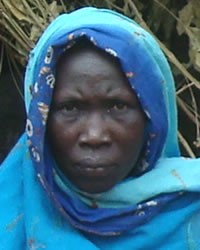
Jumjum, Berin People Photo
View Jumjum, Berin in all countries.
Submit People Photo:
Peoples
               
Geographic
Global
               
Global
           
 
Affinity Bloc
           
Global


People Cluster
       
Region


People
   
Country


People-by-Country (Profile)


Religion
Language


Global
   
Language


Religion
                             
Jumjum, Berin of Sudan
 
Profile Text
Submit Profile Text:
The Jumjum live in the Fung region of the Blue Nile Province in eastern Sudan. They are a Nilotic people, a term used to refer to those who live in or around the upper Nile Valley. This area is mostly flat, with some rocky hills. Most Jumjum live at the foot of these hills. Long subjected to foreign influence, the Jumjum are a somewhat mixed group. In years past, they have had close contact with the Dinka, Nuer, and Shilluk groups. These tribes often invaded the Jumjum area, raiding it for slaves. The Jumjum are closely related, both geographically and linguistically, to the Burun; and some consider the two groups as one.

The Jumjum speak a Nilotic language. Although they have a lighter skin color than do many Nilotes, they share other standard, physical Nilotic characteristics. For example, they are typically quite tall, thin, and long-legged. Their noses are usually broad, but their lips are thin. Their hair is often frizzy and their heads are long.

What Are Their Lives Like?
The Jumjum are farmers and shepherds. Both men and women participate in growing crops such as millet, sesame, and beans. The men and boys herd cattle, goats, and sheep. Also, the men regularly engage in hunting and fishing, and the women gather wild fruit and grain.

Each Jumjum village has a number of homesteads separated from each other by about one hundred yards. Every homestead has two or three huts used as living areas, a granary, and several huts for sheltering animals. A "rain chief" acts as the headman for each village. He has both political and religious power, and his hut is regarded as a sanctuary. He is considered the "Father of the Land." His office is characterized by the possession of the village drums, heirloom spears, and other symbolic insignia related to ancient Jumjum culture.

Individual huts in the villages are round with mud walls and roofs made of thatched grass. Each wife has her own hut where she rears her children and conducts all other household activities.

Parents usually arrange marriages, sometimes when their children are quite young. Before a marriage takes place, the young man must perform a long period of "bride-service" for the girl and her family. This service usually involves cultivating the father's land and helping herd his animals. The young man must also pay to the girl's family a small bride-price, which usually consists of cows, goats, spears, and other objects. After the marriage, the wife will move in with her husband in his village. A wealthy man may have more than one wife.

Some Jumjum are able to attend regional schools. English is taught at the higher levels, and Arabic is taught at the lower levels. Because few medical facilities exist in the area, the people often look to their chiefs for the healing of simple illnesses.

When a Jumjum dies, he is buried with his spear, hoe, and ornaments. After his burial, branches are placed on the top of his grave, and a few stakes are driven into it. Offerings are then made over the grave to bid him farewell.

What are their beliefs?
Most Jumjum are animists, meaning that they believe non-human objects have spirits. The Jumjum worship the supreme god Dyong. They believe Dyong lives in the sky and sits on a horse. Using powers which they believe are hereditary, the Jumjum also practice witchcraft and divination.

The rain maker also plays a large role in Jumjum religion. He obtains rain by placing "rain stones" on a piece of raised ground in his shrine. He then makes sacrifices, allowing the blood to drip onto the rain stones so that it will rain.

What are their needs?
There are few Christian resources available to the Jumjum. The people need Bibles and other Christian materials translated into their language. They also need much prayer and intercession so that their hearts will be ready to receive the Gospel message.

Prayer Points
Ask the Lord to send forth Christian laborers to work among the Jumjum of Sudan.
Ask the Holy Spirit to grant wisdom and favor to missions agencies that may be currently targeting the Jumjum.
Pray that the Bible, the Jesus film, and other evangelistic materials will be translated into the Jumjum language.
Pray that God will reveal Himself to the Jumjum through dreams and visions.
Pray that God will save key Jumjum leaders who will boldly share the love of Jesus with their own people.
Take authority over the spiritual principalities and powers that are keeping the Jumjum bound.
Ask God to raise up prayer teams who will break up the soil through worship and intercession.
Ask the Lord to bring forth a triumphant Jumjum church for the glory of His name!

View Jumjum, Berin in all countries.

 
Prayer Links Submit Links:
PrayerGuard.net
 
Web Profile Links Submit Links:
www.everyculture.com/Africa-Middle-East/index.html
www.muslimjourneytohope.com
www.sudanpartners.org/
 
Web Resource Links Submit Links:
Audio RecordingsMegaVoice Audio Bible and Stories
Audio RecordingsGlobal Recordings

 
Maps
Submit Map:
Country Map:
Detailed UN Political map
Linguistic Map:
Ethnologue language map
  
  Submit Update:
Country: Sudan
Continent:
Africa
Region:
East and Southern Africa
Yes
Country Details: World Factbook
Population in this Country:
66,000
Largest Provinces on file:
An Nil al Azraq
Total Provinces on file:1
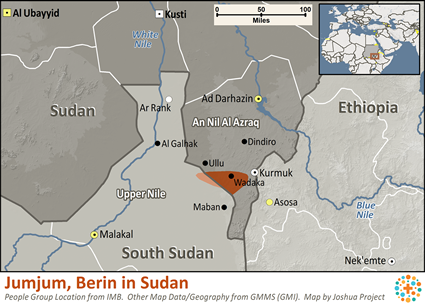
Location within Country:Northern Upper Nile Province, along Khor Jumjum on Jebels Tunga, Terta, and Wadega.
(Source: www.ethnologue.com)
   
 
People
Submit Update:
People Name in Country: Jumjum, Berin
People Name General:
Jumjum
Alternate People Names:
BerinOlga
Wadega
People Code: 104326
Population in this Country: 66,000
Population in all Countries: 66,000
Yes
   
 
Sub-Saharan African
Nilotic
People Name General:
Jumjum
NAB62z
Ethnic Relationships:
Affinity Bloc -> People Cluster -> Peoples Ethnicity Tree
   
 
Language
Submit Update:
Primary Language:
Jumjum (66,000 Speakers)
Language Code (16th): jum    Ethnologue Listing
JUM
Total Languages Spoken:
1
   
 
Religion
Submit Update:
Primary Religion:
Islam
% Christian Adherents:2.00 %
% Evangelical:0.80 %
   
 
Joshua Project Progress Indicators
Yes
Progress Scale: 1.2     Evangelicals >.01% but <=2%. Christian Adherents <=5%.
Need-Ranking Score: 65        Details
   
 
Other Progress Indicators *
Global Evangelical Status:Level 1   Less than 2% Evangelical. Some evangelical resources available, but no active church planting within past 2 years
Agency Progress (API):Level 2   At least one agency on-site
Church Progress (CPI):Level 2   One known church
 
 
Bible Translation Status
Submit Update:
Bible Portions: Help start a Bible Translation
New Testament: None Reported
Complete Bible: None Reported
 
 
Ministry Activity
Register Ministry Activity:
Description: Register your ministry activity among this people group. Contact the Adopt-A-People Clearinghouse to learn about others that might be focused on this people group.
 
Jumjum, Berin of Sudan
* Notes:
  • Significant effort is made to match photos with people groups. In most cases the photo source has identified the people group. However, in some instances when the exact people group is not identified Joshua Project has made educated attempts at matching. As a result some photos may be representative of the people cluster rather than the specific people group. Mismatches are the fault of Joshua Project, not the photographer. Please contact us if you believe a photo is not matched with the correct people group.
  • Percentages may be printed as '0.00%' because of space limitations, but some are slightly greater than zero.
  • The exactness of the above numbers can be misleading. Numbers can vary by several percentage points or more.
  • People group population figures are now maintained as a percentage of the national population. Click here for details.
  • Joshua Project does not have specific ministry activity data supporting the "Other Progress Indicators."
  • Discrepancies may exist between "Other Progress Indicators" because of the varying sources of information.
  • Joshua Project does not know the exact content of web audio recordings. In general they are Bible reading and teaching.
  • As on-site realities are understood, barriers of acceptance may be found in many of the larger people groups that will require multiple distinct church planting efforts.
  • This data may contain errors and needs continual correcting and updating. Click here to send feedback.