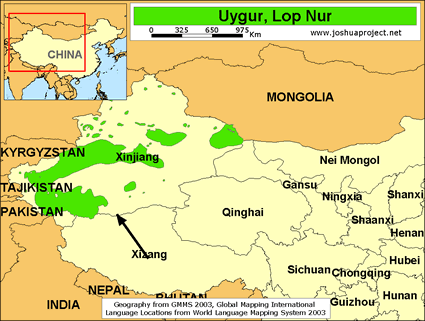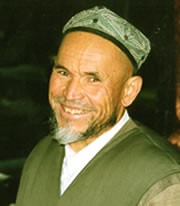

Although the Lop Nur people have been officially included as part of the Uygur nationality, "they differ from the Uygur people in both language and appearance, looking more like Mongolians."
The Lop Nur Uygurs are "believed to be descended from the ancient Loulan people. ... Their ancestors all lived at Lop Nur and were engaged in fishing and hunting. When Lop Nur dried up several decades ago, they were forced to move and settle down in Miran." When Marco Polo visited the ancient city of Lop, now buried deep beneath the sand, he noted, "There are many springs of bad and bitter water, though in some places the water is good and sweet. When it happens that an army passes through the country, if it is a hostile one, the people take flight with their wives and children and their beasts two or three days' journey into the sandy wastes to places where they know there is water and they can live with their beasts."
Seven centuries ago, Marco Polo described the effect the Taklimakan Desert had on stray travelers. "When a man is riding by night through the desert and something happens to make him loiter and lose touch with his companions ... he hears spirits talking in such a way that they seem to be his companions. Sometimes, indeed, they even hail him by name. Often these voices make him stray from the path, so that he never finds it again. And in this way many travelers have been lost and have perished."
The Lop Nur Uygurs converted to Islam several centuries ago. They retain many features of their pre-Islamic spirit-appeasement rituals, including the worship of the sun, moon, stars, and wind.
There is no apparent Christian presence among the people living in the desolate wastes of the Lop Nur region. Nestorian missionaries from the eighth to thirteenth centuries established churches along the Silk Road townships, but all memory of them and their message has long since been obliterated by the all encompassing sands of the Taklimakan Desert.
The Lop Nur Uygur people need to accept the warm embrace of the only Savior so they can enjoy spiritually meaningful lives.
Pray for the authority of Christ to bind hindering spiritual forces to lead them from darkness to light.
Pray for signs and wonders to happen among them and for great breakthroughs with a rapid multiplication of disciples and house churches.
Pray for bold workers who are driven by the love of the Holy Spirit to go to them.
Pray for an unstoppable movement to Christ among them.
Scripture Prayers for the Uygur, Lop Nur in China.
Operation China, Asia Harvest, Copyrighted © Used with permission
| Profile Source: Joshua Project |