


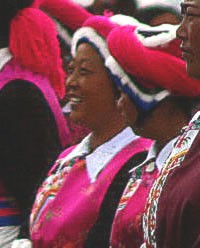

Local legends say the ancestors of the Shangri La Tibetans were Qiang people who came to Zhongdian, fought and overcame the locals in battle, and eventually became assimilated to Tibetan ways. This would explain the linguistic, clothing, and cultural differences they have today with other Tibetan groups. Zhongdian is home to the Shangri La Tibetans. Thus, they are known either as Shangri La Tibetans or Zhongdians.
Their women still wear a different traditional dress from all other Tibetans. Shangri La Tibetan women prefer to wear a cone-shaped headdress which they wrap inside a scarf. They live in two-story wooden houses. Except for a few new roads and electricity lines, life has not changed much in this remote part of China.
The great majority of Shangri La Tibetans adhere to Tibetan Buddhism. The large Jietang Songlin Monastery, which houses several hundred monks, is located just to the north of Zhongdian Township.
French Catholic missionaries commenced work among the Shangri La Tibetans in the late 1800s. Today, a large French-style cathedral still stands at Tchronteu, near Weixi. "The purpose of the monks of Saint Bernard was to minister to all in need who traveled over the high mountain trails in trade and commerce. Their most valuable helpers were huge Saint Bernard dogs - half Swiss and half Tibetan. In the city of Weixi, the monks, helped by the Cluny Sisters of Saint Joseph and two Tibetan nuns, ran a mission school attended by children from Sikkim, Nepal, Bhutan and Tibet." A Catholic priest was responsible for 9,500 Tibetan believers in his area. Of these, about 7,500 belong to the Deqen Tibetan group and 2,000 to the Shangri La Tibetans.
the Shangri La Tibetan people need to allow Jesus to be their Lord and find their identity in relationship with him.
Pray for the Lord to reveal himself as savior and friend to the Shangri La Tibetan people.
Pray for laborers to be sent to these people with a passion to see them come to salvation in Christ.
Pray that the Holy Spirit would be opening and preparing their hearts to receive the gospel.
Pray that they would not see Christianity as an outside movement or religion, but they would see salvation as God's redemption plan that he's offered all along.
Pray for discipleship communities to grow and thrive among the Shangri La Tibetan people.
Scripture Prayers for the Tibetan, Shangri La in China.
Operation China, Asia Harvest, Copyrighted © Used with permission.
| Profile Source: Joshua Project |



