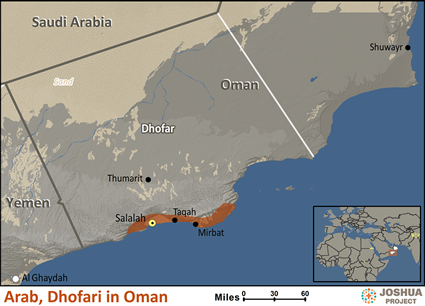

The Dhofar region is subdivided into 9 wilayats. Its climate is dramatically different to the rest of Oman due to the effects of the monsoon rains (khareef) which arrive during the summer months, creating humidity and moderate temperatures of around 30 degrees Celsius. As a consequence, the area becomes lush and green, with waterfalls and rivers feeding the surrounding pastures. The mountain ridge, which receives the most rain, stretches for 400 km from east to west. During the khareef, springs gush forth and provide plentiful water supplies for much of the rest of the year. The fresh greenery is ideal for cattle grazing and livestock rearing is an important occupation in the area.
One of the most popular crafts is making majmars, the Dhofari-style incense burners, which are decorated in yellow, green, blue, and red geometric designs.
The Dhofari people started large scale exploitation of frankincense 8000 years ago. Dhofari frankincense has played a very important role in commercial enterprises between the Arab regions and the Asian and African civilizations. Ancient Sumerian inscriptions refer to bokhur (incense) and it is thought that this incense travelled by ship from Oman to Sumer, Bahrain and parts of Iraq.
At the beginning of April each year, laborers harvest the crop of frankincense by making incisions in the olibanum (frankincense) tree. A sticky, milky white resin congeals on the trunk of the tree, which is harvested 14 days later. A second harvest will then be gathered, but this is generally of a lower standard to the initial batch. A third harvest releases a 'prime quality' frankincense which is yellow. One tree can yield between 10 - 20 kg of frankincense per season. The annual harvest of Dhofari frankincense can be as much as 7,000 tonnes which is worth around RO 3 million. Incense is used at Arabic wedding and birth ceremonies, as well as by the Vatican and Roman Catholic churches across the world.
Frankincense is not only used as incense, it also has certain medical properties. The people of Dhofar will add a few lumps of olibanum to their drinking water, which they believe acts as a diuretic and cleanses the kidneys. It is used to staunch internal and external bleeding, to aid in fat elimination and to cure forgetfulness. Aromatherapists use frankincense oil as an aid to depression and in Salalah, it is customary to waft the incense around the home before the household awakes in order to bring harmony to the inhabitants through the day. Frankincense also provides the added bonus of being an insect repellent.
The Dhofari Arab people are Sunni Muslims who believe that the supreme God, Allah, spoke through his prophet, Mohammed, and taught mankind how to live a righteous life through the Koran and the Hadith. To live a righteous life, you must utter the Shahada (a statement of faith), pray five times a day facing Mecca, fast from sunup to sundown during the month of Ramadan, give alms to the poor, and make a pilgrimage to Mecca if you have the means. Muslims are prohibited from drinking alcohol, eating pork, gambling, stealing, slandering, and making idols. They gather for corporate prayer on Friday afternoons at a mosque, their place of worship.
The two main holidays for Sunni Muslims are Eid al Fitr, the breaking of the monthly fast and Eid al Adha, the celebration of Abraham's willingness to sacrifice his son to Allah.
Sunni religious practices are staid and simple. They believe that Allah has pre-determined our fates; they minimize free will.
In most of the Muslim world, people depend on the spirit world for their daily needs since they regard Allah as too distant. Allah may determine their eternal salvation, but the spirits determine how well we live in our daily lives. For that reason, they must appease the spirits. They often use charms and amulets to help them with spiritual forces.
Like people everywhere, the Dhofari Arab people need to allow the loving Savior to direct their lives. They need his forgiveness for sin.
Pray the Dhofari Arab would see they do not have to live in slavery to spirits if they put their trust in Jesus Christ.
Pray for the Lord to intervene in their families, calling people to his side.
Pray for loving workers.
Pray for their hearts to be drawn to the Lord of lords.
Pray for a church planting movement to thrive in their communities.
Scripture Prayers for the Arab, Dhofari in Oman.
https://en.wikipedia.org/wiki/Dhofari_Arabic
https://dbpedia.org/page/Dhofari_Arabic
| Profile Source: Joshua Project |