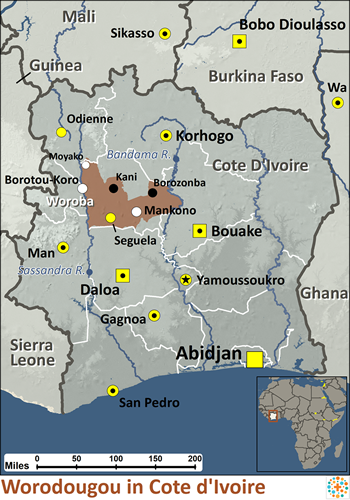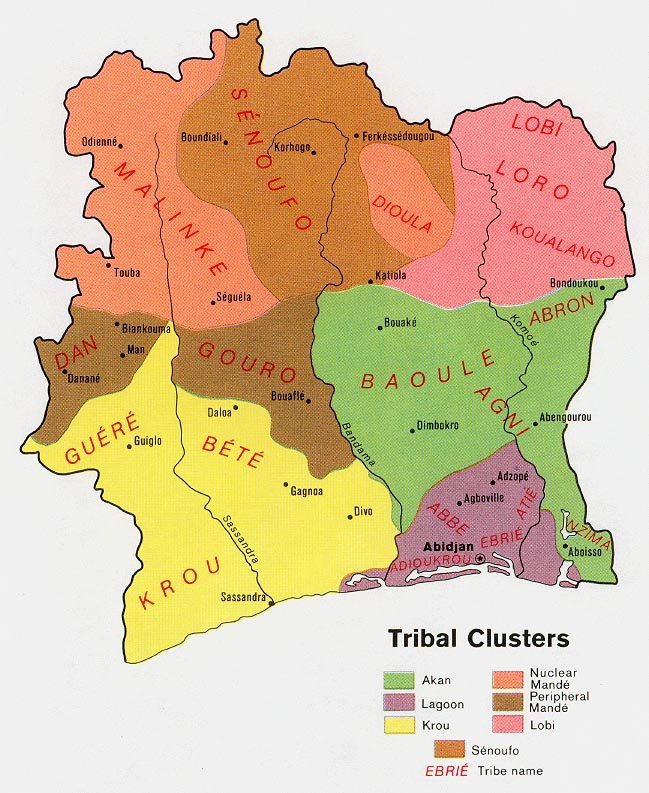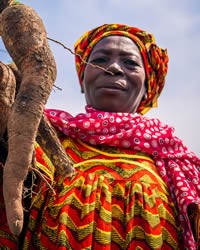

The Worodougous live in 213 villages and towns. There is a region in central Cote d'Ivoire named after them. They have their own language, also called Worodougou.
Many are subsistence farmers in the small villages. They grow rice, corn, yams, cashews, and cotton. Some of their children have moved to larger cities. This change has brought them into larger commercial enterprises or small businesses. Some have gone far in French education and gained government positions. High schools are only available in the larger towns.
Their grandfathers were the first to become Muslims, but in most of the small villages they are "Muslim" in name only.
Their grandparents were the first to become Muslims. But in most of the small villages, they are "Muslim" in name only. Most don't go to the mosque. It is their mask and spirit/ancestor worship that really holds their attention. People are afraid of sorcerers, death, hell, and their ancestral spirits. They spend most of their money on "protection" of various sorts.
Funerals are an enormous expense, with different days of ceremonies, because of the ancestor veneration. In the larger towns and cities, madrasa schools and teaching at the mosque, often through the loudspeakers, teaches the Islamic Haddith. They memorize the Koran without understanding except by higher-level students. Aware of death's closeness, older people become very religious. They pray regularly. However, they do not have the sharp attention to all the laws as do Middle Eastern Muslims. Whoever has money has to send their oldest relatives to Mecca.
There are a small number of Worodougou believers, but they can easily be persecuted in this Muslim culture.
Around 2001 WEC and IMB stepped into a loose partnership to reach the Worodougou. Nigerian Mission Ami trains missionaries in a school in Abidjan, and in early 2005 sent two missionaries. One is Worodougou. In early 2004, AEECI, the church planted by WEC in Côte d'Ivoire, sent their first missionaries to the Worodougou.
Pray for the Lord to provide the Worodougou people with an abundant harvest this year as proof of his power and love.
Pray for a spiritual harvest that will result in a powerful movement to Christ.
Pray for believing Worodougou family members to have the spiritual power to walk as Jesus walked, blessing all those around them.
Pray for the Lord to thrust our workers to the Worodougou people in Cote D'Ivoire.
Scripture Prayers for the Worodougou in Côte d'Ivoire.
| Profile Source: Joshua Project |