
People-in-Country Profile
Peoples Data Filter:
Printer friendly version:
Step 1 - Select a Country:  
Send us your updates!
Can you provide any of the following for this people?
Step 2 - Select a People:
Arab, Sudanese of Egypt
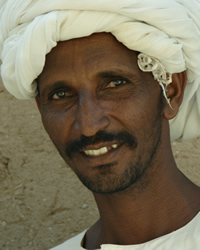
Arab, Sudanese People Photo
View Arab, Sudanese in all countries.
Submit People Photo:
Peoples
               
Geographic
Global
               
Global
           
 
Affinity Bloc
           
Global


People Cluster
       
Region


People
   
Country


People-by-Country (Profile)


Religion
Language


Global
   
Language


Religion
                             
Arab, Sudanese of Egypt
 
Profile Text
Submit Profile Text:
The Sudanese Arabs originated in the Khartoum region of Sudan many centuries ago. Today, they live primarily in northern and central Sudan and in Egypt. A few groups are also scattered in Saudi Arabia, Ethiopia, Libya, Yemen, and the United Arab Emirates.

The first "pure" Arabs were called "Bedouins." They were tribal nomads from Saudi Arabia, famous for their love of poetry and war. The Sudanese are a tribe who branched off of the Bedouins. They are a heterogeneous people with a mixture of diverse blood and cultures.

Since 1983, conflict between the predominately north Arab and southern animist and Christian regions of the Sudan has accounted for more than two million deaths. Also tragic are the recent atrocities to non-Arab African groups on the Western Sudan/Chad border in the region of Darfur. Killings, mass rapes, looting of livestock and burning of villages by the Arab militia, Janjaweed, have devastated the area. It is estimated that over 70,000 have lost their lives due to hunger and disease alone.

What Are Their Lives Like?
Over the years, many "Arabs" have emerged by either assimilating into Arab culture, religion, and language, or by intermarrying with Mongoloid or Negroid groups in their areas. The Sudanese Arabs have intermarried with the African tribes of Sudan, giving them a darker skin tone and some Negroid features.

Most Sudanese Arabs live in small rural villages. They grow grains, vegetables, and cotton, and raise livestock, all of which are used for food or trade. Clusters of mud-brick homes with dirt floors make up the villages. The homes are built close together, which reflects the close ties between the family members within the communities. Although farming is the chief occupation of the villagers, some of them have jobs as skilled carpenters, tailors, religious leaders, or barbers.

Some Sudanese Arabs live in towns or cities. They have a greater variety of occupations, but weaker family ties than those who live in the villages. These Arabs have more concern for such things as economic prosperity and education. Today, many of them work in the oil fields of Saudi Arabia, attend universities in neighboring countries, or use trucks instead of camels.

Other Sudanese Arabs have continued living the nomadic lifestyle of their ancestors. They have temporary dwellings and move from place to place with their herds. Camels are used to transport them across desert lands, and their economy is based primarily on stock breeding and trade. Rigid codes of honor, loyalty, hostility, and hospitality are among those values that have remained strong throughout the centuries.

In the Arab culture, children are considered to be a family's greatest asset, providing both workers and security for the parents as they grow older. Although boys and girls may be raised together when they are young, they are treated differently. Mothers show great affection towards the boys, pampering them and responding to their every wish. Girls are shown some affection, but are not pampered. The boys are taught by their fathers to obey and respect older males. Girls are taught the values of obedience to their future husbands. Teenagers are not permitted to have any contact with the opposite sex until after marriage.

What Are Their Beliefs?
The Sudanese Arabs are Muslims, as are most Arabs. Identification with the Islamic religion is one of the primary cultural characteristics of most Arabs. They are devoted to their faith, and this is evident in their daily life.

While the men gather in the local mosque five times a day for prayer, the women meet in homes and have their own religious services, conducted by female religious leaders. Only on certain occasions are the women permitted inside the mosques.

According to Islamic law, a man may have up to four wives. Rules concerning marriage and divorce are held in accordance to what is written in the Koran. Regulations regarding inheritance, taxation, wartime, submission to those in authority, and the roles of family members can also be found there.

What Are Their Needs?
The Sudanese Arabs live in a country engulfed by tension, terror, and war. Even more than the physical provisions that are so badly needed in the Sudan, Sudanese Arabs need to hear about the saving love of Jesus. They have some Christian resources available to them. But churches are often closed, destroyed, or not allowed to be built. Converts from the Muslim faith are not well accepted. They will need courage and grace to withstand persecution from their Islamic relatives.

Prayer Points
Ask God to strengthen, encourage, and protect church planters, especially the women workers.
Pray for additional Bibles and Christian literature to be provided and placed.
Ask God to bring natural and spiritual peace to this needy country.
Ask the Lord to call out prayer teams to go and break up the soil through worship and intercession.
Pray that God will raise up long term workers to join those who have already responded.
Pray that the Holy Spirit will complete the work begun in their hearts through adequate discipleship.
Pray that the Holy Spirit will anoint the Christian broadcasts as they are aired among the Sudanese Arabs.
Ask God to reveal Himself to these tribes through dreams and visions.
Ask the Lord to raise up strong local churches among the Sudanese Arabs for the glory of His name!

View Arab, Sudanese in all countries.

 
Prayer Links Submit Links:
PrayerGuard.net
Global Prayer Digest: 2008-01-25
 
Web Profile Links Submit Links:
www.everyculture.com/Africa-Middle-East/index.html
www.muslimjourneytohope.com
en.wikipedia.org/wiki/Arab
www.alnour.com
www.arabbible.com
www.arabicbible.com
www.arabvision.org
www.eritreanbeauty.com
www.Pray4Yemen.com
www.sharifbible.com/
www.sudanpartners.org/
 
Web Resource Links Submit Links:
Audio RecordingsMegaVoice Audio Bible and Stories
Audio RecordingsArabic Bibles Online
Audio RecordingsGlobal Recordings
Audio RecordingsGospel Widgets
Film / VideoJesus Film
Film / VideoWorld Christian Videos
GeneralEvangelism Toolbox
GeneralFour Spiritual Laws
ScriptureBible-in-Your-Language
ScriptureUnbound Bible
ScriptureWorld Scriptures
Worship / MusicEthnic Worship Music

 
Maps
Submit Map:
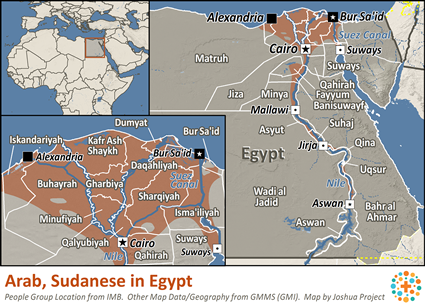
Country Map:
Detailed UN Political map
Linguistic Map:
Ethnologue language map
  
  Submit Update:
Country: Egypt
Continent:
Africa
Region:
Middle East and North Africa
Country Persecution Rank:21 (Only top 50 ranked, 1 = highest persecution ranking)
Yes
Country Details: World Factbook
   
 
People
Submit Update:
People Name in Country: Arab, Sudanese
People Name General:
Arab, Sudanese
Alternate People Names:
Arabic, Sudanese SpokenSudanese
Sudanese Arab
People Code: 109571
Population in this Country: 4,310,000
Population in all Countries: 14,164,000
Yes
   
 
Arab World
Arab, Sudan
People Name General:
Arab, Sudanese
CMT30
Ethnic Relationships:
Affinity Bloc -> People Cluster -> Peoples Ethnicity Tree
   
 
Language
Submit Update:
Primary Language:
Arabic, Sudanese Spoken (4,310,000 Speakers)
Language Code (16th): apd    Ethnologue Listing
APD
Total Languages Spoken:
1
   
 
Religion
Submit Update:
Primary Religion:
Islam
Religion Sub-division:Sunni
% Christian Adherents:1.40 %
% Evangelical:0.20 %
   
 
Joshua Project Progress Indicators
Yes
Progress Scale: 1.2     Evangelicals >.01% but <=2%. Christian Adherents <=5%.
Need-Ranking Score: 77        Details
   
 
Other Progress Indicators *
Global Evangelical Status:Level 1   Less than 2% Evangelical. Some evangelical resources available, but no active church planting within past 2 years
Agency Progress (API):Level 3   Multiple agencies involved
Church Progress (CPI):Level 2   One known church
 
 
Bible Translation Status
Submit Update:
Bible Portions: 1927-1964
New Testament: 1978
Complete Bible: None Reported
Possible Bible Sources: Forum of Bible Agencies
 World Bible Finder
 World Christian Resource Directory
 
 
Ministry Activity
Register Ministry Activity:
Description: Register your ministry activity among this people group. Contact the Adopt-A-People Clearinghouse to learn about others that might be focused on this people group.
 
Arab, Sudanese of Egypt
* Notes:
  • Significant effort is made to match photos with people groups. In most cases the photo source has identified the people group. However, in some instances when the exact people group is not identified Joshua Project has made educated attempts at matching. As a result some photos may be representative of the people cluster rather than the specific people group. Mismatches are the fault of Joshua Project, not the photographer. Please contact us if you believe a photo is not matched with the correct people group.
  • Percentages may be printed as '0.00%' because of space limitations, but some are slightly greater than zero.
  • The exactness of the above numbers can be misleading. Numbers can vary by several percentage points or more.
  • People group population figures are now maintained as a percentage of the national population. Click here for details.
  • Joshua Project does not have specific ministry activity data supporting the "Other Progress Indicators."
  • Discrepancies may exist between "Other Progress Indicators" because of the varying sources of information.
  • Joshua Project does not know the exact content of web audio recordings. In general they are Bible reading and teaching.
  • As on-site realities are understood, barriers of acceptance may be found in many of the larger people groups that will require multiple distinct church planting efforts.
  • This data may contain errors and needs continual correcting and updating. Click here to send feedback.