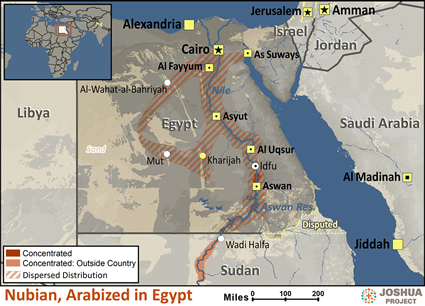

The name Nubian was given to the original inhabitants of Nubia, a thin settlement along the Nile River in southern Egypt. Their settlements were south of the ancient Egyptian Empire. For centuries, foreign conquerors and traders passed through Nubia, sometimes settling and intermarrying with the Nubians. The Arabs, who invaded much of North Africa in the seventh and eleventh centuries, displaced some Nubian groups and absorbed others. As a result, nearly 390,000 Nubians are now "Arabized," influenced by the Arab culture, language and religion. Islamization happened slowly and peacefully; it was difficult for the Arabs to dominate the Nubians at that time.
Most of Nubia was submerged by the flooding of the Aswan High Dam in 1964, and thousands of Nubians were relocated to an area in Komombo called New Nubia.
Nubian culture was not suppressed until the 20th century when Nubians were expected to replace their traditional Nobiin language with Egyptian Arabic. In the 21st century some Nubians have tried to revive their written and spoken language while others recognize the benefits of learning Egyptian Arabic, the trade language throughout the Arabic-speaking world. The latter group would be considered “Arabized” Nubians.
Though they share the same ethnic origins of their Nubian neighbors, Arabized Nubians have adopted the lifestyle of Egyptian Arabs. Today some consider them one of the Arab groups. Arabized Nubians live east of Komombo in Aswan and speak Egyptian Arabic.
The land in which the Arabized Nubians live is low-lying, fertile and suitable for cultivation because of its proximity to the Nile River. They grow millet, wheat, barley, beans, dates and watermelons for both household consumption and trade. One of the basic staples of their diet is dura, a thin, coarse bread favored by Bedouin Arabs. Pieces of the bread are piled on top of one another and eaten with vegetables and sauces.
Most Arabized Nubians live in rural villages. Many of their homes are brightly colored, making a huge contrast to the brown desert environment. Homes have doorways with elaborate wood carvings. The front door is left open ajar to invite guests to join them with coffee and conversation. There are triangular shaped holes on the walls which some believe allow the spirits of the dead to come join their social gatherings. Men and women meet separately.
Just as the original Arabs lived a nomadic life, some Arabized Nubians also seasonally migrate with their herds. These live in temporary camps, with dome-shaped shelters made of branches covered with grass. Arabized Nubians dress in a fashion similar to other Arabs.
Family honor is important to Nubians. Each member of a family has a defined role, according to Arab tradition. The Arabized Nubians find shelter in the family during times of economic hardship and in old age. Children are a great asset to the village, as they provide the family work force and security for the future. When young people leave to work in the towns or cities, the family's socio-economic system is often weakened. Although most Arabized Nubians are farmers, many have found jobs in the cities as teachers, government workers, seamstresses and retailers. Those with a high income can offer financial help to their rural families.
The birth of children, especially boys, is cause for celebration among Arabized Nubians. The first word a baby hears is the word "Allah" whispered in its ear. Boys and girls are raised together during early childhood yet receive different treatment. Boys are given much affection and are pampered by their mothers, while girls, though shown some affection, are not pampered. The father is a stern disciplinarian to both boys and girls. Boys help their fathers and older brothers in the fields and are taught to obey and respect older males. Girls help their mothers cook and help care for the younger children.
Life for Nubians center around important ceremonies such as birth, marriage, death, and the first haircut and circumcision for boys. The most elaborate of all ceremonies is the marriage ceremony. Some men have more than one wife, but under Islamic law, they cannot have more than four.
Arabized Nubians are totally Sunni Muslim, following the teachings of the prophet Mohammed, as written in the Koran. To the Muslim, Islam provides hope for a better life for this life and the life to come. The mosque is the center of worship where mostly men go to pray. If the women go to the mosque, they must pray in the back of the building.
Like most Muslims, Arabized Nubians think they need the help of local spirits for their daily practical needs. This is not sanctioned by Islam.
The great majority of Nubians have not had an opportunity to hear the gospel. Prayer is the key to breaking any spiritual stronghold that keeps them from experiencing life to the full as Jesus offered his followers.
Ask the Lord to send laborers into Egypt to minister the love of Jesus to Arabized Nubians.
Pray that biblical literature in the Egyptian Arabic language will be made easily available to Arabized Nubians.
Ask the Holy Spirit to soften the hearts of Arabized Nubians to the gospel and the savior.
Ask the Lord to save key leaders among Arabized Nubians who will open the door for others to accept Christ's lordship.
Pray that strong multiplying churches will be raised up among Arabized Nubians in Egypt.
Scripture Prayers for the Nubian, Arabized in Egypt.
https://en.wikipedia.org/wiki/Nubians
https://face2faceafrica.com/article/the-history-of-the-darker-skinned-nubians-in-egypt-and-their-struggle-to-find-a-voice-today
https://ancientscholar.org/nubian-dynasty-cultural-and-historical-influence-on-egypt/
https://newlinesmag.com/spotlight/in-egypt-and-sudan-nubians-are-trying-to-bring-an-alphabet-back-from-the-dead/
| Profile Source: Joshua Project |