
The Laowu are part of the official Yi nationality in China. Unfortunately, most outsiders view the Yi as one people group. In reality they are a complex collection of ethnolinguistic peoples. Scholars have stated that the Yi consist of "several dozen branches," and that they are "made up of 93 tribes." The Laowu are not the same ethnolinguistic group as the similarly named Lawu (who speak a Western Yi language) or Luowu (an Eastern Yi group), even though all three are part of the Yi nationality.
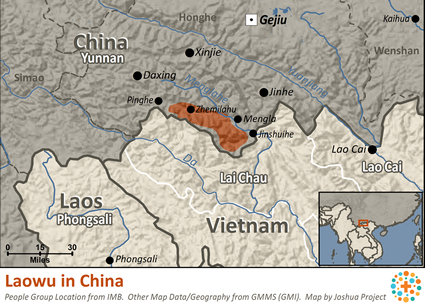
The Laowu in Jinping County seem to have once been distributed over a far wider area than they are today. Many non-Laowu villages in other parts of the county bear the name Laowuzhai (Laowu Village).
Laowu marriages are traditionally arranged through a matchmaker. A shaman is consulted. If the horoscopes of both parties are agreeable and if the parents on both sides give their consent, the two may become engaged. Before they hold a wedding, the family of the bride must donate articles such as clothes, blankets, a standing closet, and a trunk. When a Laowu bride leaves her home on the wedding day, she must be singing the "crying song" accompanied by her brothers, uncles, and maid-of-honor. Immediately before the bride and groom cross the threshold of their new home, the groom's sisters or mother takes a gourd filled with oats, wheat, corn, and beans and smashes it at their feet. This represents a wish for a lifetime of prosperity for the new couple.
After entering the house, the newly wed Laowu couple pay their respects first to heaven and earth, then to their ancestors, and finally to their parents. After a few more rituals, the couple is considered married. This ritual shows the polytheistic worldview of the Laowu. They believe a complex hierarchy of spirits guide and control their lives. They also consider it important to worship their ancestors.
There is no Christian presence among the Laowu people in China. Little is known about the history of Christian missionary work in Jinping County prior to 1949. The area was a political hotbed, influenced by the restrictive French control of nearby Vietnam and Laos. In recent years thousands of Hmong and Iu Mien people in Jinping have come to Christ as a result of gospel radio broadcasts in their languages. These new believers, though they speak completely different languages from the Laowu, represent the best chance of the Laowu hearing the gospel.
Without the guidance of Christ, these people are like sheep without a shepherd. They need the good shepherd in their families and communities.
Pray for the Lord to thrust out loving workers.
Pray for the Lord to intervene in their families, calling people to his side.
Pray for their hearts to be drawn to the Lord of lords.
Pray for a church planting movement to thrive in their communities.
Scripture Prayers for the Laowu in China.
Operation China, Asia Harvest, Copyrighted © Used with permission
| Profile Source: Joshua Project |