
People-in-Country Profile
Peoples Data Filter:
Printer friendly version:
Step 1 - Select a Country:  
Send us your updates!
Can you provide any of the following for this people?
Step 2 - Select a People:
Bedouin, Laguat of Algeria
Bedouin, Laguat People Photo
View Bedouin, Laguat in all countries.
Submit People Photo:
Peoples
               
Geographic
Global
               
Global
           
 
Affinity Bloc
           
Global


People Cluster
       
Region


People
   
Country


People-by-Country (Profile)


Religion
Language


Global
   
Language


Religion
                             
Bedouin, Laguat of Algeria
 
Profile Text
Submit Profile Text:
The name "Bedouin" is derived from the Arab word bedu. It is a term used to differentiate between those groups who migrate with their herds and those who have settled in an urban or agricultural area. Although distinct, both communities rely on each other economically, socially, and politically.

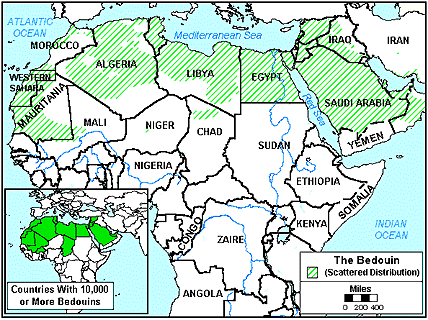
Most people picture the Bedouin as nomads clothed in long flowing robes, riding across the desert on their camels. In reality, however, their identity is much more complex. Today, many Bedouin live as semi-nomads, both migrating with their herds and engaging in some form of settled agriculture. Most Bedouin are organized into tribes, virtually all of which speak Arabic and claim Arab descent.

The Arab conquests of the seventh century brought about a rapid expansion of the Bedouin. At that time, thousands of Bedouin left the Middle East and began spreading across North Africa. They have adapted well to the nomadic or semi-nomadic way of life in the desert. Apart from tribal affiliations, there is little to distinguish one group of Bedouin from another.

What Are Their Lives Like?
The Bedouin economy is primarily based on raising livestock. At the core of their society is the need for migration, which is determined by the supply of water and the availability of grazing land. Territories belonging to specific tribes are well defined and their boundaries are known to all. Political borders are of little importance to the Bedouin, although various government restrictions are now having more affect on their migratory lifestyle than in times past.

Because food is scarce in the desert regions, most Bedouin suffer from hunger at some time in their lives. Dairy products are their main food source. Milk from camels and goats is made into yogurt and a type of butter called ghee. The women also bake round loaves of unleavened bread that are made from coarse, stone-ground wheat. Dates and other fruits found in desert oases are also eaten when available. Meat is only served on special occasions such as marriage feasts, ceremonial events, or when guests are present. During such times a young goat, camel, or lamb is slaughtered and roasted.

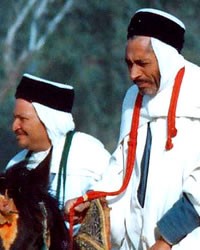
To endure the extreme heat of the desert, the Bedouin wear lightweight, light-colored clothing. It is very loose-fitting, allowing for the circulation of air and freedom of movement, yet providing protection from the sun and windblown sand. Their garments are designed to cover the entire body except for the face, hands, and feet. The main garment for men is the cotton thawb, which is a long straight-cut white, brown, or gray robe. Over the robe, the men wear long silk or cotton jackets called kibrs. The jackets are open in the front and secured with leather belts.

Most of the Bedouin live in low, rectangular tents woven from camel or goat hair. A line of poles supports the center of the tent. The wealthier a Bedouin is, the longer his tent will be. The sides of the tents may be rolled up to let the breezes in, or closed up tightly during rain or sandstorms. The tents are divided by decorative partitions called gatas. Half of the tent is for the men. It contains a fireplace and is used for entertaining guests. The other half is for the women, children, and stored items. It also has a fireplace that is used for cooking.

The women do most of the work, while the men socialize and make plans for the group. Bedouin children stay with their mothers in the women's section of the tent until they are about seven years old. Older boys often help with the herds and tend to the needs of guests. The women's responsibilities include tending to the children; preparing meals; sewing; collecting and weaving the animal hair; pitching, striking, and loading the tents; gathering fuel for cooking; and nurturing the elderly. Marriage ideally occurs within the extended family. Generally, the father's cousins have the first preference.

Bedouin society is organized according to a series of overlapping kin groups. The family is the smallest unit, followed by the clan, then the tribe. In the past, it was shameful for a Bedouin to accept a wage-paying job. Today, however, many have been forced by economic circumstances into full- or part-time employment.

What are their beliefs?
While most of the Bedouin are Sunni Muslims (many of the Malikite branch), there is still a basic belief in spirits known as jinnis. The jinnis are, according to Muslim legend, spirits capable of assuming human or animal form and exercising supernatural influence over humans.

A few of the tribes have been influenced by the mystic tradition in Islam known as Sufism. A Sufi is someone who believes that he has acquired a special inner knowledge direct from Allah.

What are their needs?
All of the Bedouin groups are basically untouched with the Gospel. Although there are resources available in their languages, the Bedouin have proved to be resistant to Christianity. Fervent, effective prayer must be offered up on behalf of these tribes in order to break down the barriers that separate them from the Truth.

Prayer Points
Ask the Holy Spirit to grant wisdom and favor to the missions agencies that are targeting the Bedouin.
Pray that the Lord will raise up additional long term workers to join the few who have already responded.
Ask God to raise up prayer teams who will faithfully intercede for the Bedouin.
Pray that God will reveal Himself to these precious people through dreams and visions.
Ask the Holy Spirit to complete the work begun in the hearts of the Bedouin believers through adequate discipleship.
Pray that God will give the Bedouin believers boldness to share Christ with their own people.
Ask the Holy Spirit to soften the hearts of the Bedouin towards Christians so that they will be receptive to the Gospel.
Pray that strong local churches will be raised up among each of the Bedouin tribes.

View Bedouin, Laguat in all countries.

 
Prayer Links Submit Links:
PrayerGuard.net
 
Web Profile Links Submit Links:
www.everyculture.com/Africa-Middle-East/index.html
www.muslimjourneytohope.com
en.wikipedia.org/wiki/Bedouins
www.alnour.com
www.arabbible.com
www.arabicbible.com
www.thefellowship.info/Missions/Global-Missions/Pe...
 
Web Resource Links Submit Links:
Audio RecordingsMegaVoice Audio Bible and Stories
Audio RecordingsArabic Bibles Online
Audio RecordingsGlobal Recordings
Film / VideoJesus Film
Film / VideoWorld Christian Videos
GeneralEvangelism Toolbox
GeneralFour Spiritual Laws
ScriptureBible-in-Your-Language
ScriptureUnbound Bible

 
Maps
Submit Map:
Ethnolinguistic Map:
University of Texas map collection
Linguistic Map:
Ethnologue language map
  
  Submit Update:
Country: Algeria
Continent:
Africa
Region:
Middle East and North Africa
Country Persecution Rank:19 (Only top 50 ranked, 1 = highest persecution ranking)
Yes
Country Details: World Factbook
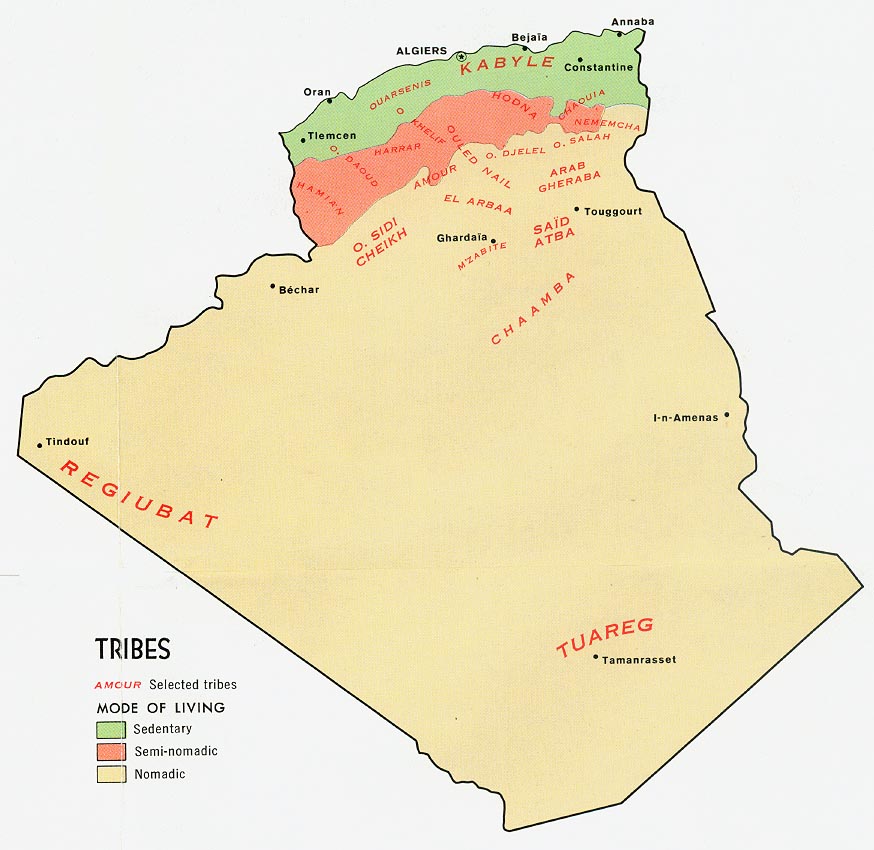
Location within Country:Steppes of Atlas Mountains, along Moroccan border.
(Source: www.ethnologue.com)
   
 
People
Submit Update:
People Name in Country: Bedouin, Laguat
People Name General:
Bedouin, Laguat
Alternate People Names:
Laguat Bedouin
People Code: 105567
Population in this Country: 66,000
Population in all Countries: 66,000
Yes
   
 
Arab World
Bedouin, Saharan
People Name General:
Bedouin, Laguat
CMT30
Ethnic Relationships:
Affinity Bloc -> People Cluster -> Peoples Ethnicity Tree
   
 
Language
Submit Update:
Primary Language:
Arabic, Algerian Spoken (66,000 Speakers)
Language Code (16th): arq    Ethnologue Listing
ARQ
Total Languages Spoken:
1
   
 
Religion
Submit Update:
Primary Religion:
Islam
Major Religions:
Buddhism0.00 % 
Christianity0.00 %(Evangelical: 0.00 %)
Ethnic Religions0.00 % 
Hinduism0.00 % 
Islam100.00 % 
Non-Religious0.00 % 
Other / Small0.00 % 
Unknown0.00 % 
Christianity Segments:
Anglican0.00 %
Independent0.00 %
Protestant0.00 %
Orthodox0.00 %
Other Christian0.00 %
Roman Catholic0.00 %
 
(Evangelicals distributed across Christianity segments)
   
 
Joshua Project Progress Indicators
Yes
Progress Scale: 1.1     Few, if any, known believers. Christian Adherents <=5%.
Need-Ranking Score: 72        Details
   
 
Other Progress Indicators *
Global Evangelical Status:Level 1   Less than 2% Evangelical. Some evangelical resources available, but no active church planting within past 2 years
Unengaged Status:Yes   Unengaged
Agency Progress (API):Level 0   No agency commitment
Church Progress (CPI):Level 0   No known believers
 
 
Bible Translation Status
Submit Update:
Bible Portions: 1872-1964
New Testament: None Reported
Complete Bible: None Reported
Possible Bible Sources: Forum of Bible Agencies
 World Bible Finder
 World Christian Resource Directory
 
 
Ministry Activity
Register Ministry Activity:
Description: Register your ministry activity among this people group. Contact the Adopt-A-People Clearinghouse to learn about others that might be focused on this people group.
 
Bedouin, Laguat of Algeria
* Notes:
  • Significant effort is made to match photos with people groups. In most cases the photo source has identified the people group. However, in some instances when the exact people group is not identified Joshua Project has made educated attempts at matching. As a result some photos may be representative of the people cluster rather than the specific people group. Mismatches are the fault of Joshua Project, not the photographer. Please contact us if you believe a photo is not matched with the correct people group.
  • Percentages may be printed as '0.00%' because of space limitations, but some are slightly greater than zero.
  • The exactness of the above numbers can be misleading. Numbers can vary by several percentage points or more.
  • People group population figures are now maintained as a percentage of the national population. Click here for details.
  • Joshua Project does not have specific ministry activity data supporting the "Other Progress Indicators."
  • Discrepancies may exist between "Other Progress Indicators" because of the varying sources of information.
  • Joshua Project does not know the exact content of web audio recordings. In general they are Bible reading and teaching.
  • As on-site realities are understood, barriers of acceptance may be found in many of the larger people groups that will require multiple distinct church planting efforts.
  • This data may contain errors and needs continual correcting and updating. Click here to send feedback.