
People-in-Country Profile
Peoples Data Filter:
Printer friendly version:
Step 1 - Select a Country:  
Send us your updates!
Can you provide any of the following for this people?
Step 2 - Select a People:
Arab, Gulf of United Arab Emirates
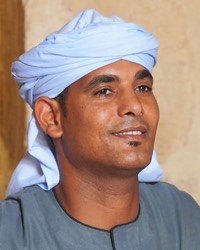
Arab, Gulf People Photo
View Arab, Gulf in all countries.
Submit People Photo:
Peoples
               
Geographic
Global
               
Global
           
 
Affinity Bloc
           
Global


People Cluster
       
Region


People
   
Country


People-by-Country (Profile)


Religion
Language


Global
   
Language


Religion
                             
Arab, Gulf of United Arab Emirates
 
Profile Text
Submit Profile Text:
The Levant Arabs originally settled all over the Arabian Peninsula and later migrated to North Africa. Today, several hundred thousand Levant Arabs live along the northern edges of the Arabian Desert. They are spread from Israel to Kuwait and as far east as Iran. "Levant" is a broad term that includes several groups of Arabs: the Jordanian, Palestinian, Iraqi, Arabic Jewish, Chaldean, and Syrian Arabs.

Most scholars consider Arabs from the Arabian Peninsula to be the original Arabs. The Arabian culture was developed by tribes of nomads and villagers who lived in the Arabian Desert for many centuries. It was also from there that Arab migrations began, eventually leading to the expansion of the Arab world.

The Levant Arabs have had a close association with Islam throughout their history; and today, all of them except for the Arabic Jewish Arabs are Muslims. The two main branches of Islam in the region are the Shi'ites and Shafiites. Most Levant Arabs speak an Arabic language called Arabiya, with varying local dialects. Others speak an Arabic language known as Mashriqi.

What Are Their Lives Like?
The Levant Arabs typically live in villages located near fertile regions; but they can also be found near mountain foothills in less arid regions. Although they have settled in towns or villages, they have held on to their tribal affiliations.

The various tribes are ruled by sheiks (Arab chiefs that are considered to be experts in Islam and in relating to the outside world). Their fortress-like villages can be easily defended. Each house has windows on all sides and is built facing the outside of the village. All goods and persons passing through town are strictly controlled.

Individual dwellings tend to be elaborately decorated, flat-roofed homes called "town houses." Lime wash and brickwork are used around the windows as a form of artistic design. The rooms usually have some type of carpeting, and when entering the house, one must leave his shoes at the door. The walls are lined with mattresses and cushions to sit on and lean against. A main reception room and a kitchen are located on the top floor. The flat roofs are used by the women for drying laundry.

Social life is extremely important to Arabs. They like to share a daily coffee time by sitting on the floor and drinking coffee from cups without handles. Their diet basically consists of wheat bread and porridge made with boiled meat or chicken.

Despite Islamic teachings, the reality of different classes of Arabs still persists. The type of clothing worn has become one of the determining factors. Levant tribesmen dress differently than other villagers and can be easily recognized. The women wear veils both in town and at home. Boys show that they are becoming men by changing their headgear and wearing daggers.

In spite of the fact that Muslims are allowed to have up to four wives, most marriages among the Levant Arabs are monogamous. In the past, all marriages were arranged by the parents; however, it is becoming more acceptable for young people to choose their own mates. Young girls are considered ready for marriage by age nine.

In recent years, many of the Levant Arab nomads have settled into mountain villages where they now raise grains, vegetables, coffee, melons, dates, mangoes, and pomegranates. Domestic animals are kept to supply milk and eggs.

What are their beliefs?
Almost all of the Levant Arabs are Muslims. Islam is a religion of works that is based on five basic "pillars." (1) A Muslim must affirm that "there is no god but Allah, and Mohammed is his prophet." (2) He must pray five times a day while facing Mecca. (3) He must give generously. (4) He must fast during Ramadan, the ninth month of the Muslim year. (5) He must try to make at least one pilgrimage to Mecca in his lifetime.

Islam has greatly influenced the lives of the Levant Arabs. To preserve their people, they are only allowed to marry those inside their own group. Levant Arab society is patrilineal, which means that inheritances are passed down through the males. In this system, boys inherit more than girls. Since children are considered a family's greatest asset, females are valued for their ability to bear children.

What are their needs?
There is a great need for the Gospel to be preached among the Levant Arabs. Currently, there are only a few agencies ministering to these tribes. Very few Christian radio broadcasts are being aired in their region and only portions of the New Testament have been translated into their language.

At the present time, there are only a few known Christians within the Levant Arab community, with the largest number found among the Iraqi Arabs. Evangelization efforts among these tribes are challenging due to restrictions in many of the countries, as well as general antagonism towards Christianity. Prayerful intercession is the key to reaching them with the Gospel.

Prayer Points
Ask the Lord to call people who are willing to reach out and share the love of Christ with them.
Pray that God will raise up faithful intercessors who will stand in the gap for the Levant Arabs.
Ask God to give the Levant Arab believers opportunities to share the love of Christ with their own people.
Pray that their traditional Muslim culture will soften, creating open doors for the Gospel to be preached among them.
Ask the Holy Spirit to open the hearts of these people towards Christians so that they will be receptive to the Gospel.
Pray that God will reveal Himself to them through dreams and visions.
Ask the Lord to raise up strong local churches among the Levant Arabs.

View Arab, Gulf in all countries.

 
Prayer Links Submit Links:
PrayerGuard.net
Global Prayer Digest: 2006-11-28
 
Web Profile Links Submit Links:
www.everyculture.com/Africa-Middle-East/index.html
www.muslimjourneytohope.com
en.wikipedia.org/wiki/Arab
www.alnour.com
www.arabbible.com
www.arabicbible.com
www.arabvision.org
www.farsinet.com/pwo
www.Pray4Yemen.com
www.sharifbible.com/
 
Web Resource Links Submit Links:
Audio RecordingsMegaVoice Audio Bible and Stories
Audio RecordingsArabic Bibles Online
Audio RecordingsAudio Recordings Resources
GeneralFour Spiritual Laws
ScriptureBible-in-Your-Language
ScriptureUnbound Bible

 
Maps
Submit Map:
  
  Submit Update:
Country: United Arab Emirates
Continent:
Asia
Region:
Middle East and North Africa
Country Persecution Rank:35 (Only top 50 ranked, 1 = highest persecution ranking)
Yes
Country Details: World Factbook
Population in this Country:
525,000
Largest Provinces on file:
'AjmanAbu Zaby
Al FujayrahAsh Shariqah
DubayyRa's al Khaymah
Umm al Qaywayn
Total Provinces on file:7
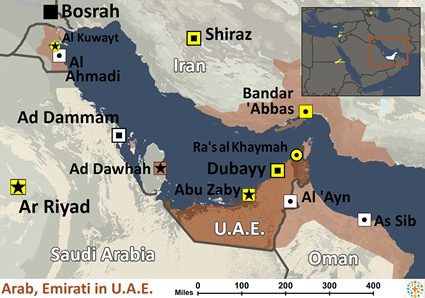
Location within Country:Gulf Bedu or village peoples.
(Source: www.ethnologue.com)
   
 
People
Submit Update:
People Name in Country: Arab, Gulf
People Name General:
Arab, Gulf
Alternate People Names:
Al-HasaaArab
Arab, Gulf Arabic SpeakingBahraini Arab
EmirianGulf Arab
Gulf Arabic SpeakingGulf Arabs
Gulf SpeakingIranian Arab
Saudi Arab
People Code: 100427
Population in this Country: 525,000
Population in all Countries: 1,248,000
Yes
   
 
Arab World
Arab, Arabian
People Name General:
Arab, Gulf
CMT30
Ethnic Relationships:
Affinity Bloc -> People Cluster -> Peoples Ethnicity Tree
   
 
Language
Submit Update:
Primary Language:
Arabic, Gulf Spoken
Language Code (16th): afb    Ethnologue Listing
AFB
Total Languages Spoken:
1
   
 
Religion
Submit Update:
Primary Religion:
Islam
Religion Sub-division:Sunni
% Christian Adherents:1.20 %
% Evangelical:Unknown
   
 
Joshua Project Progress Indicators
Yes
Progress Scale: 1.2     Evangelicals >.01% but <=2%. Christian Adherents <=5%.
Need-Ranking Score: 77        Details
   
 
Other Progress Indicators *
Global Evangelical Status:Level 1   Less than 2% Evangelical. Some evangelical resources available, but no active church planting within past 2 years
Agency Progress (API):Level 2   At least one agency on-site
Church Progress (CPI):Level 1   No churches, some believers
 
 
Bible Translation Status
Submit Update:
Bible Portions: Help start a Bible Translation
New Testament: None Reported
Complete Bible: None Reported
 
 
Ministry Activity
Register Ministry Activity:
Description: Register your ministry activity among this people group. Contact the Adopt-A-People Clearinghouse to learn about others that might be focused on this people group.
 
Arab, Gulf of United Arab Emirates
* Notes:
  • Significant effort is made to match photos with people groups. In most cases the photo source has identified the people group. However, in some instances when the exact people group is not identified Joshua Project has made educated attempts at matching. As a result some photos may be representative of the people cluster rather than the specific people group. Mismatches are the fault of Joshua Project, not the photographer. Please contact us if you believe a photo is not matched with the correct people group.
  • Percentages may be printed as '0.00%' because of space limitations, but some are slightly greater than zero.
  • The exactness of the above numbers can be misleading. Numbers can vary by several percentage points or more.
  • People group population figures are now maintained as a percentage of the national population. Click here for details.
  • Joshua Project does not have specific ministry activity data supporting the "Other Progress Indicators."
  • Discrepancies may exist between "Other Progress Indicators" because of the varying sources of information.
  • Joshua Project does not know the exact content of web audio recordings. In general they are Bible reading and teaching.
  • As on-site realities are understood, barriers of acceptance may be found in many of the larger people groups that will require multiple distinct church planting efforts.
  • This data may contain errors and needs continual correcting and updating. Click here to send feedback.