Kadazan, Central in Malaysia
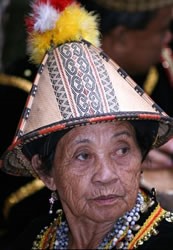
Photo Source:
MySabah.com
Used with permission
|
Send Joshua Project a map of this people group.
|
| People Name: | Kadazan, Central |
| Country: | Malaysia |
| 10/40 Window: | Yes |
| Population: | 38,000 |
| World Population: | 38,000 |
| Primary Language: | Kadazan Dusun |
| Primary Religion: | Ethnic Religions |
| Christian Adherents: | 36.00 % |
| Evangelicals: | 10.00 % |
| Scripture: | Complete Bible |
| Ministry Resources: | Yes |
| Jesus Film: | Yes |
| Audio Recordings: | Yes |
| People Cluster: | Borneo-Kalimantan |
| Affinity Bloc: | Malay Peoples |
| Progress Level: |

|
Introduction / History
The Central Kadazan are an indigenous people of Sabah in Malaysian Borneo, found across the West Coast Division and nearby interior districts, including Papar, Penampang, Ranau, Tambunan, Keningau, Kota Belud, Kota Marudu, Beaufort, Tenom, and Kota Kinabalu. They belong to the wider Kadazan-Dusun world, but this profile treats them as a distinct branch within that larger family. Their language is listed as Kadazan Dusun, and the broader linguistic evidence strongly points to the Central Dusun / Kadazandusun language continuum that serves as a major speech form among many Kadazan and Dusun communities in Sabah.
Historically, the Central Kadazan are part of Sabah's long-rooted indigenous societies whose identity was shaped by village settlement, kinship networks, agriculture, and customary leadership rather than by large, centralized states. Publicly available historical writing focused narrowly on this exact subgroup is limited, so it is better to place them within the broader Kadazan-Dusun heritage than to overstate details that are not clearly documented. What can be said with confidence is that they are not an isolated fringe community, but part of one of Sabah's most visible and enduring indigenous cultural streams.
What Are Their Lives Like?
The Central Kadazan are spread across both rural and semi-urban parts of Sabah, so their daily life is more mixed than that of some smaller interior-only groups. In many areas, family life remains strongly communal, with extended relatives, elders, and local social ties still carrying real influence in marriage, work, celebrations, and mutual support. Because they are present in both farming districts and more connected towns near the west coast, their communities can range from village-centered to more economically integrated settings.
Their livelihoods are often tied to the broader Kadazan-Dusun pattern in Sabah: agriculture, local trade, public-sector work, small business, and wage labor. In rural areas, rice farming has long been central to Kadazan-Dusun identity, while more connected districts bring access to markets, education, and varied employment. Meals in these communities commonly center on rice, vegetables, fish, root crops, and other locally available foods. Recreation and celebration are usually communal rather than commercial—family gatherings, harvest-related events, church activities where Christianity is present, music, and local festivals all matter. Since this is a broad and regionally spread people, it would be misleading to portray them as living in one single narrow lifestyle pattern.
What Are Their Beliefs?
The Central Kadazan are mostly identified with ethnic religion, though there is also a meaningful Christian presence among them. That means they should not be treated as a people with no gospel witness, but neither should outward Christian identity be assumed to reflect deep biblical faith. Where ethnic religion remains influential, people may still look to inherited spiritual beliefs, ritual practices, or unseen powers for protection and guidance rather than resting fully in Jesus Christ alone.
Because there is also a Christian witness among them, some may identify as Christian while still carrying older spiritual assumptions or blended loyalties. In that case, the central issue is not lack of exposure but divided faith. Scripture resources are reported as available in their language, and the Bible is listed as complete.
What Are Their Needs?
The Central Kadazan need a clear and faithful gospel witness that not only reaches those still shaped mainly by ethnic religion, but also strengthens those who already identify as Christian. Since there is a real Christian presence among them, the deepest need is not merely first exposure. They need biblical clarity, genuine conversion where faith is only cultural, and mature discipleship where Christ is named but older spiritual patterns still linger.
They also likely face practical pressures that differ by district. In rural areas, better access to medical care, stronger schools, reliable transportation, and stable livelihoods can make a major difference. In more connected areas, the challenge may be less raw isolation and more spiritual drift, nominal religion, and pressure from modern social change. Because this is a relatively broad Sabah people with both village and semi-urban settings, their needs are not one-dimensional. Practical help matters, but it should support the greater need for strong churches, sound teaching, and durable Christian witness.
Prayer Points
Pray that the Central Kadazan would turn from every spirit-centered belief and trust in Jesus Christ alone.
Pray that those who identify as Christian would grow in biblical depth and reject every form of blended or nominal faith.
Pray for stronger access to medical care, education, transportation, and stable livelihoods across their communities.
Pray that believers among the Central Kadazan would become a strong gospel witness to other peoples in Sabah who still need clear biblical truth.