Sarera (Sikh traditions) in India

Photo Source:
Anonymous
|
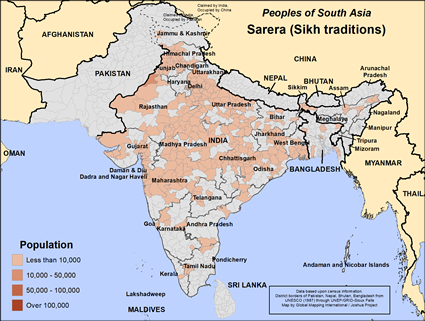
Map Source:
People Group data: Omid. Map geography: UNESCO / GMI. Map Design: Joshua Project.
|
| People Name: | Sarera (Sikh traditions) |
| Country: | India |
| 10/40 Window: | Yes |
| Population: | 94,000 |
| World Population: | 94,000 |
| Primary Language: | Punjabi, Eastern |
| Primary Religion: | Sikhism |
| Christian Adherents: | 0.00 % |
| Evangelicals: | 0.00 % |
| Scripture: | Complete Bible |
| Ministry Resources: | Yes |
| Jesus Film: | Yes |
| Audio Recordings: | Yes |
| People Cluster: | South Asia Sikh - other |
| Affinity Bloc: | South Asian Peoples |
| Progress Level: |

|
Introduction / History
The term sarera means scutching cotton, which was their traditional occupation. "Scutching" refers to removing impurities such as seeds from raw cotton.
What Are Their Lives Like?
They work as agricultural laborers, in road construction, and in small factories. The Sarera (Sikh traditions) people of India engage in recreational activities that reflect their agricultural lifestyle, strong community orientation, and Sikh cultural heritage. Leisure time is generally limited due to the demands of farming and daily labor, but it is valued as an opportunity to strengthen relationships and enjoy fellowship within the community.
Men often spend their free time gathering in small groups within the village. These gatherings provide opportunities for conversation, sharing news, and discussing community matters. Younger men and boys may participate in informal sports such as kabaddi or wrestling, which are traditionally popular in rural Sikh communities and encourage physical strength and teamwork.
Women typically find recreation through social interaction with family members and neighbors. Visiting one another's homes is an important part of daily life, allowing women to build and maintain close relationships. During these times, they may prepare food together, share stories, or engage in activities such as sewing, embroidery, or other forms of handiwork that combine productivity with relaxation.
Children enjoy simple forms of recreation, often playing outdoors in small groups. Their activities may include running games, imitation of adult tasks, or the use of improvised toys. These experiences help children develop social skills and a sense of belonging within the community.
Festivals and religious observances play a central role in recreational life among the Sarera. Sikh holidays and local celebrations bring the community together for shared meals, music, and sometimes traditional dancing. These events provide joy and renewal while reinforcing both cultural identity and religious devotion.
What Are Their Beliefs?
Some are Hindus and others are Sikhs. Sikhs reject the caste system, but the Hindu Sarera consider themselves superior to other Scheduled Castes in their region.
Sikhs do not believe in a transcendent God, one who lives apart from his creation. The creator and his creation are inseparable. The way to experience God is through his creation and meditation.
What Are Their Needs?
It will be difficult to get them to understand that Jesus Christ is the firm foundation.
Prayer Points
Pray that the Sarera people will be adopted through the People Group Adoption program so that they will have regular prayer and ultimately workers among them.
Pray for loving workers to be sent to the Sikh communities of the Punjab and beyond.
Pray that the Lord in his sovereignty would put them into contact with Spirit-filled believers in their areas who can demonstrate the love of Jesus and share his love with them.
References