Silawat (Hindu traditions) in India

Photo Source:
Anonymous
|
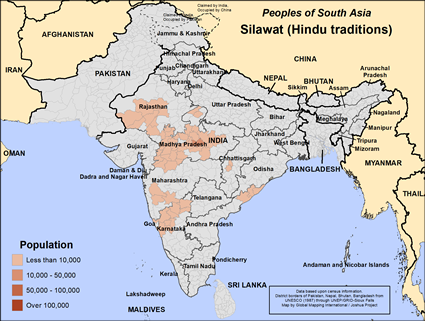
Map Source:
People Group data: Omid. Map geography: UNESCO / GMI. Map Design: Joshua Project.
|
| People Name: | Silawat (Hindu traditions) |
| Country: | India |
| 10/40 Window: | Yes |
| Population: | 74,000 |
| World Population: | 74,000 |
| Primary Language: | Hindi |
| Primary Religion: | Hinduism |
| Christian Adherents: | 0.00 % |
| Evangelicals: | 0.00 % |
| Scripture: | Complete Bible |
| Ministry Resources: | Yes |
| Jesus Film: | Yes |
| Audio Recordings: | Yes |
| People Cluster: | South Asia Dalit - other |
| Affinity Bloc: | South Asian Peoples |
| Progress Level: |

|
Introduction / History
Silawat is a Hindu community in India traditionally associated with stone masonry, carving, and construction-related trades. Their name has long been connected with skilled artisan work involving stone and building materials, and many families historically earned their livelihood through craftsmanship passed down across generations. Silawat communities are found in parts of northern and western India, especially in areas influenced by long-standing architectural and temple-building traditions. They commonly speak regional languages such as Hindi and related dialects depending on their location.
Like many artisan-based caste communities in India, the Silawat developed a distinct social identity tied to occupation, family lineage, and regional custom. Their history reflects the broader Indian pattern of hereditary vocational communities where knowledge and trade skills were preserved within the family. While modernization has changed the construction industry and reduced dependence on some traditional methods, many Silawat families still retain pride in their craftsmanship heritage and cultural identity.
What Are Their Lives Like?
Many Silawat families live in villages, towns, and expanding urban areas where they work in masonry, construction, stone cutting, transportation, small business, or wage labor. Some continue traditional stone-working occupations, while younger generations increasingly pursue education or modern employment opportunities. Economic conditions can vary widely depending on region, access to work, and education.
Family life is usually close-knit, with strong respect for elders and community traditions. Marriage is often arranged within the broader community, and preserving family honor remains important. Extended families frequently maintain strong involvement in one another's lives, especially during weddings, festivals, and times of hardship.
Their food commonly reflects northern and western Indian cuisine, including flatbreads, rice, lentils, vegetables, dairy products, and spiced dishes. Religious festivals and local celebrations are central parts of community life and often involve gatherings of relatives and neighbors.
For poorer families, financial instability, inconsistent labor opportunities, and limited access to healthcare or advanced education can create ongoing challenges. Rural communities may also face difficulties related to infrastructure and economic mobility.
What Are Their Beliefs?
The Silawat who follow Hindu traditions practice a mixture of mainstream Hindu worship and local folk religious customs. Their beliefs commonly include devotion to Hindu gods and goddesses through temple worship, household shrines, offerings, festival observances, and rituals connected to important life events.
In many cases, Hindu practice is blended with traditional beliefs involving spiritual protection, blessings, curses, ancestral customs, and fear of harmful spiritual forces. Religious rituals may accompany birth, marriage, illness, business activity, and death. Priests, astrologers, and local religious figures can hold significant influence within the community.
Most Silawat have had little exposure to a clear biblical presentation of the gospel. Many know very little about Jesus Christ beyond limited cultural awareness and have never personally encountered biblical Christianity explained in their own cultural setting.
What Are Their Needs?
The Silawat need faithful access to the gospel through Scripture, personal relationships, and long-term Christian witness. They need believers who are willing to live among them with humility, compassion, and biblical conviction. Because community identity is strong, individuals who become interested in Christianity may experience family opposition or social pressure.
Practical needs may include stable employment opportunities, healthcare access, education, vocational training, and assistance for struggling families. In areas where traditional trades are declining, uncertainty about work and income can create additional hardship.
There is also a great need for mature local believers who can disciple others, establish biblically grounded churches, and share the gospel naturally among neighboring communities.
Prayer Points
Pray that the Silawat people will hear a clear presentation of the gospel and understand the saving work of Jesus Christ.
Pray that God will raise up compassionate Christian workers who are willing to serve faithfully among the Silawat community.
Pray that the Silawat people will be adopted through the People Group Adoption program so that ongoing prayer and future gospel engagement will continue among them.
Pray that any existing believers connected to the Silawat community will grow strong in biblical faith and boldly share the gospel with surrounding peoples.