Pale in India

Send Joshua Project a photo
of this people group. |
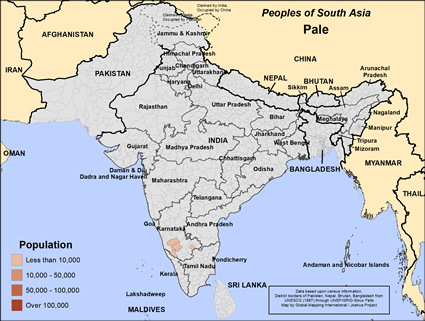
Map Source:
People Group data: Omid. Map geography: UNESCO / GMI. Map Design: Joshua Project
|
| People Name: | Pale |
| Country: | India |
| 10/40 Window: | Yes |
| Population: | 10,000 |
| World Population: | 10,000 |
| Primary Language: | Kannada |
| Primary Religion: | Hinduism |
| Christian Adherents: | 0.00 % |
| Evangelicals: | 0.00 % |
| Scripture: | Complete Bible |
| Ministry Resources: | Yes |
| Jesus Film: | Yes |
| Audio Recordings: | Yes |
| People Cluster: | South Asia Dalit - other |
| Affinity Bloc: | South Asian Peoples |
| Progress Level: |

|
Introduction / History
The Pale are a community found in India, though detailed public information about their specific historical origins and cultural development is limited. Like many smaller Indian communities, their identity has likely been shaped over generations through regional customs, hereditary occupations, family lineage, and local social structures preserved within close-knit social networks.
Communities throughout India traditionally formed distinct identities connected to agriculture, labor, trade, fishing, weaving, transport work, or village service occupations. These identities were commonly reinforced through marriage customs, oral tradition, clan relationships, and inherited religious practices. The Pale appear to belong within this broader framework of Indian social and cultural life shaped by regional traditions and strong family ties.
What Are Their Lives Like?
The daily lives of the Pale are likely centered around family responsibilities, work, and community relationships. In many Indian communities, extended families remain important sources of emotional, financial, and social support across generations. Respect for elders and preserving family reputation commonly shape household life and social expectations.
Depending on where they live, Pale families may work in agriculture, fishing, labor, local trade, transportation, crafts, weaving, or small business activities. Rural communities are often closely connected to seasonal work and village relationships, while younger generations may increasingly pursue education and employment opportunities in larger towns and cities.
Meals generally reflect regional Indian cuisine and commonly include rice, lentils, vegetables, flatbreads, dairy products, fish or locally available foods depending on the region. Weddings, religious festivals, and family ceremonies are often major social gatherings that reinforce community identity and preserve inherited traditions.
Like many traditional communities across India, the Pale are likely experiencing the effects of modernization, migration, technology, and economic change. These developments can create both new opportunities and tension between traditional expectations and contemporary lifestyles.
What Are Their Beliefs?
The Pale are associated primarily with Hindu religious traditions. Hindu religious life commonly includes devotion to gods and goddesses, temple worship, sacred festivals, ritual ceremonies, and household religious practices connected to family life and important life events.
In some communities, folk religion, ancestral customs, astrology, local spirit beliefs, and ritual purity practices may also influence everyday spiritual life. Religious identity is often deeply connected to family heritage and community belonging, with beliefs and customs passed down through generations.
Although Hinduism contains many devotional systems and philosophies, the Pale still need the gospel of Jesus Christ and the assurance of salvation that comes through faith in Him rather than through ritual observance, inherited religion, or personal effort.
What Are Their Needs?
The Pale need greater access to biblical teaching, Scripture, discipleship, and faithful Christian witness presented with humility, compassion, and cultural understanding. Many smaller communities in India continue to have limited meaningful exposure to evangelical Christianity or clear explanations of the gospel.
Practical needs may include educational opportunities, healthcare access, stable employment, and support for families facing financial hardship or social pressures. Rural and marginalized communities may also struggle with limited infrastructure and reduced access to resources and services.
There is a need for mature believers who will demonstrate Christ's love through compassionate service while faithfully sharing biblical truth. Strong local fellowships capable of discipling believers and strengthening families are important for long-term spiritual growth and lasting gospel witness.
Prayer Points
Pray that the Pale people would hear the gospel clearly and come to know Jesus Christ as Savior and Lord.
Pray that God would raise up faithful Christian workers who will serve among the Pale with wisdom, humility, and perseverance.
Pray that the Pale would be adopted through the People Group Adoption program so that sustained prayer, discipleship, and long-term gospel outreach would continue among them.
Pray for strengthened families, educational opportunity, practical provision, and spiritual openness within the Pale community.