Vakkaliga Gangadikara in India

Send Joshua Project a photo
of this people group. |
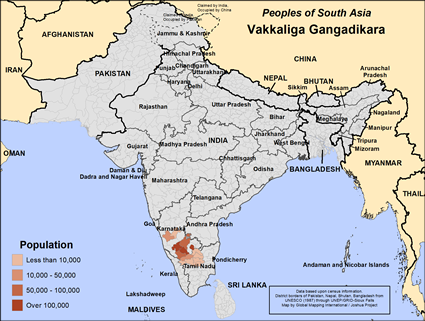
Map Source:
People Group data: Omid. Map geography: UNESCO / GMI. Map Design: Joshua Project
|
| People Name: | Vakkaliga Gangadikara |
| Country: | India |
| 10/40 Window: | Yes |
| Population: | 569,000 |
| World Population: | 569,000 |
| Primary Language: | Kannada |
| Primary Religion: | Hinduism |
| Christian Adherents: | 0.00 % |
| Evangelicals: | 0.00 % |
| Scripture: | Complete Bible |
| Ministry Resources: | Yes |
| Jesus Film: | Yes |
| Audio Recordings: | Yes |
| People Cluster: | South Asia Hindu - Vakkaliga |
| Affinity Bloc: | South Asian Peoples |
| Progress Level: |

|
Introduction / History
The Gangadikara Vakkaliga are a major subgroup of the broader Vakkaliga community of southern India, found primarily in Karnataka with smaller populations in neighboring states. They are Kannada-speaking people whose name is derived from Gangavadi, the historic region once ruled by the Western Ganga dynasty. The term "Gangadikara" literally means "people of Gangavadi." Community traditions and historical studies connect the Gangadikara with the agricultural populations that inhabited this region for centuries. Over time, they became one of the most prominent sections of the Vakkaliga community, known for farming, land stewardship, and local leadership.
Historically, the Vakkaligas were cultivators, livestock keepers, village leaders, and at times military supporters of regional kingdoms. The Gangadikara have long been concentrated in the districts of Mysuru, Mandya, Hassan, Bengaluru, Ramanagara, Chamarajanagar, and Tumakuru. Their identity remains closely tied to Kannada language, agricultural traditions, and the cultural heritage of southern Karnataka.
What Are Their Lives Like?
Agriculture has traditionally been the foundation of Gangadikara Vakkaliga life. Many families have been involved in cultivating crops, raising livestock, and managing agricultural land. While farming continues to be important, modern generations have expanded into education, business, government service, healthcare, engineering, science, forestry, and the arts. This combination of agricultural heritage and educational advancement has helped the community maintain a significant presence in Karnataka society.
They highly value family relationships, and extended family networks often provide social and economic support. Marriage, family celebrations, and religious festivals help strengthen community ties. Traditional foods commonly include rice, millet, lentils, vegetables, dairy products, and locally grown crops. Many households maintain strong connections to their ancestral villages even when family members move to cities for education or employment. Respect for elders, family honor, and community cooperation continue to play important roles in daily life.
What Are Their Beliefs?
The Gangadikara Vakkaliga are predominantly Hindu. Within the community there are both Shaiva and Vaishnava traditions, and religious life commonly includes temple worship, household rituals, festival observances, pilgrimages, and devotion to various Hindu deities. Historical influences from Jainism can still be seen in some customs among certain subgroups, though Hinduism remains the dominant faith.
Like many Hindu communities, the Gangadikara generally believe in karma, rebirth, and the pursuit of spiritual merit through religious devotion and good works. Worship may include offerings, vows, ceremonies, and participation in major Hindu festivals. Their spiritual worldview is shaped by Hindu scriptures, traditions, and local customs. Most have had little opportunity to understand the biblical teaching that salvation comes through God's grace by faith in Jesus Christ rather than through religious observances or accumulated merit.
What Are Their Needs?
The Gangadikara Vakkaliga need greater access to the gospel through personal relationships, faithful Christian witness, and Scripture presented in culturally understandable ways. Although Bible resources exist in Kannada and many members of the community are well educated, a large number have never personally encountered the message of Christ through trusted relationships.
Practical needs vary between rural and urban settings. Some families continue to face challenges related to agricultural sustainability, employment opportunities, and economic change. Educational opportunities, vocational development, and community support initiatives can strengthen families and communities. Above all, the Gangadikara need opportunities to hear the gospel, study God's word, and see the transforming power of Christ demonstrated through mature believers and healthy local churches.
Prayer Points
Pray that the Gangadikara Vakkaliga would encounter faithful followers of Jesus Christ who can clearly explain the gospel and demonstrate his love through their lives.
Pray that God would raise up workers with a burden for the Gangadikara Vakkaliga and give them wisdom to build meaningful relationships within the community.
Pray that the Gangadikara Vakkaliga would be adopted through the People Group Adoption program so that churches and believers will commit to ongoing prayer, outreach, and future gospel engagement among them.
Pray that existing Kannada-speaking believers would be strengthened in their faith and equipped to share the gospel effectively among the Gangadikara Vakkaliga and neighboring peoples.