Dhobi Mathuria in India

Send Joshua Project a photo
of this people group. |
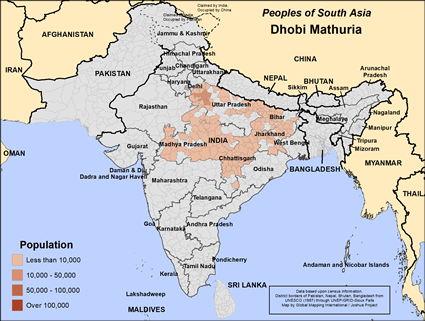
Map Source:
People Group data: Omid. Map geography: UNESCO / GMI. Map Design: Joshua Project
|
| People Name: | Dhobi Mathuria |
| Country: | India |
| 10/40 Window: | Yes |
| Population: | 183,000 |
| World Population: | 183,000 |
| Primary Language: | Hindi |
| Primary Religion: | Hinduism |
| Christian Adherents: | 0.00 % |
| Evangelicals: | 0.00 % |
| Scripture: | Complete Bible |
| Ministry Resources: | Yes |
| Jesus Film: | Yes |
| Audio Recordings: | Yes |
| People Cluster: | South Asia Hindu - other |
| Affinity Bloc: | South Asian Peoples |
| Progress Level: |

|
Introduction / History
The Mathuria Dhobi are a community found in India whose identity is historically connected with washing, cloth cleaning, and laundry-related occupations. The term "Dhobi" has long been associated with traditional washer communities throughout South Asia, while "Mathuria" reflects a distinct subgroup identity shaped by regional history, family lineage, and cultural tradition. Like many occupational communities in India, the Mathuria Dhobi developed within a social structure where family trade, caste identity, and village relationships were closely connected.
For generations, Dhobi communities played an important practical role within towns and villages by washing garments, ceremonial cloths, and household fabrics for surrounding populations. Even as modernization introduced commercial laundries and mechanized cleaning methods, many families retained aspects of their traditional identity and community structure. Over time, urban migration, education, and changing economic opportunities have gradually reshaped daily life for younger generations.
What Are Their Lives Like?
Many Mathuria Dhobi families live in rural or semi-urban communities, though increasing numbers have moved into larger towns and cities in search of broader employment opportunities. Some remain connected to laundry work, garment care, or service occupations, while others are employed in labor, transportation, retail, government work, or small business activity.
Family and community ties remain very important. Extended families often maintain close relationships, and social life commonly centers around weddings, festivals, religious observances, and gatherings with relatives and neighbors. Meals frequently include rice, lentils, vegetables, flatbreads, and regionally common foods.
Economic conditions vary widely. Some families have benefited from improved education and urban employment opportunities, while others continue to face poverty, unstable income, and limited social advancement. Access to healthcare, sanitation, and quality education may still be difficult in poorer communities. Younger generations often face pressure to balance traditional family expectations with modern ambitions and changing social realities.
What Are Their Beliefs?
The Mathuria Dhobi are generally influenced by Hindu traditions and regional religious customs. Religious life may include devotion to Hindu gods and goddesses, temple worship, participation in festivals, household rituals, and practices tied closely to family heritage and caste identity.
Alongside formal Hindu worship, folk religion and traditional spiritual beliefs may also influence daily life. Concerns about ritual purity, blessings, curses, astrology, ancestral customs, and protection from harmful spiritual forces can remain deeply rooted within the culture. These practices may foster spiritual fear and dependence on ritual rather than on the truth of God's Word.
Those who come to faith in Jesus Christ may face social opposition, family pressure, or fear of rejection within their community. New believers need strong biblical discipleship, fellowship, and encouragement so their faith is firmly established in Scripture and not mixed with older religious traditions or syncretistic practices.
What Are Their Needs?
The Mathuria Dhobi need greater access to the gospel through faithful Christian witness, Scripture, and discipleship clearly rooted in biblical truth. Many have little understanding of salvation through Jesus Christ alone and need opportunities to hear the gospel in ways that are understandable and personal.
Practical needs also affect many communities. Poverty, educational limitations, unstable employment, healthcare challenges, and social marginalization can place heavy burdens on families. Ministry that demonstrates Christ's compassion through both practical help and spiritual truth can open doors for meaningful long-term relationships.
Believers among the Mathuria Dhobi need mature leadership, healthy local churches, and ongoing biblical training so they can grow spiritually and effectively reach future generations with the gospel. Strong discipleship is especially important where cultural pressure and traditional religious expectations remain influential.
Prayer Points
Pray that the Mathuria Dhobi people would hear the gospel clearly and place their faith in Jesus Christ alone for salvation.
Pray that Christian workers serving among the Mathuria Dhobi would have wisdom, humility, and loving relationships that open hearts to biblical truth.
Pray that the Mathuria Dhobi would be adopted through the People Group Adoption program so that ongoing prayer, discipleship, and future gospel engagement would continue among them.
Pray that believers among the Mathuria Dhobi would grow in biblical maturity, stand firm against syncretism, and become faithful witnesses within their families and communities.