Gandharb (Muslim traditions) in India

Send Joshua Project a photo
of this people group. |
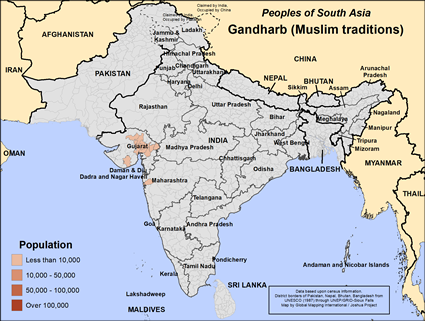
Map Source:
People Group data: Omid. Map geography: UNESCO / GMI. Map Design: Joshua Project
|
| People Name: | Gandharb (Muslim traditions) |
| Country: | India |
| 10/40 Window: | Yes |
| Population: | 5,800 |
| World Population: | 5,800 |
| Primary Language: | Gujarati |
| Primary Religion: | Islam |
| Christian Adherents: | 0.00 % |
| Evangelicals: | 0.00 % |
| Scripture: | Complete Bible |
| Ministry Resources: | Yes |
| Jesus Film: | Yes |
| Audio Recordings: | Yes |
| People Cluster: | South Asia Muslim - other |
| Affinity Bloc: | South Asian Peoples |
| Progress Level: |

|
Introduction / History
The Gandharb who follow Muslim traditions are found primarily in northern India and are connected to communities historically associated with music, entertainment, storytelling, and performance traditions. The name "Gandharb" has long-standing cultural associations in South Asia with musicians and performers, and over generations some Gandharb communities adopted Islam while retaining aspects of their occupational and cultural identity. Their primary languages are generally Hindi and regional dialects spoken in the areas where they live.
Historically, many Gandharb families earned their livelihood through singing, playing instruments, performing at celebrations, and participating in local cultural events. Some also worked as traveling entertainers or musicians connected to weddings and festivals. Economic and social changes over time reduced dependence on traditional performance occupations, leading many families into wage labor, small trade, transportation work, agriculture, or other forms of employment.
Despite these changes, music, oral tradition, and community identity still remain important among many Gandharb families. Their history reflects a blending of occupational heritage, regional customs, and Islamic influence shaped over centuries in northern India.
What Are Their Lives Like?
Many Muslim Gandharb families live in villages, small towns, or poorer urban neighborhoods where economic opportunities can be limited. Some continue involvement in music and entertainment, especially during weddings or local celebrations, while others work in agriculture, construction, transportation, manual labor, or small business activities. Employment is often unstable, and many households face financial pressure.
Family and community relationships are highly valued. Extended families commonly maintain close ties, and marriages are generally arranged within the community. Social life often centers around family gatherings, religious festivals, weddings, and local traditions. Meals commonly include rice, wheat breads, lentils, vegetables, and regional foods typical of northern India.
Although younger generations increasingly seek education and work in larger cities, many still retain strong cultural connections to their family heritage and traditional social structure. Daily life is often shaped by balancing economic survival with maintaining community identity and religious customs.
What Are Their Beliefs?
The Muslim Gandharb are primarily Sunni Muslims. They believe in Allah as the one true God and follow Islamic teachings based on the Quran and the traditions associated with Muhammad. Religious life commonly includes daily prayers, fasting during Ramadan, giving to the poor, mosque attendance, and observance of Islamic festivals such as Eid al-Fitr and Eid al-Adha.
Alongside formal Islamic practice, some families may also retain folk customs and local traditions tied to blessings, protection, healing, or spiritual guidance. In certain communities, cultural practices inherited from earlier generations continue alongside orthodox Islamic beliefs and rituals.
Very few Muslim Gandharb have heard a clear presentation of the gospel. Many know of Jesus only through Islamic teaching, where He is viewed as a prophet rather than the crucified and risen Son of God who offers salvation through faith. Christian witness among them remains very limited.
What Are Their Needs?
The Muslim Gandharb face both spiritual and practical challenges. Many families struggle with unstable employment, poverty, limited educational opportunities, and inadequate healthcare access. Communities dependent on traditional occupations may also face economic uncertainty as social and cultural changes continue to reshape local economies.
Spiritually, the Muslim Gandharb have little access to biblical teaching, discipleship, or churches equipped to minister effectively within their cultural setting. There is a need for faithful Christian workers who can patiently build relationships, serve practical needs, and communicate the gospel clearly and compassionately.
Ministries involving literacy, education, healthcare support, vocational training, and family assistance may help open doors for long-term gospel witness. Local believers in northern India also need encouragement and boldness to lovingly share the truth of Christ with Muslim communities around them.
Prayer Points
Pray that the Muslim Gandharb people would hear a clear explanation of the gospel and come to know Jesus Christ as Lord and Savior.
Pray for Christian workers to serve among the Muslim Gandharb with wisdom, humility, perseverance, and genuine love.
Pray that the Muslim Gandharb people would be adopted through the People Group Adoption program so that ongoing prayer, outreach, discipleship, and future gospel engagement would continue among them.
Pray that believers in India would faithfully share biblical truth with Muslim communities and reflect the compassion and holiness of Christ in their daily lives.