Marakkan (Hindu traditions) in India

Send Joshua Project a photo
of this people group. |
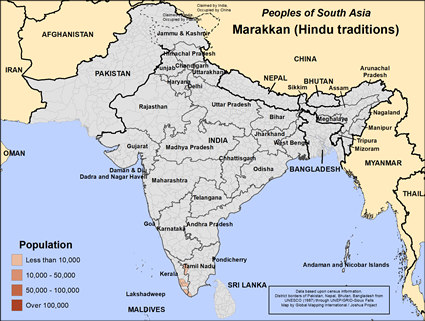
Map Source:
People Group data: Omid. Map geography: UNESCO / GMI. Map Design: Joshua Project
|
| People Name: | Marakkan (Hindu traditions) |
| Country: | India |
| 10/40 Window: | Yes |
| Population: | 9,400 |
| World Population: | 9,400 |
| Primary Language: | Malayalam |
| Primary Religion: | Hinduism |
| Christian Adherents: | 0.00 % |
| Evangelicals: | 0.00 % |
| Scripture: | Complete Bible |
| Ministry Resources: | Yes |
| Jesus Film: | Yes |
| Audio Recordings: | Yes |
| People Cluster: | South Asia Hindu - other |
| Affinity Bloc: | South Asian Peoples |
| Progress Level: |

|
Introduction / History
The Marakkan with Hindu traditions are a community found in southern India, particularly in coastal regions influenced by long-standing maritime trade, fishing, agriculture, and regional Hindu culture. Public information about this specific Hindu Marakkan community is limited, but communities bearing similar names in Kerala and Tamil Nadu have historically been connected with coastal livelihoods, local trade networks, and village-based social structures.
Over generations, the Marakkan developed their identity through family lineage, regional language traditions, occupational specialization, and religious customs preserved within close-knit communities. Life along the southwestern coast of India has historically exposed communities to cultural exchange through trade routes, migration, and interaction with neighboring peoples, while still maintaining strong local traditions rooted in village and family life.
What Are Their Lives Like?
Many Marakkan families live in rural or coastal settings where agriculture, fishing, and small-scale craftsmanship remain important sources of livelihood. Rice cultivation, coconut farming, spice production, fishing, weaving, and pottery may all contribute to household income depending on the region. Coastal living often requires strong cooperation within families and villages, especially during difficult fishing seasons or economic hardship.
Extended family relationships are important, and weddings, religious festivals, and village celebrations help preserve community identity and social bonds. Traditional South Indian meals commonly include rice, lentils, vegetables, coconut-based dishes, seafood, and regional curries. Community celebrations may involve music, dance, ritual observances, and shared meals.
Like many communities in India, the Marakkan are increasingly affected by modernization, migration, education, and changing economic opportunities. Younger generations may move toward urban employment while older generations continue traditional occupations and village-centered lifestyles.
What Are Their Beliefs?
The Marakkan with Hindu traditions primarily follow Hindu religious practices. Their religious life commonly includes devotion to Hindu gods and goddesses, temple worship, sacred festivals, family rituals, and ceremonies connected to major life events. Festivals such as Onam, Vishu, and Navratri may hold important places within community life.
In addition to mainstream Hindu practices, local folk traditions, reverence for ancestors, village deity worship, astrology, and ritual observances may also shape everyday spiritual life. In many Indian communities, religion is deeply intertwined with family identity, inherited custom, and social belonging.
Although the Marakkan may value morality, devotion, and religious tradition, they still need the gospel of Jesus Christ and the assurance of salvation that comes through Him alone rather than through ritual observance or inherited religion.
What Are Their Needs?
The Marakkan need greater access to biblical teaching, Scripture, discipleship, and faithful Christian witness presented with humility, compassion, and cultural understanding. Many may have little meaningful exposure to evangelical Christianity or a clear explanation of the gospel.
Practical needs may include improved healthcare access, educational opportunity, economic stability, modern agricultural and fishing support, and infrastructure development in rural or coastal areas. Environmental challenges, fluctuating fishing conditions, and limited economic opportunity can create ongoing pressure for many families.
There is a need for mature believers who will serve the Marakkan through compassionate ministry, long-term relationships, and faithful proclamation of biblical truth. Strong local fellowships capable of discipling future generations are also important for lasting spiritual growth.
Prayer Points
Pray that the Marakkan people would hear the gospel clearly and come to know Jesus Christ as Savior and Lord.
Pray that God would raise up compassionate and biblically faithful workers who will build lasting relationships among the Marakkan community.
Pray that the Marakkan would be adopted through the People Group Adoption program so that sustained prayer, discipleship, and long-term gospel outreach would continue among them.
Pray for strengthened families, improved educational and economic opportunities, and spiritual openness among the Marakkan people throughout southern India.