Gadaria (Hindu traditions) in India
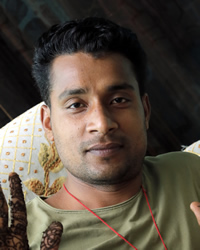
Photo Source:
Anonymous
|
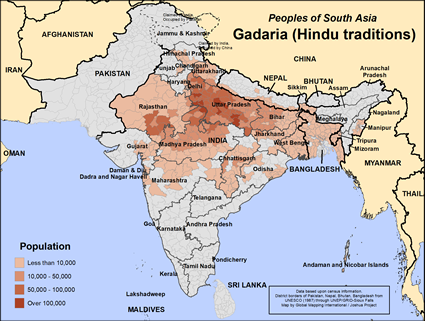
Map Source:
People Group data: Omid. Map geography: UNESCO / GMI. Map Design: Joshua Project.
|
| People Name: | Gadaria (Hindu traditions) |
| Country: | India |
| 10/40 Window: | Yes |
| Population: | 7,132,000 |
| World Population: | 7,140,800 |
| Primary Language: | Hindi |
| Primary Religion: | Hinduism |
| Christian Adherents: | 0.00 % |
| Evangelicals: | 0.00 % |
| Scripture: | Complete Bible |
| Ministry Resources: | Yes |
| Jesus Film: | Yes |
| Audio Recordings: | Yes |
| People Cluster: | South Asia Hindu - other |
| Affinity Bloc: | South Asian Peoples |
| Progress Level: |

|
Introduction / History
The Gadaria caste is a North Indian community (also in Nepal) that was traditionally involved in pastoral activities such as cow herding and sheep herding for wool. They were also engaged in making woolen clothes and blankets and selling them, along with practicing agriculture. They primarily use surnames such as Pal, Baghel, Chandel, Mohania, and Moriya. Some people also use their gotras as surnames, such as Chauhan, Rathod, Kashyap, Sisodiya, etc. They have two subgroups: Dhangar and Nikhar.
The Gadaria caste is known by different names in various regions of India. In Rajasthan and Madhya Pradesh, they are sometimes called Gaari/Gairi or Chaudhary. In Maharashtra, they are known as Dhangar. In Gujarat, they are referred to as Motabhai Bharwad. In Karnataka, they are known as Kuruba.
They have a very rich history as their name evolved from Gandhara, an ancient Indo-Aryan kingdom. Historically, Gandhara was a kingdom of shepherds (Gadaria), as per the Vedas. The Persian inscriptions at Persepolis from the 4th century BC, made by the Achaemenid ruler Darius I, mention the Gandhara region and its people as Gadariyas. Most likely the Gadarias migrated from Gandhara through the mountains to North India and settled there. They were the earliest settlers of the Narmada Valley, and places like Gadariyakheda and Gadarwara derives their names from this caste. A smaller number are in Nepal.
The Gadarmal Temple, built in the 7th century AD (Around 1400 years ago) in present-day Madhya Pradesh, is attributed to deities like Krishna, Shiva, Shakti, and Gadarmal Devi. Scholars like Kalidasa, regarded as one of the greatest poets and playwrights of ancient India, belonged to the Gadaria caste. It is also claimed that the Pala Empire of medieval India belonged to the Gadaria caste. Similarly, Chandragupta Maurya, the founder of the Mauryan dynasty, is believed by some traditions to have belonged to this caste. In modern India, Malhar Rao Holkar, belonged to the Gadaria caste, he founded the Holkar dynasty, which ruled the Malwa region of India for more than 200 years until Indias independence. Malwa region included western Madhya Pradesh with cities like Indore (the capital of the Holkar dynasty), Maheshwar, Ujjain, and Ratlam, as well as parts of southeastern Rajasthan and Gujarat. In this dynasty, Queen Ahilyabai Holkar, the daughter-in-law of Malhar Rao Holkar, is highly revered by Hindus for protecting and reconstructing many sacred Hindu temples. Another ruler, Yashwantrao Holkar, is sometimes described as the "Napoleon of India" for challenging the British.
What Are Their Lives Like?
The Gadaria are now mainly engaged as laborers in masonry work, while some are involved in animal husbandry.
What Are Their Beliefs?
The Gadaria people practice Hinduism, the ancient religion of India. Hinduism is a catch-all phrase for the local religions of South Asia, so it is very diverse. At the popular level, Hindus worship and serve the gods of the Hindu pantheon. They visit Hindu temples and offer prayers, food, flowers, and incense to their gods in hopes of gaining protection and benefits. They do not have a personal or familial relationship with their gods like Christians or Jews. There are other Hindus who are much more philosophical, especially among the Brahmins.
Almost all Hindus participate in yearly celebrations like Holi, the festival of colors and the start of spring / Diwali, the festival of lights / Navratri, the celebration of autumn / and Rama Navami, Rama's birthday.
What Are Their Needs?
Low literacy rates can be an obstacle to the gospel, but not necessarily. If oral means of communication are effectively used, individuals can readily understand. Christian workers need to carry the message of Christ to the Gadaria community using stories from Scripture, as well as gospel recordings and films.
Prayer Points
Pray for Scriptures and other study materials to become easily available to the Gadaria community in India and Nepal.
Pray they will have teachable hearts, willing to accept the abundant life that only Jesus Christ can offer.
Pray for the Hindu Gadaria community to be able to care well for their families.
Pray also for the widow and orphans among them, that they will be well cared for.
Pray for the Holy Spirit to work powerfully through their family leaders.