Bathada in India

Send Joshua Project a photo
of this people group. |
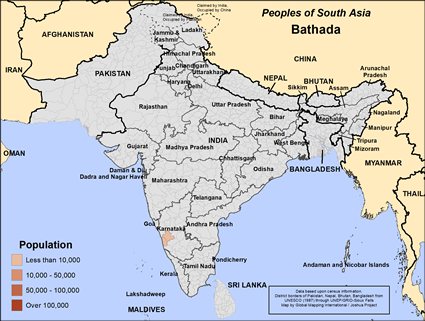
Map Source:
People Group data: Omid. Map geography: UNESCO / GMI. Map Design: Joshua Project
|
| People Name: | Bathada |
| Country: | India |
| 10/40 Window: | Yes |
| Population: | 3,200 |
| World Population: | 3,200 |
| Primary Language: | Kannada |
| Primary Religion: | Hinduism |
| Christian Adherents: | 0.00 % |
| Evangelicals: | 0.00 % |
| Scripture: | Complete Bible |
| Ministry Resources: | Yes |
| Jesus Film: | Yes |
| Audio Recordings: | Yes |
| People Cluster: | South Asia Dalit - other |
| Affinity Bloc: | South Asian Peoples |
| Progress Level: |

|
Introduction / History
The Bathada are a small Kannada-speaking community living primarily in the Indian state of Karnataka in southern India. They are part of the broader social landscape of rural South India, where caste identity, village traditions, and family networks continue to shape everyday life. Historical information about the Bathada is limited, and much of their background has likely been preserved through oral tradition and local community memory rather than written historical records.
Most Bathada communities are found in rural settings where agriculture and village labor have long formed the basis of economic life. Like many smaller communities in India, they have experienced gradual social change through modernization, migration, expanded education, and exposure to media and urban culture. Despite these changes, traditional family structures and social customs remain important within Bathada society.
The Bathada have had limited exposure to consistent evangelical Christian witness. While Christianity has existed in parts of Karnataka for generations, many Bathada families have never personally encountered clear biblical teaching or long-term discipleship.
What Are Their Lives Like?
The Bathada are predominantly rural and are closely connected to village life and agriculture. Farming, agricultural labor, and related manual work provide income for many families. Men and women both contribute significantly to household economic responsibilities, reflecting the practical demands of rural life in Karnataka.
Family life is important within Bathada society. Monogamous marriage is the norm, and marriages generally occur later than in previous generations. Divorce is permitted in cases of adultery or severe marital conflict. Families often seek to maintain relatively small household sizes compared to older generations.
Food habits among the Bathada differ somewhat from those of many Hindu communities because they are known for eating pork and are not traditionally vegetarian. Meals commonly include rice, lentils, vegetables, spicy curries, and locally available meat dishes. Community gatherings, local festivals, and family celebrations remain important parts of social life.
Radio and media have historically played an important role in communication and entertainment among the Bathada. Increased access to mobile phones, television, and internet services is gradually reshaping younger generations and exposing rural communities to wider cultural influences.
What Are Their Beliefs?
The Bathada are primarily Hindu. Their religious life includes temple worship, observance of Hindu festivals, family rituals, and devotion to Hindu gods and goddesses. Religion is closely connected to family identity, village tradition, and cultural belonging.
Like many rural Hindu communities in South India, spiritual life may also include folk religious practices, local deities, ritual offerings, and beliefs concerning blessing, protection, curses, and unseen spiritual forces. Religious customs are often woven into major life events such as marriage, childbirth, harvest celebrations, and funerals.
Very few known believers exist among the Bathada. Many have never heard a clear biblical explanation of sin, salvation, grace, and forgiveness through Jesus Christ alone. Social pressure and fear of disrupting family relationships can make conversion to Christianity difficult.
What Are Their Needs?
The Bathada need greater access to the gospel in the Kannada language through evangelism, Scripture resources, radio ministry, and long-term discipleship. Because they are known to value radio and media communication, gospel-centered audio programs and digital resources may provide meaningful opportunities for outreach.
Practical needs also remain important in many rural Bathada communities. Economic instability, healthcare access, educational opportunity, and employment challenges affect many families, especially in poorer agricultural areas. Younger generations increasingly face uncertainty as traditional village life changes under modernization and migration pressures.
The Bathada would benefit from compassionate Christian ministry that combines biblical teaching with practical care, literacy support, medical assistance, and community development. Mature Kannada-speaking believers willing to build long-term relationships among them are greatly needed.
Prayer Points
Pray that the Bathada people would hear the gospel clearly through personal witness, radio ministry, and Scripture resources in the Kannada language.
Pray that God would raise up faithful Christian workers who are willing to serve among the Bathada with humility, wisdom, and perseverance.
Pray that the Bathada would be adopted through the People Group Adoption program so they receive sustained prayer, ongoing gospel engagement, and future discipleship efforts.
Pray that believers throughout Karnataka would grow bold in sharing the truth of Christ with the Bathada and neighboring rural communities.