Bhin in India

Send Joshua Project a photo
of this people group. |
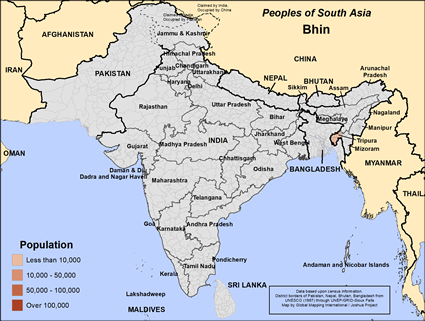
Map Source:
People Group data: Omid. Map geography: UNESCO / GMI. Map Design: Joshua Project.
|
| People Name: | Bhin |
| Country: | India |
| 10/40 Window: | Yes |
| Population: | 1,500 |
| World Population: | 1,500 |
| Primary Language: | Bengali |
| Primary Religion: | Hinduism |
| Christian Adherents: | 8.15 % |
| Evangelicals: | 0.00 % |
| Scripture: | Complete Bible |
| Ministry Resources: | Yes |
| Jesus Film: | Yes |
| Audio Recordings: | Yes |
| People Cluster: | South Asia Hindu - other |
| Affinity Bloc: | South Asian Peoples |
| Progress Level: |

|
Introduction / History
The Bhin are a Bengali-speaking people group found primarily in the northeastern Indian state of Tripura. Little has been recorded about their origins or historical development, and they remain one of the lesser-known communities of the region. Tripura has long been a crossroads of ethnic groups, languages, and religious traditions, and the Bhin have developed within this diverse cultural environment.
Although information about their history is limited, the Bhin have maintained a distinct identity while living among larger populations influenced by Hinduism and other regional traditions. Their language and location connect them to the broader Bengali-speaking world, yet they remain a separate people group with their own spiritual and social identity.
What Are Their Lives Like?
Because little research has been conducted among the Bhin, details about their daily lives are limited. However, as a Bengali-speaking people group living in Tripura, they likely share some characteristics with other small rural communities in the region.
Agriculture plays an important role throughout Tripura, and many families depend on farming, seasonal labor, or local trade to support their households. Daily life often revolves around family responsibilities, community relationships, and the changing seasons. Close-knit family networks provide support and help preserve traditions from one generation to the next.
Rice is a staple food throughout the region and is commonly eaten with vegetables, fish, lentils, or locally available meats. Meals often serve as important opportunities for families to gather and strengthen relationships.
Community celebrations and religious festivals are significant parts of life in Tripura. Such occasions bring families and neighbors together, reinforcing social bonds and shared values. While the specific customs of the Bhin are not well documented, community life is likely shaped by similar patterns of family, tradition, and local celebrations.
What Are Their Beliefs?
The Bhin primarily follow an ethnic religion influenced by both animistic beliefs and Hindu traditions. They place trust in spiritual forces that they believe are active throughout the natural world and capable of affecting daily life.
Ancestor veneration is an important aspect of their faith. Many believe that deceased family members continue to exist in the spirit realm and should be honored through rituals and offerings. Maintaining a proper relationship with these spirits is often viewed as essential for protection, blessing, and well-being.
Like many traditional communities in northeastern India, the Bhin often view spiritual realities as closely connected to everyday concerns. Health, prosperity, relationships, and misfortune may all be understood through a spiritual lens.
Over time, Hindu beliefs and practices have also shaped their worldview. Concepts such as karma, reincarnation, and devotion to various deities may influence how they understand life, death, and the spiritual realm. Although the Bhin are deeply spiritual people, few have had the opportunity to hear a clear presentation of the gospel or learn about the hope found in Jesus Christ.
What Are Their Needs?
The Bhin face both practical and spiritual challenges. Limited information is available regarding their educational, economic, and healthcare circumstances, making it difficult to fully understand the issues affecting their communities. Additional research and meaningful relationships would help identify opportunities to serve them more effectively.
Access to Scripture, Christian discipleship, and long-term gospel witness remains extremely limited. Greater opportunities to encounter the message of Christ in culturally understandable ways would help the Bhin hear and respond to the good news of the gospel. Faithful workers, prayer support, and sustained ministry efforts could play an important role in making Christ known among this small and often overlooked people group.
Prayer Points
Pray that the Bhin will have opportunities to hear and understand the gospel in ways that connect with their language and culture.
Pray that soon Bhin disciples will make more disciples.
Ask the Lord of the harvest to send faithful workers who will build meaningful relationships among the Bhin and share the love of Christ.
Ask the Holy Spirit to draw Bhin families and community leaders to faith in Jesus Christ and to transform their communities through his power.
Pray that the Bhin will come to know the one true God and Jesus Christ whom he has sent (John 17:3).
Ask God to open many hearts to receive his word and respond to the gospel with faith.
Ask the Lord to send laborers into the harvest among the Bhin so that many will hear the good news of Jesus Christ.