Bajikar (Muslim traditions) in India

Send Joshua Project a photo
of this people group. |
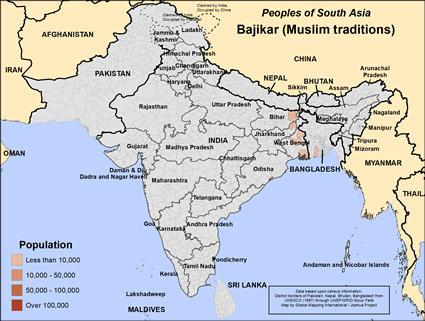
Map Source:
People Group data: Omid. Map geography: UNESCO / GMI. Map Design: Joshua Project
|
| People Name: | Bajikar (Muslim traditions) |
| Country: | India |
| 10/40 Window: | Yes |
| Population: | 2,400 |
| World Population: | 2,400 |
| Primary Language: | Bengali |
| Primary Religion: | Islam |
| Christian Adherents: | 0.00 % |
| Evangelicals: | 0.00 % |
| Scripture: | Complete Bible |
| Ministry Resources: | Yes |
| Jesus Film: | Yes |
| Audio Recordings: | Yes |
| People Cluster: | South Asia Muslim - other |
| Affinity Bloc: | South Asian Peoples |
| Progress Level: |

|
Introduction / History
The Bajikar (Muslim traditions) are a traditionally nomadic community found mainly in northern India, especially in states such as Punjab, Haryana, Rajasthan, Uttar Pradesh, and nearby regions. The name "Bajikar" is linked to performance and entertainment skills, reflecting their historical role as traveling acrobats, animal trainers, magicians, musicians, and entertainers. Over generations, some Bajikar communities adopted Islam while retaining aspects of older cultural traditions and social structures.
Historically, the Bajikar traveled from village to village performing acrobatic feats and other forms of entertainment in exchange for food, money, or goods. Their mobile lifestyle set them apart socially from settled agricultural communities. As modernization, urbanization, and new forms of entertainment spread throughout India, many Bajikar gradually abandoned nomadic life and settled in permanent communities.
Many Bajikar communities have experienced social marginalization and economic hardship for generations. In some regions they have been viewed as socially low-status or associated with wandering occupations that brought little stability or political influence. Their oral traditions, clan structures, and strong community ties nevertheless helped preserve a distinct identity.
Among the Muslim Bajikar, Islamic identity is blended with older folk customs and local traditions shaped by centuries of interaction with surrounding Hindu and Muslim populations. Christian witness among them has remained very limited, and many have never heard a clear explanation of the gospel.
What Are Their Lives Like?
Most Bajikar families today live in settled villages, roadside communities, or poorer urban areas rather than maintaining a fully nomadic lifestyle. Many work as agricultural laborers, day workers, street vendors, mechanics, animal traders, drivers, entertainers, or in small informal businesses. Economic insecurity remains common in many Bajikar communities.
Family and clan relationships are important within Bajikar society. Marriages are often arranged within the community, and elders continue to play a major role in resolving disputes and preserving tradition. Oral storytelling, music, and performance traditions remain valued parts of their cultural identity even though fewer families now depend on entertainment as their primary livelihood.
Food commonly includes flatbreads, lentils, rice, vegetables, tea, and regional meat dishes when affordable. Hospitality and loyalty to family are highly valued. In poorer communities, access to education, healthcare, and stable employment may be limited, especially for women and children.
Many Bajikar communities continue to face social stigma connected to their historical nomadic identity. Younger generations increasingly seek education and wage labor opportunities, creating tension between preserving traditional identity and adapting to modern economic realities.
What Are Their Beliefs?
The Bajikar (Muslim traditions) are primarily Sunni Muslims, but many continue to practice forms of folk Islam mixed with older traditional beliefs and customs. Religious life may include devotion at local shrines, respect for spiritual leaders, belief in protective rituals, and fear of curses or unseen spiritual forces.
Like many marginalized Muslim communities in South Asia, religion is often shaped by local tradition as much as by formal Islamic teaching. Spiritual healing practices, charms, ritual prayers, and shrine-centered devotion may all play a role in community religious life. This syncretistic blend of Islam and folk belief continues to influence many Bajikar families.
Religious identity is closely connected to family and community belonging, which can make conversion to Christianity socially difficult. Very few known believers exist among the Bajikar (Muslim traditions), and access to biblical teaching, discipleship, and Christian fellowship remains extremely limited.
What Are Their Needs?
The Bajikar (Muslim traditions) need clear access to the gospel in culturally understandable ways and in the languages they use daily. Many have little understanding of Jesus Christ or the biblical message of salvation. Long-term Christian witness rooted in humility, compassion, and perseverance is greatly needed.
Practical needs are also significant. Many Bajikar communities face poverty, social exclusion, limited educational opportunity, unstable employment, and inadequate healthcare access. Children may leave school early to support their families financially, and some communities continue to struggle with discrimination tied to their historical nomadic background.
The Bajikar would benefit from Scripture resources, oral Bible teaching, literacy efforts, vocational support, medical outreach, and mature believers willing to build long-term relationships within their communities. Compassionate ministry that addresses both spiritual and practical needs may help open doors for meaningful gospel engagement.
Prayer Points
Pray that the Bajikar (Muslim traditions) would hear the gospel clearly and come to trust in Jesus Christ alone for salvation.
Pray that God would raise up faithful Christian workers who are willing to serve among the Bajikar with wisdom, humility, and perseverance.
Pray that the Bajikar (Muslim traditions) would be adopted through the People Group Adoption program so they receive sustained prayer, ongoing gospel engagement, and future discipleship efforts.
Pray that believers living among Muslim communities in northern India would grow bold in sharing the truth of Christ with the Bajikar and neighboring peoples.