Kota Marudu Tinagas in Malaysia
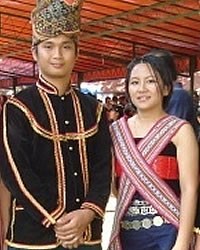
Photo Source:
MySabah.com
Used with permission
|
Send Joshua Project a map of this people group.
|
| People Name: | Kota Marudu Tinagas |
| Country: | Malaysia |
| 10/40 Window: | Yes |
| Population: | 3,300 |
| World Population: | 3,300 |
| Primary Language: | Kadazan Dusun |
| Primary Religion: | Ethnic Religions |
| Christian Adherents: | 22.00 % |
| Evangelicals: | 5.00 % |
| Scripture: | Complete Bible |
| Ministry Resources: | Yes |
| Jesus Film: | Yes |
| Audio Recordings: | Yes |
| People Cluster: | Borneo-Kalimantan |
| Affinity Bloc: | Malay Peoples |
| Progress Level: |

|
Introduction / History
The Kota Marudu Tinagas are an indigenous Dusunic people of northern Sabah in Malaysian Borneo, centered in and around Kota Marudu District. They belong to the wider Kadazan-Dusun world, but they are recognized as a distinct local speech community and ethnic branch rather than simply a generic Dusun subgroup. Their language is Kota Marudu Tinagas, a Dusunic Austronesian language of Sabah. Linguistic sources treat it as a distinct Sabah language, and even ISO documentation has specifically named Kota Marudu Tinagas in classification discussions, which confirms that this is not just a casual label but a recognized ethnolinguistic identity.
Historically, they are part of the long-rooted interior and near-interior peoples of northern Sabah whose identity grew through village settlement, kin networks, and local customary life rather than through large centralized political structures. Public historical material focused narrowly on the Kota Marudu Tinagas themselves is limited, so it is best to place them within the broader Kota Marudu setting and the wider Dusunic heritage rather than overstate details that are not well documented. The district itself has long been home to multiple Dusun-related communities, and published district summaries explicitly list Tinagas among the local indigenous groups of the area.
What Are Their Lives Like?
The Kota Marudu Tinagas are best understood as a rural or semi-rural Sabah community whose life is shaped by village ties, family obligations, and the agricultural rhythms of northern Sabah. Because they are associated with Kota Marudu District rather than a major urban center, daily life likely remains more community-based than city-driven. In this part of Sabah, extended family and local social ties often play a major role in marriage, work, celebrations, and mutual support. Public descriptions of Dusun life in Kota Marudu highlight a strong pattern of cooperation in communal events and shared labor, which fits the broader setting in which the Tinagas live.
Their livelihoods are likely tied to the practical patterns common in Kota Marudu: farming, local trade, and some mixed rural employment. The district is known for agriculture, and broader reporting on Kota Marudu Dusun communities describes involvement in crops, fisheries, animal husbandry, business, and public-sector work. Meals in such communities commonly center on rice, vegetables, root crops, fish where available, and other locally accessible foods. Recreation and celebrations are usually communal rather than commercial—family gatherings, harvest-related events, church activities where Christianity is present, music, and village festivities. Their language remains an important local identity marker, even though Sabah Malay and other wider languages are commonly used beyond the immediate community.
What Are Their Beliefs?
The Kota Marudu Tinagas are mostly identified as Christian, and they should not be treated as a people with no gospel witness. There is already a meaningful Christian presence among them. At the same time, in Sabah's indigenous communities, older spiritual assumptions and customary beliefs can sometimes remain influential beneath outward Christian identity. Where that happens, the need is not simply more exposure to Christianity but deeper repentance, stronger biblical understanding, and wholehearted trust in Jesus Christ rather than inherited or blended religion.
Because there is already a substantial Christian base, the greatest spiritual issue is often maturity rather than first contact. Some may identify as Christian socially or historically while still needing sound discipleship, clear doctrine, and freedom from older fears or mixed loyalties. Scripture resources are reported as available in their language.
What Are Their Needs?
The Kota Marudu Tinagas need spiritually mature churches, faithful local leaders, and believers who know the gospel clearly rather than merely identifying with inherited Christianity. Since there is already a Christian witness among them, the deeper need is for strong discipleship, sound teaching, and families shaped by repentance, holiness, and confidence in Christ rather than nominal religion or lingering syncretism.
They also likely face practical challenges common to smaller indigenous communities in northern Sabah. Better access to medical care, stronger schooling, reliable transportation, and stable local livelihoods can make a real difference when communities are spread between villages and small district centers. Even where a town like Kota Marudu provides some access, smaller surrounding communities can still feel the strain of limited services or uneven opportunity. Practical help matters, but it should strengthen—not replace—the need for healthy churches and enduring Christian witness.
Prayer Points
Pray that Kota Marudu Tinagas believers would grow in deep biblical faith and reject every form of nominal or blended Christianity.
Pray that the Lord would raise up faithful pastors, teachers, and spiritually strong families among them.
Pray for better access to medical care, education, transportation, and stable livelihoods in their communities.
Pray that Kota Marudu Tinagas Christians would become a gospel force to other peoples in Borneo who still lack a clear witness to Christ.