Bororo in Brazil
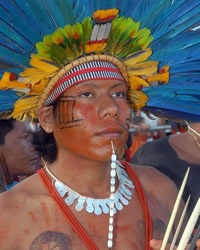
Photo Source:
Valter Campanato/Agência Brasil - Wikimedia
Creative Commons
|
Send Joshua Project a map of this people group.
|

| People Name: | Bororo |
| Country: | Brazil |
| 10/40 Window: | No |
| Population: | 1,700 |
| World Population: | 1,700 |
| Primary Language: | Bororo |
| Primary Religion: | Ethnic Religions |
| Christian Adherents: | 19.00 % |
| Evangelicals: | 4.00 % |
| Scripture: | New Testament |
| Ministry Resources: | Yes |
| Jesus Film: | Yes |
| Audio Recordings: | Yes |
| People Cluster: | Amazon |
| Affinity Bloc: | Latin-Caribbean Americans |
| Progress Level: |

|
Introduction / History
The Bororo people live in central Brazil, primarily in the state of Mato Grosso, where open savanna meets forest and river. For generations, their lives have been shaped by wide skies, seasonal movement, and strong collective identity. The Bororo language—distinct and expressive—has long carried their understanding of the world, community, and the unseen.
Historically, the Bororo maintained a structured and ceremonial society, ordered around clan relationships and ritual responsibilities. Contact with Brazilian society brought deep disruption—loss of land, altered livelihoods, and sustained pressure to assimilate. Yet the Bororo have not disappeared. Their identity endures, held together by memory, kinship, and a shared sense that life is shaped by forces larger than what can be seen.
What Are Their Lives Like?
Bororo community life is deliberate and relational. Families are closely connected, and individuals understand themselves as belonging first to the group rather than standing alone. Daily work—farming, fishing, gathering, or wage labor—unfolds within this web of relationships.
Much of life is communal. Decisions affect the whole, and milestones are marked together. Elders carry authority not by position alone but through knowledge—of tradition, of story, of what has sustained the people thus far. Children grow up learning who they are by participating in shared life, not by instruction alone.
Though daily routines have changed over time, the Bororo continue to value rhythm, continuity, and meaning. Life may look outwardly modest, but it is rich with memory and expectation.
What Are Their Beliefs?
Bororo spirituality is deeply rooted and continues to shape how life is understood. The world is believed to be ordered by spiritual forces that govern life, death, illness, and harmony. Rituals surrounding ancestry and the journey beyond death carry great weight, reflecting a profound concern for continuity and belonging beyond the present moment.
These beliefs are not symbolic remnants of the past but living faith—trust placed in spiritual systems believed to hold life together. At the same time, the name of Jesus Christ has reached Bororo communities. A minority have heard the gospel, and some have begun to follow Christ. This Christian presence is small, but it exists—and where it exists, it introduces a new way of understanding hope, forgiveness, and eternal life.
What Are Their Needs?
The Bororo stand at a meaningful crossroads. Material needs—healthcare, education, and stability—remain ongoing concerns. Yet beneath these lies a deeper spiritual longing: a desire for life that endures, for reconciliation beyond death, and for peace that does not fracture under fear.
Spiritually, the Bororo need the gospel to be proclaimed clearly and patiently. Many continue to trust in spiritual systems that speak powerfully about death but cannot offer resurrection, forgiveness, or restored relationship with God. Those Bororo who have begun following Christ need teaching, encouragement, and Scripture?rooted discipleship so their faith can grow strong within their own cultural setting. Their communities need believers who can carry hope forward in familiar language and trusted relationships.
Prayer Points
Pray that Bororo hearts will be stirred toward the hope found in Jesus Christ.
Ask God to strengthen the small gospel presence already among them.
Pray for clear communication of the gospel that honors Bororo identity and language.
Ask the Lord to raise up Bororo believers who will become faithful disciples and witnesses.
Pray that trust in spiritual systems would give way to confidence in Christ's saving work.