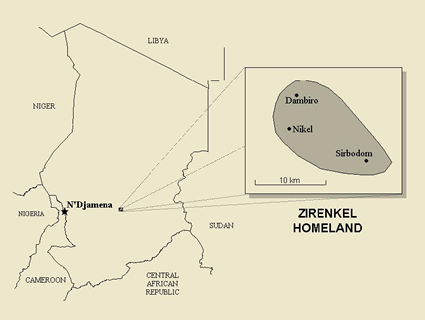
The Zirenkel are a small ethnic group living in the Guéra region of central Chad, especially near the Mongo subprefecture in villages such as Dambiro, Nikel, and Sirbodom. Their existence as a distinct language group was only identified relatively recently by outside researchers because they are surrounded by larger neighboring peoples and have often been overlooked in regional studies. The Zirenkel language belongs to the East Chadic branch of the Afro-Asiatic language family and is related to the Mubi language, though the two are not mutually understandable. Many Zirenkel are also bilingual in Chadian Arabic, Dadjo, or Dangaleat because of close interaction with neighboring groups.
Historical accounts indicate that the ancestors of the Zirenkel originally came from the Mangalmé area farther east before migrating westward into their present territory. Local Dadjo communities reportedly granted them land where several villages were established between Dadjo and Dangaleat regions. Over generations, the Zirenkel developed a distinct identity while maintaining close economic and social ties with neighboring peoples through trade, intermarriage, and shared agricultural life.
Because of their small population and isolation, the Zirenkel language and cultural identity face ongoing pressure from dominant regional languages and broader social assimilation. Younger generations increasingly use Chadian Arabic and surrounding languages in daily life, placing their traditional language at risk.
The Zirenkel live primarily as subsistence farmers in the dry savanna environment of central Chad. Their daily life closely resembles that of neighboring peoples in the Guéra region. Families cultivate crops suited to harsh climatic conditions, and agriculture remains central to survival and household stability. Seasonal rainfall patterns strongly affect farming success, food availability, and economic wellbeing.
Village life revolves around extended family relationships and community cooperation. Intermarriage with Dadjo, Dangaleat, and other neighboring peoples is common, helping maintain peaceful regional relationships while also increasing outside cultural influence on the Zirenkel. Homes are generally simple rural structures built from local materials, and most communities have limited infrastructure and access to modern services.
Life in central Chad can be physically difficult because of drought, poor roads, limited healthcare, and economic isolation. Many rural communities face challenges related to food insecurity, access to clean water, educational opportunity, and medical care. Oral tradition and close-knit social structures remain important for preserving identity and passing down cultural knowledge between generations.
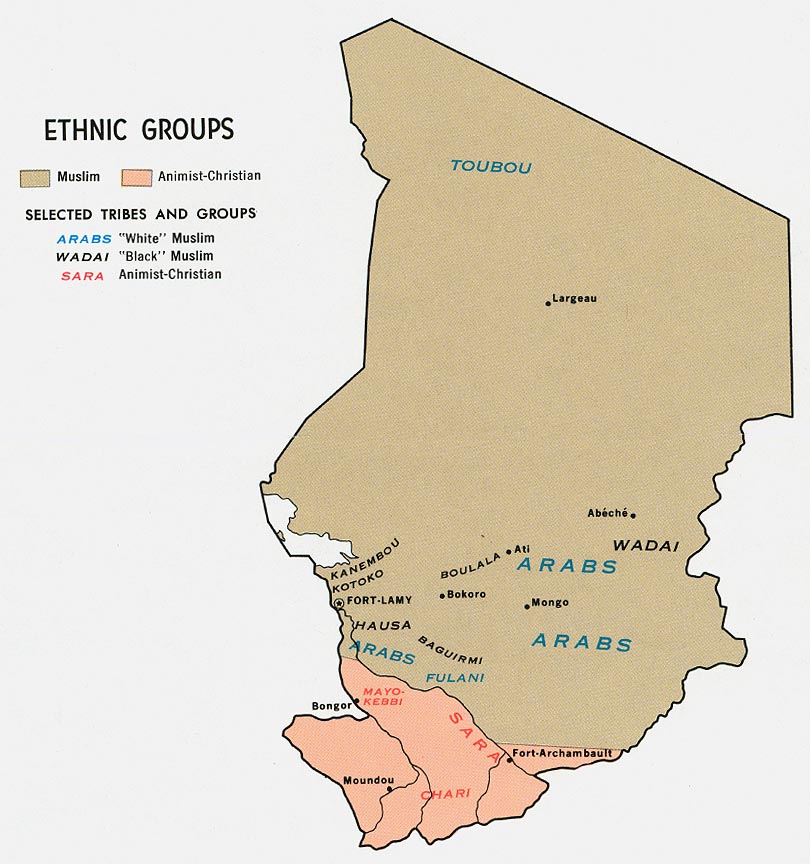
The Zirenkel are overwhelmingly Muslim, and Islamic identity shapes much of community life. Religious practices commonly include prayer, fasting during Ramadan, participation in mosque life, and observance of Islamic customs connected to family and community events. Islam spread throughout much of Chad over centuries through trade networks, regional kingdoms, and contact with Arabized populations.
As with many rural Muslim communities in Central Africa, traditional spiritual beliefs may also continue to influence daily life alongside formal Islamic practice. Fear of curses, spirits, unseen powers, or harmful supernatural influences can remain part of local thinking and spiritual behavior. Folk practices connected to protection, healing, or blessing may exist alongside Islamic identity, creating a syncretistic religious environment.
Very few Zirenkel have had meaningful exposure to biblical Christianity or a clear explanation of the gospel. They need to hear that forgiveness of sins and reconciliation with God come through Jesus Christ alone rather than through religious identity, rituals, or human effort.
The Zirenkel remain largely unreached with the gospel and have little known Christian presence among them. Their small population, remote location, and integration with neighboring Muslim peoples make sustained outreach difficult. There is a need for faithful Christian workers willing to learn their language and culture while building long-term relationships grounded in humility and compassion.
Practical needs are also significant. Rural communities in central Chad often struggle with limited healthcare access, food insecurity, inadequate education, economic hardship, and weak infrastructure. Drought and environmental pressures can further increase instability and poverty. Language preservation is another growing concern as younger generations increasingly shift toward dominant regional languages.
The Zirenkel need Scripture resources, biblical discipleship, and gospel teaching in forms they can clearly understand. Any believers among them would need encouragement, protection, and strong biblical grounding because of social pressure and isolation. Compassionate ministry that addresses both spiritual and practical needs can help demonstrate the love of Christ in meaningful ways.
Pray that the Zirenkel people will hear a clear presentation of the gospel and place their faith in Jesus Christ for salvation.
Pray that God will raise up faithful Christian workers who are willing to serve among the Zirenkel with wisdom, perseverance, and compassion.
Pray that the Zirenkel people will be adopted through the People Group Adoption program so that churches and believers will commit to sustained prayer and future gospel outreach among them.
Pray that any believers among the Zirenkel will grow strong in biblical truth and boldly share the hope of Christ with their families and neighboring communities.
Scripture Prayers for the Zirenkel in Chad.
https://en.wikipedia.org/wiki/Zirenkel_language
https://ru.wikipedia.org/wiki/%D0%97%D0%B8%D1%80%D0%B5%D0%BD%D0%BA%D0%B5%D0%BB%D1%8C
https://peoplegroups.org/country/tcd/
https://www.chad.wecinternational.org/unreached-peoples/
https://minorityrights.org/country/chad/
| Profile Source: Joshua Project |