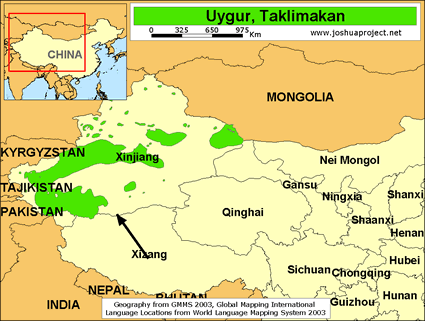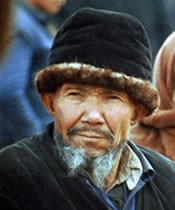

In early 1990 a Chinese oil exploration team came across a village of people living around an extremely remote oasis in the heart of the desert. They were described as having a "gentle culture, living primitive lives in extreme isolation." Experts discovered this tribe had been out of touch with the world for 350 years. "As a result, they ... knew nothing of the historical fact of the Qing Dynasty (China's last dynasty) or about anything else up to the present time."
We do not know why the ancestors of the Taklimakan Uygur fled deep into the desert three and a half centuries ago. It may have been to escape the marauding bandits who infested the area at the time. The Xinjiang authorities - never slow to spot a money-making opportunity - sold the rights to film the tribe to the London-based Third Eye Television. This will no doubt have a massive impact on this tribe which had never seen a machine or electric appliance before. They will probably be consumed into mainstream Uygur culture before too long.
At the time of their discovery, the Taklimakan Uygurs "told the time by the sun, had no form of government or authority structure, and no schools or writing system. They lived around an oasis, farming animals and growing crops for their existence."
Temperatures in the Taklimakan Desert are as harsh as anywhere in the world. Both work and family life are strongly shaped by their desert environment, Islamic traditions, and close-knit community structures. Daily life is often organized around sustaining the household and maintaining long-established cultural patterns.
Most Taklimakan Uygur are engaged in agriculture or pastoral activities adapted to oasis environments on the edge of the Taklimakan Desert. Families cultivate crops such as wheat, corn, cotton, and fruits where irrigation is possible. Water management is essential, and much of their labor is tied to maintaining irrigation systems and making efficient use of limited natural resources. In addition to farming, some households raise livestock, including sheep, goats, and camels, which provide both food and income.
Men typically bear primary responsibility for heavy agricultural work, trading, and interactions outside the village. Some may also engage in small-scale commerce, transporting goods or selling produce in local markets. Where available, a portion of the population may seek wage labor in nearby towns, though opportunities can be limited and often require travel or seasonal migration.
Women play a vital and active role in both family and economic life. In addition to managing the household, they frequently assist in agricultural labor, food preparation, and the care of animals. Women are also skilled in traditional crafts such as weaving, embroidery, and textile production, which can contribute to family income or serve important cultural purposes.
Family life among the Taklimakan Uygur is highly valued and typically extended in structure. Households often include multiple generations living together or in proximity. Respect for elders and strong family loyalty are central values, with elders playing an influential role in decision-making, marriage arrangements, and the preservation of cultural and religious traditions.
Marriage is considered an important institution, and families are closely involved in the process. Once married, individuals take on clearly defined roles within the household, contributing to both economic survival and family stability. Children are raised within a framework that emphasizes obedience, respect, and participation in family responsibilities from a young age.
Islam shapes many aspects of both work and family life. Daily routines may be organized around times of prayer, and religious teachings influence moral values, social relationships, and community expectations. Religious festivals and observances bring families together and reinforce both spiritual identity and social cohesion.
Despite their isolation, reports indicate that the Taklimakan Uygur were still Muslims when they were discovered.
The Taklimakan Desert is surrounded by the ancient Silk Road, which witnessed the arrival of Buddhism, Islam, and Christianity in China. At the Dunhuang oasis which skirts the desert, startled archaeologists in the early 1900s began to unearth hundreds of Nestorian Christian documents. Accessible by helicopter only, the Taklimakan Uygur are the epitome of an unevangelized people group.
The Taklimakan Uygur people need to accept the warm embrace of the only Savior so they can enjoy spiritually meaningful lives.
Pray for the authority of Christ to bind hindering spiritual forces to lead them from darkness to light.
Pray for signs and wonders to happen among them and for great breakthroughs with a rapid multiplication of disciples and house churches.
Pray for bold workers who are driven by the love of the Holy Spirit to go to them.
Pray for an unstoppable movement to Christ among them.
Scripture Prayers for the Uygur, Taklimakan in China.
Operation China, Asia Harvest, Copyrighted © Used with permission
| Profile Source: Joshua Project |