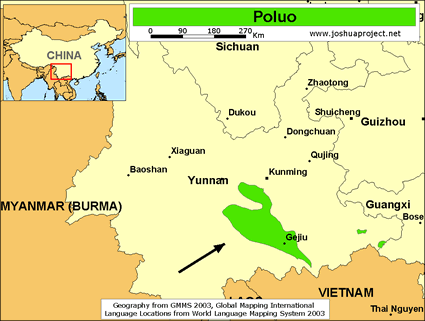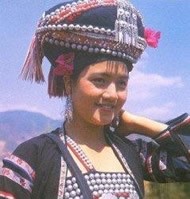

The Poluo are a small ethnic community living primarily in Yunnan Province in southwestern China, especially in and around the counties of Guangnan, Funing, and Xichou. They are officially classified by the Chinese government as part of the larger Yi nationality, but they maintain a distinct identity, language, and cultural heritage separate from neighboring groups. Their language belongs to the Tibeto-Burman branch of the Sino-Tibetan language family and is related to other Phula and Yi languages spoken throughout southern Yunnan and northern Vietnam.
Historically, the Poluo lived in remote mountain areas where difficult terrain and geographic isolation helped preserve their customs and language over many generations. Like many minority peoples of southwestern China, they developed through centuries of migration, tribal separation, and adaptation to mountain agriculture. Their communities remained relatively isolated from mainstream Han Chinese culture until modern transportation, education, and government integration policies increasingly reached rural Yunnan during the twentieth century.
Today, the Poluo remain a small and vulnerable minority population. Modernization, migration to urban areas, and the growing use of Mandarin Chinese place pressure on traditional language use and cultural continuity among younger generations.
Most Poluo families live in rural mountain villages where agriculture and livestock care shape daily life. Families commonly cultivate rice, corn, wheat, beans, and vegetables suited to the hilly terrain and subtropical climate of Yunnan. Livestock such as pigs, chickens, and cattle also contribute to household income and food supplies.
Village life is strongly centered around family and community relationships. Extended families often remain closely connected, and cooperation among neighbors is important during planting seasons, harvests, house building, and festivals. Traditional customs, songs, oral storytelling, and community ceremonies continue to hold importance in many villages.
Food commonly includes rice, corn, vegetables, preserved foods, chili peppers, and locally raised meat when available. Seasonal agricultural cycles still influence the rhythm of daily life in many rural communities. Traditional festivals often include singing, dancing, and ceremonies connected to ancestors and local customs.
Economic opportunities in isolated mountain areas can be limited. Some younger Poluo leave their villages for factory work or jobs in larger cities, while older generations remain connected to farming life. Remote communities may face difficulties related to transportation, healthcare access, education, and stable employment.
The Poluo traditionally practice animistic and folk religious beliefs centered on spirits, ancestors, and supernatural powers connected to nature and village life. Their worldview commonly includes fear of unseen spiritual forces believed to affect health, crops, fertility, and family well-being.
Traditional ceremonies and rituals are performed to seek protection, blessing, healing, or success in agriculture. Ancestor reverence remains important, and spiritual practices are closely tied to family identity and village traditions. Ritual specialists may be consulted during sickness, family crises, or important community events.
Because the Poluo live in regions influenced by both Chinese and Yi cultural traditions, elements of Chinese folk religion and local customs may also shape their spiritual practices. Religion is deeply woven into daily life rather than separated from ordinary community activities.
Very few Poluo have heard a clear biblical presentation of the gospel. Although there are Christians among some neighboring ethnic groups in Yunnan, many Poluo villages remain largely unreached with little access to biblical teaching, discipleship, or Christian resources in their own language.
The Poluo need faithful access to the gospel through Scripture, discipleship, audio resources, and compassionate Christian witness presented in culturally understandable ways. Many have never heard a clear explanation of salvation through Jesus Christ.
Practical needs include healthcare access, educational opportunities, transportation infrastructure, and economic development for isolated mountain communities. Language preservation is also becoming increasingly important as younger generations shift toward Mandarin Chinese and mainstream Chinese culture.
There is also a strong need for spiritually mature believers willing to build long-term relationships among the Poluo and establish biblically grounded churches free from syncretism with animistic traditions. Oral Bible teaching and translated Scripture resources would greatly strengthen future gospel outreach among them.
Pray that the Poluo people will hear a clear and understandable presentation of the gospel in their own language and cultural setting.
Pray that God will raise up compassionate Christian workers who are willing to serve faithfully among the Poluo communities of Yunnan Province.
Pray that the Poluo people will be adopted through the People Group Adoption program so that ongoing prayer and future gospel engagement will continue among them.
Pray that future believers among the Poluo will grow strong in biblical faith and faithfully share the truth of Jesus Christ with neighboring peoples.
Scripture Prayers for the Poluo in China.
https://people-groups.asiaharvest.org/China/
https://en.wikipedia.org/wiki/Yi_people
https://en.wikipedia.org/wiki/Languages_of_Yunnan
https://www.britannica.com/place/Yunnan
https://www.yn.gov.cn/yngk/zxyn/202112/t20211228_235154.html
| Profile Source: Joshua Project |