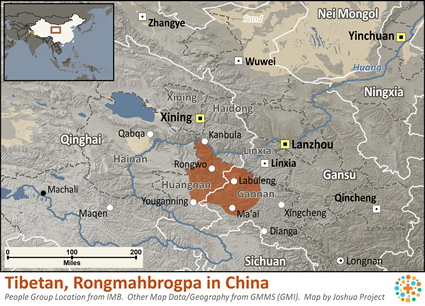

Although ethnically and culturally the Rongmahbrogpa belong to the Tibetan nationality, they speak a language that is distinct from other Tibetan varieties. The name Rongmahbrogpa is a combination of the Tibetan words Rongba (villager or farmer) and Brogpa (nomad or herder).
Rongmahbrogpa - which contains "two or more dialects" - is part of the Northern Bodic branch of Tibetan languages. Although they may not understand each other's speech, all Tibetans use the same written script. Tibetans from different areas can often be seen exchanging notes to communicate.
Most Rongmahbrogpa Amdo people are involved in a mix of agriculture and pastoral work. Families who live in valleys or more settled areas often cultivate crops suited to the high-altitude environment, while others tend herds of yaks, sheep, or goats on surrounding grasslands. Herding requires long hours outdoors and a deep knowledge of seasonal patterns, grazing areas, and animal care. In some cases, families may move seasonally with their animals, while others remain in more permanent villages and combine farming with livestock management. Work is typically shared among family members, with men often responsible for herding and field labor, while women help with milking animals, processing dairy products, preparing food, and managing the household.
Their work extends beyond basic survival. Animal products such as butter, milk, wool, and meat are essential not only for daily use but also for trade in local markets. Farming and herding are labor-intensive, requiring persistence and cooperation within extended families. Life is shaped by the natural environment, with weather and terrain playing a major role in determining the rhythm of their work.
Recreational activities among the Rongmahbrogpa Amdo are closely tied to their spiritual and community life rather than being separated as individual leisure pursuits. Religious practices themselves often form an important part of daily and seasonal rhythms.
Socially, recreation tends to center on community interaction and shared experiences. People may gather for conversation, storytelling, or participation in religious festivals and local events. These gatherings provide opportunities to strengthen relationships and maintain cultural traditions. Music, oral storytelling, and traditional celebrations are likely important expressions of identity, especially during festivals or seasonal occasions.
In addition, market days, religious observances, and pilgrimages to important Buddhist sites can serve as times of both social and recreational engagement. These events bring families and communities together, offering relief from the demands of daily labor while reinforcing shared beliefs and cultural unity.
Outwardly the Amdo are Tibetan Buddhists, but the ancient Bon religion has experienced growth in recent years. Bon was characterized by shamans, whose job was to "present the sacrifices, appease the spirits with magic, heal the sick, and even control the weather. The shaman specialized in a kind of ecstatic trance that let him travel to the spirit world and serve as a medium for the ghosts of the dead. In addition to the shamans there were also magicians and healers who had the power to control gods, demons and locality spirits." The Tibetan prayer wheel, or manichorkor, can be turned by hot air, hand, wind, or water. As it spins, the scroll contained in the cylinder is believed to release prayers to the heavens.
The Christian and Missionary Alliance church opened a mission base in the town of Xiahe in the early 1920s. They made little progress against the Buddhist stronghold. One wrote, "The main difficulties as they appear to me are: The food question. The food of the Tibetans is such that for a foreigner it is very hard to partake of, and still harder to digest, yet the itinerating missionary in this district has to eat it, for if he does not, he greatly offends his host and gets no opportunity to preach the gospel." The JESUS Film was translated into Amdo in 1998.
Without the guidance of Christ, these people are like sheep without a shepherd. They need the good shepherd in their families and communities.
Pray for the spiritual blindness and bondage to the evil one to be removed so they can understand and respond to Christ.
Pray for the Lord to provide for their physical and spiritual needs as a testimony of his power and love.
Pray that the Rongmahbrogpa Amdo people will have a spiritual hunger that will open their hearts to the King of kings.
Pray for an unstoppable movement to Christ among them.
Scripture Prayers for the Amdo, Rongmahbrogpa in China.
Operation China, Asia Harvest, Copyrighted © Used with permission
| Profile Source: Joshua Project |