


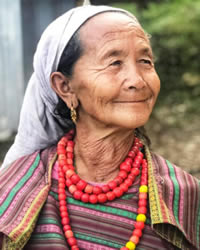

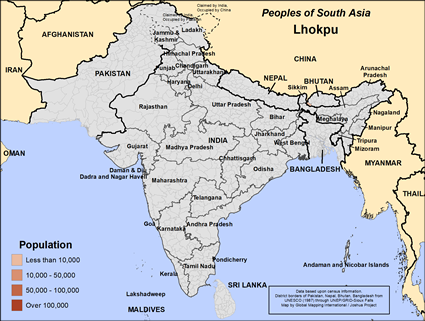
The Lhokpu are one of the oldest known indigenous peoples of Bhutan and are believed by many scholars to represent part of the aboriginal population of western Bhutan. They live primarily in the southwestern districts of Samtse and Chukha near the Indian border. The people are also known as the Lhop or Doya, and they speak the Lhokpu language, a rare and distinctive Sino-Tibetan language that is not closely related to Bhutan's dominant languages. Their language and culture have remained relatively isolated because of the rugged mountain terrain and limited outside contact.
Historically, the Lhokpu lived in small hill communities dependent on agriculture, forest resources, and close family cooperation. Their traditions differ noticeably from the Tibetan Buddhist culture dominant in much of Bhutan. Scholars have noted that the Lhokpu preserve ancient customs and social structures that may predate later Tibetan influence in the region. Their society has traditionally been matrilineal, with inheritance and family identity often traced through the mother's side of the family.
Today, the Lhokpu remain a very small and vulnerable minority community. Their language and cultural traditions face increasing pressure from modernization, migration, and the spread of dominant regional languages.
Most Lhokpu families live in rural hill villages where farming remains central to daily life. Agriculture is difficult because of the steep terrain and changing mountain climate, but families cultivate crops such as rice, maize, millet, and vegetables. Livestock raising and forest gathering also help support village life. In remote areas, daily routines often revolve around farming cycles, caring for animals, gathering firewood, and maintaining homes and fields.
Family and clan relationships are very important within Lhokpu society. Their traditional matrilineal customs differ from many surrounding cultures, and extended family networks remain central to social and economic life. Villages tend to be tightly connected communities where cooperation is necessary for survival and agricultural work.
Food commonly includes rice, maize, vegetables, chili peppers, dairy products, and locally available meat. Traditional homes are built to suit the mountainous environment and village lifestyle. Community gatherings, seasonal festivals, and ceremonies tied to agriculture and family life remain important aspects of their culture.
Economic opportunities are limited in many Lhokpu areas. Access to healthcare, advanced education, transportation, and employment can be difficult in isolated mountain communities. Younger generations may leave villages in search of work or schooling, which can weaken traditional language use and cultural continuity.
The Lhokpu traditionally practice a blend of Tibetan Buddhism and animistic folk religion. While many identify with Buddhism, older indigenous beliefs involving spirits, sacred natural places, ancestral customs, and ritual protection remain influential in community life.
Religious practices may include ceremonies performed to seek protection from harmful spirits, blessings for crops and livestock, healing from sickness, and guidance during times of difficulty. Sacred mountains, forests, and natural locations often carry spiritual significance. Ritual specialists and traditional practices may still hold influence in some villages.
Unlike mainstream Bhutanese Buddhist customs, the Lhokpu have historically buried their dead rather than cremating them. Certain traditional burial practices and ancestral customs continue to distinguish them from neighboring populations.
Very few Lhokpu have heard a clear biblical explanation of the gospel. Christian resources in the Lhokpu language are extremely limited, and many have never encountered biblical teaching about salvation through Jesus Christ.
The Lhokpu need faithful access to the gospel through Scripture translation, audio resources, discipleship, and compassionate Christian witness presented in culturally understandable ways. Because many communities are remote and oral in communication style, personal relationships and spoken communication are especially important for ministry.
Practical needs include healthcare access, educational opportunities, transportation infrastructure, and economic support for isolated rural families. Communities also face challenges related to language preservation and cultural pressure from dominant surrounding populations.
There is a great need for spiritually mature believers willing to serve patiently among the Lhokpu and help establish biblically grounded discipleship and local churches. The development of Christian resources in the Lhokpu language would greatly strengthen future gospel outreach.
Pray that the Lhokpu people will hear a clear and understandable presentation of the gospel in their own language.
Pray that God will raise up compassionate Christian workers who are willing to serve faithfully among the remote Lhokpu communities of Bhutan.
Pray that the Lhokpu people will be adopted through the People Group Adoption program so that ongoing prayer and future gospel engagement will continue among them.
Pray that God will provide Scripture resources, discipleship tools, and faithful local believers who can help establish strong biblical foundations among the Lhokpu people.
Scripture Prayers for the Lhokpu in Bhutan.
https://en.wikipedia.org/wiki/Lhop_people
https://en.wikipedia.org/wiki/Lhokpu_language
https://www.drukasia.com/blog/interesting-facts-about-the-bhutanese-languages/
https://wikitongues.org/languages/lhp/
https://en.wikipedia.org/wiki/Languages_of_Bhutan
| Profile Source: Joshua Project |



