


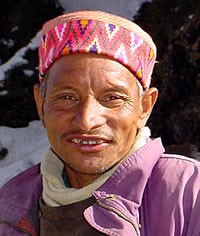

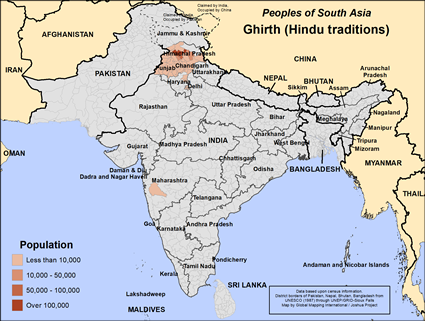
The Ghirth, also known as Ghirath, Ghrit, Bahri, Bahti, Chang, or Chaudhary in some regions, are an agricultural Hindu community found mainly in the state of Himachal Pradesh in northern India, especially in Kangra, Hamirpur, Una, and Bilaspur districts. Smaller populations also live in neighboring states such as Punjab, Jammu and Kashmir, Haryana, and Delhi. The name "Ghirth" is traditionally linked to agriculture and animal husbandry, and some community traditions connect the name to the Sanskrit word ghrita meaning "ghee," reflecting their historic connection to cattle raising and farming.
Historically, the Ghirth were one of the major cultivating communities of the lower Himalayan region. Although traditionally regarded as a lower but "clean" caste within the regional social order, they became an important agricultural population in Himachal Pradesh. In earlier centuries many Ghirth families worked as small farmers, tenant cultivators, and agricultural laborers under the dominance of Rajput landowners and higher-caste elites. Over time, the community organized socially and politically to improve its standing and resist humiliating caste restrictions.
Oral traditions within the community vary. Some Ghirth trace their ancestry to ancient sages or to Kshatriya and Rajput origins, while others emphasize their long-standing identity as the agrarian people of the Kangra region. Their history reflects the broader social changes of Himachal Pradesh, where farming communities gradually gained greater political influence during the twentieth century. Today, the Ghirth are considered one of the significant Other Backward Class communities in Himachal Pradesh.
The Ghirth are traditionally farmers and cattle keepers. Agriculture remains central to the lives of many families, especially in rural Himachal Pradesh where terraced farming is common because of the hilly terrain. Families cultivate crops such as wheat, maize, rice, barley, vegetables, and pulses depending on elevation and local climate. Animal husbandry, especially cattle and buffalo raising, has historically been an important source of milk, ghee, labor, and income.
Village life usually centers around extended family relationships, local traditions, and close community cooperation. Men commonly work in agriculture, transportation, labor, or government employment, while women contribute heavily to farming, livestock care, household management, and food preparation. In mountain regions, women often carry significant physical workloads connected with farming, gathering fodder, collecting firewood, and maintaining the household.
Marriage customs generally follow Hindu traditions and are often performed by Brahmin priests according to Vedic rites. Weddings remain important social occasions involving extended family and community participation. Traditional ceremonies may include circling a sacred fire or symbolic sacred tree as part of the marriage ritual.
Education and government employment have increased among younger generations, and many Ghirth families now live in towns and cities or work in business, education, transport, military service, and government sectors. Even so, many rural families still face economic pressures tied to small landholdings, changing agricultural conditions, unemployment, and migration away from villages.
The Ghirth are Hindus, and Hindu beliefs strongly shape family and community life. Religious practices commonly include temple worship, household rituals, observance of Hindu festivals, pilgrimages, and devotion to gods such as Shiva, Durga, Krishna, Hanuman, and regional Himalayan deities. Religious life in Himachal Pradesh often combines mainstream Hindu traditions with strong local village customs and folk practices.
Many Ghirth communities also maintain folk religious beliefs involving local gods, ancestral traditions, blessings, curses, astrology, ritual purity, and protective spiritual practices. In the Himalayan regions, village deities and local shrines frequently hold an important place in community identity and seasonal festivals. Religious observance is often closely connected to agriculture, family wellbeing, and local cultural tradition.
Like many Hindu communities, religious identity is tied closely to family lineage, caste identity, and social belonging. Ritual observance and participation in festivals are often viewed as essential parts of maintaining social harmony and spiritual wellbeing.
Although there has been some Christian presence among the Ghirth, many still have little understanding of the biblical gospel. Some may see Christianity as foreign or disconnected from traditional community identity. They need to hear clearly that forgiveness of sins and reconciliation with God come through Jesus Christ alone rather than through rituals, caste identity, karma, or inherited religion.
The Ghirth have greater exposure to Christianity than many other Indian communities, but large numbers still remain without clear biblical teaching or strong discipleship. In areas where believers exist, there is still need for mature biblical leadership, sound teaching, and discipleship that is rooted firmly in Scripture rather than mixed with cultural religion.
Practical needs vary between rural and urban communities. Many farming families continue to face challenges connected to small landholdings, unstable agricultural income, debt burdens, healthcare access, and limited employment opportunities for younger generations. Mountain agriculture can be physically demanding and highly dependent on weather conditions. Migration to cities has also created social and economic pressures within traditional family structures.
The Ghirth speak several regional languages and dialects, which can create challenges for Christian ministry and discipleship efforts. Scripture resources, Bible teaching, and discipleship materials are needed in forms that are understandable and culturally accessible. Oral teaching, relationship-centered ministry, and strong local fellowships may all help strengthen believers and expand gospel witness among the Ghirth community.
Pray that the Ghirth people will hear a clear presentation of the gospel and place their faith in Jesus Christ for salvation.
Pray that Ghirth believers will grow strong in biblical truth and faithfully disciple others within their families and communities.
Pray that the Ghirth people will be adopted through the People Group Adoption program so that churches and believers will commit to sustained prayer and future gospel outreach among them.
Pray that God will raise up wise and compassionate Christian workers who can serve among the Ghirth with humility, perseverance, and sound biblical teaching.
Scripture Prayers for the Ghirth (Hindu traditions) in India.
https://en.wikipedia.org/wiki/Ghirth
https://hpgeneralstudies.com/caste-system-himachal-pradesh/
https://civilstaphimachal.com/quizbase/castes-of-himachal-march-30-2022/
https://www.reddit.com/r/SouthAsianAncestry/comments/1nq9vqt/what_could_be_the_ancestory_of_ghirath_caste_of/
https://en.wikipedia.org/wiki/Kanet
| Profile Source: Joshua Project |



