


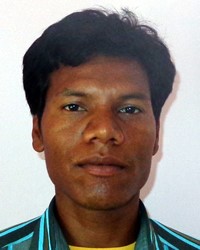

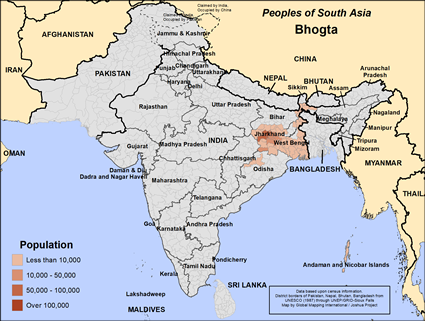
According to their traditional beliefs, the Bhogta emerged from a union of religious preachers and tribal women. The children from these unions became the Bhogta, most of whom now live in India's eastern states of Jharkhand, West Bengal, Odisha and Bihar. The Bhogta were traditionally farmers, though they also made rope, cots and parched rice for a living.
The Bhogta of India are primarily a rural people, and their daily lives are closely tied to the land and seasonal rhythms. Most Bhogta families depend on agriculture as their principal means of livelihood. They commonly engage in subsistence farming, cultivating crops such as rice, wheat, pulses, and vegetables, depending on the region in which they reside. In addition to farming their own small plots, some Bhogta men and women work as agricultural laborers on the fields of larger landowners, especially during planting and harvest seasons. Animal husbandry may also supplement their income, with families keeping goats, cattle, or poultry for milk, meat, or trade. In times when agricultural work is scarce, some individuals seek wage labor in nearby towns or participate in seasonal migration to secure additional income. Some are day-laborers on tea plantations while others work in private and government services.
The work of the Bhogta is typically shared among family members. Men often take responsibility for plowing fields, tending crops, and engaging in heavier labor, while women contribute significantly through planting, weeding, harvesting, and managing the household. Women also care for children, prepare food, and collect firewood and water, forming an essential part of the community's economic and social stability. Children often assist their parents with chores from a young age, learning the skills necessary for adulthood through observation and participation.
Recreational life among the Bhogta is simple and community oriented. Leisure activities are often woven into the fabric of village life rather than existing as separate pursuits. Social gatherings provide opportunities for relaxation and enjoyment, particularly during festivals, weddings, and religious celebrations. These events frequently include traditional music, singing, and dancing, which play an important role in preserving cultural identity and strengthening communal bonds. Storytelling and informal conversations are common evening pastimes, especially after the day's labor is complete.
Traditional games and outdoor activities may also be enjoyed, particularly by children and young people. Men sometimes gather to discuss village matters or share news, while women may socialize as they complete shared tasks such as fetching water or working in the fields. Religious observances and local fairs offer additional occasions for recreation, bringing together extended families and neighboring communities.
The Bhogta people practice Hinduism, the ancient religion of India. Hinduism is a catch-all term for the local religions of South Asia, so it is very diverse. At the popular level, Hindus worship and serve the gods of the Hindu pantheon. They visit Hindu temples and offer prayers, food, flowers, and incense to their gods in hopes of gaining protection and benefits. They do not have a personal or familial relationship with their gods like Christians or Jews. There are other Hindus who are much more philosophical, especially among the Brahmins.
Almost all Hindus participate in yearly celebrations like Holi, the festival of colors and the start of spring / Diwali, the festival of lights / Navratri, the celebration of autumn / and Rama Navami, Rama's birthday.
There are probably no Christ followers among the Bhogta. Who will go to them?
Pray for believers to develop special radio broadcasts for the Bhogta.
Pray for believers to provide ways for the Bhogta to obtain small business loans so they can find a way out of being day laborers.
May God be glorified, and his kingdom extended among the Bhogta.
The Bhogta usually speak Hindi, the most common language in northern India. There are all kinds of gospel materials in this major language. Pray for the Bhogta to find them and allow them to transform their lives.
References
Scripture Prayers for the Bhogta in India.
| Profile Source: Joshua Project |



