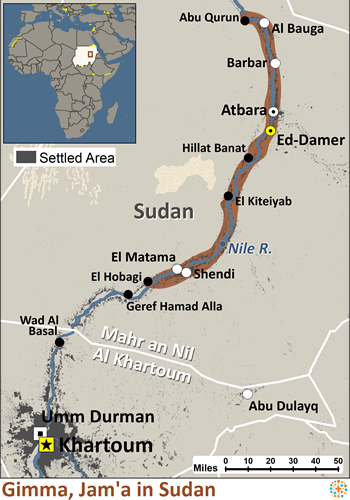

The Gimma, also called Jam'a or Jawam'a in some sources, are an Arabized Muslim people group living mainly in the Kordofan region of central Sudan, especially around El Obeid and surrounding rural areas. They are generally considered a subgroup of the larger Ja'alin or Ja'aliyin Arab cultural world, a major Arabized population in Sudan with deep historical influence across the country. The Gimma speak Sudanese Arabic and identify strongly with Arab and Islamic cultural traditions.
Very little detailed public research exists specifically about the Gimma themselves, which reflects the limited documentation available for many smaller Sudanese tribal groups. Oral history and tribal lineage remain important sources of identity within the community. Some Sudanese discussions identify the community as sedentary Arab farmers living mainly in eastern Kordofan between El Obeid, Bara, Tendalti, and Tegali.
Historically, communities in Kordofan developed within a harsh semi-arid environment where access to water, seasonal rainfall, farming land, and livestock routes shaped daily survival. The region became a crossroads between Arab migration, African tribal cultures, trade routes, and Islamic influence over many centuries. The process of Arabization in Sudan blended Arabic language and Islamic identity with older African ethnic roots, creating communities such as the Gimma who are culturally Arabized while still shaped by the regional history of Kordofan.
Like many Sudanese rural communities, the Gimma have also lived through decades of political instability, economic hardship, and civil conflict that have deeply affected Sudan as a whole.
The Gimma are most likely a rural farming people living in villages and small settlements across the dry regions of central Sudan. Farming and livestock care are central to survival in Kordofan, where families depend heavily on seasonal rainfall and access to water. Sorghum and millet are common crops because they can survive the difficult climate conditions of Sudan's dry interior. Sesame, roselle, and gum arabic production are also important economic activities in parts of Kordofan.
Many families likely combine farming with livestock raising, including goats, sheep, and cattle. Rural life in Sudan often requires close cooperation between extended family members. Men commonly work in farming, herding, trade, transportation, or labor-intensive occupations, while women carry major responsibilities related to food preparation, gathering water, childcare, livestock care, and household management.
Homes in rural Sudan are commonly built from mud brick, thatch, or other locally available materials adapted to the hot climate. Hospitality and family honor are highly valued cultural traits within Sudanese Arab communities. Oral storytelling, poetry, tribal memory, and communal gatherings remain important ways of preserving identity and passing traditions from one generation to another.
Life in Kordofan can be physically demanding. Water shortages, drought, inflation, political instability, conflict, and weak infrastructure continue to affect many families throughout Sudan. Healthcare access, educational opportunity, and stable employment are limited in many rural areas. Younger generations increasingly migrate toward cities seeking work and education, placing pressure on traditional village life and tribal structures.
The Gimma are overwhelmingly Sunni Muslims, and Islam strongly shapes their family, social, and community life. Religious practices commonly include daily prayer, fasting during Ramadan, mosque participation, and observance of Islamic customs connected to marriage, burial, and family celebrations. Islamic identity is deeply tied to both tribal belonging and cultural heritage within Sudanese Arab society.
At the same time, folk religious beliefs and traditional spiritual practices often remain influential in many Sudanese Muslim communities. Belief in spirits, curses, amulets, blessings, supernatural protection, and unseen spiritual forces may affect decisions involving sickness, protection, family wellbeing, and daily hardships. Among many Arabized Sudanese peoples, formal Islamic belief exists alongside older folk practices and spiritual fears, creating a syncretistic religious environment.
Most Gimma have had little meaningful exposure to biblical Christianity. Christianity is often viewed through political, historical, or cultural suspicion rather than through direct understanding of the gospel itself. Some may believe the Bible has been corrupted or replaced, reflecting common Islamic teaching in the region.
The Gimma need to hear clearly that forgiveness of sins and reconciliation with God come through Jesus Christ alone rather than through religious identity, rituals, tribal heritage, or human effort.
The Gimma remain largely unreached or only lightly reached with the gospel. Although there may be a small number of believers among them, there is still a strong need for clear biblical teaching, discipleship, and culturally understandable gospel witness. Long-term Christian ministry among Sudanese Arab communities can be difficult because of strong Islamic identity, political instability, social pressure, and regional insecurity.
Practical needs are also significant. Many families in Kordofan face drought, water shortages, unstable agricultural conditions, healthcare limitations, educational challenges, and economic hardship. Ongoing instability in Sudan has increased suffering across much of the country and disrupted normal community life. Rural populations are especially vulnerable to food insecurity, displacement, and limited access to basic services.
The Gimma need Scripture resources, discipleship materials, and gospel teaching communicated clearly in Sudanese Arabic. Audio Scripture, oral Bible storytelling, and relationship-centered ministry may be especially effective in rural communities where literacy rates are limited. Existing believers among them need encouragement, biblical training, and strong fellowship support so they can grow in faith and share the gospel within their own tribal and family networks.
Pray that the Gimma people will hear a clear presentation of the gospel and place their faith in Jesus Christ for salvation.
Pray that God will strengthen and encourage the few Gimma believers and help them stand firmly in biblical truth.
Pray that the Gimma people will be adopted through the People Group Adoption program so that churches and believers will commit to sustained prayer and future gospel outreach among them.
Pray that God will raise up faithful Christian workers who are willing to serve among the Gimma with wisdom, humility, perseverance, and genuine love for the people.
Scripture Prayers for the Gimma, Jam'a in Sudan.
https://en.wikipedia.org/wiki/Gimma_people
https://peoplegroups.org/people_groups/pg012031/
https://www.reddit.com/r/Sudan/comments/1dahrii/does_anyone_here_have_any_info_on_the_gim3a_tribe/
https://minorityrights.org/country/south-sudan/
https://en.wikipedia.org/wiki/Ja%27alin_tribe
| Profile Source: Joshua Project |