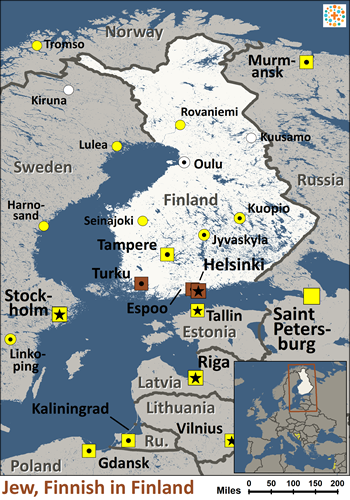

Jewish history in Finland traces back to the late 18th century, with its roots taking hold in the first half of the 19th century when Jewish soldiers — known as Cantonists — who served in the Russian Army were permitted to remain in Finland following their discharge. Many of these early Cantonists had been forcibly conscripted as children for the notorious 25-year military draft, and upon completing their service, they and their families were granted permission to settle in areas normally closed to Jews.
Their presence was initially governed by a series of restrictive decrees. Jews were confined to certain towns, limited in their occupations — primarily to dealing in second-hand clothing — and forbidden from attending fairs or conducting business outside their designated areas of residence. The slightest violation of these limitations could result in expulsion.
The struggle for equal rights was taken up in the Finnish Diet as early as 1872, but meaningful change came only when Finland declared independence. On December 22, 1917, Parliament approved an Act concerning "Mosaic Confessors," and on January 12, 1918, Jews were able for the first time to become Finnish nationals.
During World War II, Finland's position as a co-belligerent with Nazi Germany against the Soviet Union placed Finnish Jews in an extraordinarily difficult situation — Jewish soldiers fought in the Finnish army alongside German forces. Despite intense German pressure, Finnish authorities refused to take action against their Jewish citizens, who continued to enjoy full civil rights throughout the war. Eight Austrian Jewish refugees were, however, deported to Germany in 1942 — an act that provoked a national scandal and for which the Finnish government formally apologized in 2000.
After the war, the community's ties to Israel deepened considerably. Finnish Jews contributed more volunteers per capita during the Israeli War of Independence than perhaps any other diaspora community. Today, the Jewish community in Finland is concentrated primarily in Helsinki, with smaller communities in Turku and Tampere. The congregations in Helsinki and Turku belong to the Central Council of Jewish Communities in Finland, which in turn is a member of the European Council of Jewish Communities and the World Jewish Congress.
The primary language of Finnish Jews is Finnish or Swedish, though many also speak Yiddish, Russian, or Hebrew.
The Jews of Finland hold all kinds of jobs. Many are executives and professionals in business. Their influence on Finnish society has been notable, from diplomats and members of Parliament to educators and business leaders. Finnish Jews are considered a well-integrated part of a uniquely open and accepting culture.
Jewish life in Finland is largely centered in Helsinki, where there are many communal activities, including a library, choir, an elderly care home, and organizations such as WIZO, the Jewish National Fund, and a Maccabi sports club. Communal touchpoints include weekly choir practice and synagogue attendance, though few gatherings attract more than a handful of participants. The community is a close-knit mix of multigenerational Finnish families, expatriates, Israelis, and other Europeans who vary considerably in religious identity and level of observance.
The Jewish daycare in Helsinki accommodates children from age three to seven, where they are naturally introduced to Jewish customs, the Hebrew language, and traditions through daily activities. Children are served meals prepared in a kosher kitchen. A Jewish day school in Helsinki serves students from grades one through nine, and there is also a Jewish service home for the elderly.
Kosher food is available in Helsinki, with frozen kosher meat imported as needed. The community also maintains a cemetery and a chevra kadisha — in fact, the oldest Jewish association in Finland — meaning it is possible to live a fully observant Jewish life within the country.
The Jerusalem Post
Young Finnish Jews are actively encouraged to visit Israel through community programs, fostering a strong sense of Jewish identity and connection to the land. There is an active chapter of the B'nei Akiva youth movement in Finland, and BBYO has also engaged young Finnish Jews in recent years.
World Jewish Congress
Assimilation and intermarriage are significant concerns for the community's long-term survival. Nearly every Jewish family in Finland has at least one member who has married outside the faith. The Helsinki community is periodically revitalized by immigrants and professionals arriving from Israel, drawn in part by Finland's highly developed technology sector.
The Finnish Jewish Community acknowledges that antisemitism — particularly that expressed through anti-Zionism — remains a challenge. Because of security concerns, the Helsinki community center and the Jewish school that operates within the same building receive daily police protection.
World Jewish Congress
For religious Jews in Finland, God is the Supreme Being, the Creator of the universe, and the ultimate judge of human affairs. Beyond this foundation, the religious beliefs of Jewish communities in Finland vary considerably. Orthodox Jews follow the traditional beliefs and practices found in Jewish literature that interprets Scripture regarding ethical, religious, civil, and criminal matters. Reform Jews do not hold that Jewish Law is divinely revealed; they are not restricted to kosher foods, do not wear the yarmulke during prayer, and do not require Hebrew in worship. All religious Jews anticipate a coming Messianic Age, but only Orthodox Jews look for a personal Messiah.
Joshua Project
Many Jewish people in Finland maintain cultural Judaism while having set aside its spiritual foundations. They observe ritual feasts and identify deeply with the long history and heritage of their people, but they refuse to receive Jesus as the promised Messiah, awaiting another. Religion, for much of the community, has become ethnic and historical identity more than active faith. This is a spiritually significant distinction — a people possessing the Scriptures, the covenants, and the promises, yet largely separated from the living God those Scriptures reveal.
Joshua Project
Synagogue practices in Helsinki are formally Orthodox, yet much of the congregational membership is non-observant in practice. This gap between institutional tradition and personal belief is a defining characteristic of Finnish Jewish religious life today.
Times of Israel
The greatest need of the Jewish people in Finland is to encounter Yeshua — Jesus of Nazareth — as their long-awaited Messiah. The Hebrew Scriptures they hold sacred bear witness to Him on every page, yet the majority of Finnish Jews read those texts through the lens of tradition and ethnicity rather than personal faith. They need believers who will love them, respect their history, and share the gospel with both humility and conviction.
Assimilation and intermarriage pose a real and growing threat to community continuity. Younger generations need strong discipleship and mentorship within their communities. The community also needs believers to pray for and engage with Jewish people specifically, rather than simply assuming that proximity to Christian culture will be sufficient.
The Forward
Antisemitism continues to be a tangible concern, and the community relies on government support and police protection to maintain its daily security. Jewish believers and Christian communities alike should stand firmly against antisemitism in all its forms, including the anti-Zionist variety that can sometimes find a home even in church settings.
World Jewish Congress
Pray that this people group would be adopted through the People Group Adoption program, so that a church or ministry commits to ongoing intercession, engagement, and gospel partnership with the Jewish community in Finland.
Pray for Bible-believing Christians — particularly those in Finland and in Messianic Jewish ministries — to reach out to Finnish Jews with sensitivity, love, and the truth that Jesus is the promised Messiah of Israel.
Pray for a deep and sovereign spiritual hunger to rise within the Jewish community of Finland — a hunger that drives men and women to search the ancient Scriptures with open hearts until they find the One to whom every page points, no matter the cost to family or tradition.
Pray for the physical and social wellbeing of Finnish Jews — for their security in the face of antisemitism, for the protection of their schools and community centers, and for their children to grow up in safety and in the knowledge of the living God.
Scripture Prayers for the Jewish, Finnish in Finland.
https://en.wikipedia.org/wiki/History_of_the_Jews_in_Finland
https://jchelsinki.fi/en/about-us/short-history-of-the-finnish-jewry/
https://www.worldjewishcongress.org/en/about/communities/FI
https://jewish-heritage-europe.eu/finland/
https://www.jta.org/2007/03/11/lifestyle/finlands-short-jewish-history
https://www.yiddishbookcenter.org/language-literature-culture/wexler-oral-history-project-films-features-news/features/jewish-3
https://forward.com/culture/688777/finland-jews-russia-wwii-jewish-community-turku-synagogue/
https://eurojewcong.org/communities/finland/
https://www.jpost.com/diaspora/article-887292
https://jewishchronicle.timesofisrael.com/in-finland-small-jewish-community-seeks-sizable-engagement/
https://www.jdc.org/learn/countries/finland/
| Profile Source: Joshua Project |