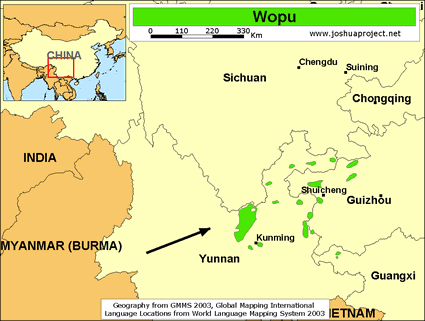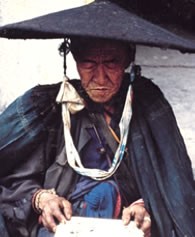

Being one of numerous subgroups of the official Yi nationality in China, the Wopu are commonly called Da Hei Yi (Big Black Yi) by their Chinese neighbors. In this regard they are similar to the Da Hei Neisu, although the two groups speak different languages.
The Wopu were formerly slave-owners and landlords. Considered the highest class of Yi people, they inherited the privilege to keep slaves and could demand free labor on their lands by force.
Like other Yi groups in Yunnan, Guizhou, and Sichuan provinces, the Wopu have "emerged from a slavery society in which they were the infamous landlords and slave-owners; and just as the Liangshan Nosu [in Sichuan], this society of 'Black People' evidently had structured a multi-tiered class system - four castes to be exact. The top ruling classes were both termed 'Black' while the bottom two were referred to as 'White'. Although their counterparts in Sichuan emerged from the slave system as late as the 1950s, this people seem to have begun slowly adopting new ways hundreds of years ago. ... Although the slaves of this system - the Gepo - seem to have spoken the same language, the ruling castes felt it important to distinguish themselves by using two different dialects."
The religious beliefs of the Wopu appear to be a combination of spirit worship, black magic, and ancestor worship. The center of a Wopu home is the kitchen fire-pit. They believe a "spirit of the kitchen" resides there. They also appease the spirit of the village, house, mountains, rivers, and forest. Some elements of Daoism, which have been absorbed from the Chinese, are also present.
Unlike many of their Yi counterparts in northwest Guizhou, most of the Wopu have never received a witness of the gospel. They remain an unreached people group. Having been forced to give up their former identity as slaveholders, the Wopu are facing something of an identity crisis and may be open to the claims of Christ at the present time. Their remote location, distinct language, and small numbers have contributed to a lack of interest in their evangelization.
People everywhere need to feel loved and cared for and their needs met. The Wopu need workers to bring them gospel resources. Loving workers can tell them about new life in Jesus and how to find that.
Pray for workers into the untapped harvest field among the Wopu people.
May the Holy Spirit fill the workers with God's love to minister to them.
Scripture Prayers for the Wopu in China.
Operation China, Asia Harvest, Copyrighted © Used with permission.
| Profile Source: Joshua Project |