


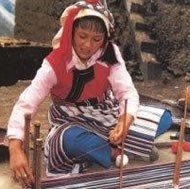

Those Nu living in the upper reaches of the Nujiang River call themselves either Nu or Anu. Those living in the lower reaches call themselves Nusu. Together, they have been combined with several smaller tribes to form the official Nu nationality.
Before their conversion to Christianity, the Lisu often bullied the Nu in the Salween Valley. The Lisu would frequently place a corpse on Nu land and claim the Nu had committed murder. "The demand for compensation, called oupuguya ('the ransom for a corpse') was imposed. This tyrannous annual exaction would be paid continuously for several generations. Each Nu village usually would have to pay six to eight such iniquitous taxes each year."
Nu men are dangerous in the use of the crossbow and are skillful hunters. "Every little boy carries his bow and arrow and every living creature, from the smallest bird to the bear or traveler, serves as target. Their arrows are very strong, and the points are poisoned with the root of aconite." In the past the Nu made all their clothing from hemp; Nu in more remote areas continue this practice. "Almost all women adorn themselves with strings of coral, agate, shells, glass beads and silver coins on their heads and chests.... In some areas, women adorn themselves in a unique way by winding a type of local vine around their heads, waists and ankles."
Most Nu are polytheists. There are also significant numbers of Christians among the Nu, although they have never embraced the gospel en masse as the neighboring Derung and Lisu minorities have. A small number of Nu, mostly those living in mixed marriages with Tibetans, follow Tibetan Buddhism.
Estimates of the current number of Nu believers range from 1,000 to 4,000. J. Russell Morse and his family worked in the Upper Salween area for 25 years prior to 1949. Their mission base was described as "one of the most isolated stations in the world." The family's zealous evangelism converted 6,900 Lisu and Nu and established 74 churches.
The Nu church needs to be saturated with a holiness and righteousness that makes it the envy of all who are looking for spiritual truth.
Pray for the gospel to penetrate the hearts of every Nu family leader.
Pray for Nu people to take seriously the commission to take Jesus to every nation.
Pray for the Nu church to be defined by holiness and love.
Scripture Prayers for the Nu in China.
Operation China, Asia Harvest, Copyrighted © Used with permission
| Profile Source: Joshua Project |



