


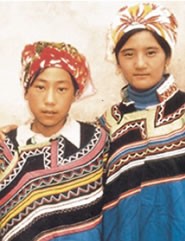

The Wusa Nasu claim they are descended from their esteemed ancestor Dumu, "who had six sons after moving into the region of present-day Zhaotong. These six sons became separate tribes - one of the tribes being the Wusa. Among the other tribes were the Wumeng and Mangbu Nosu. These six tribes have developed quite separately in terms of language."
The Wusa Nasu speak a different language from the several other Yi groups in southern China who use the autonym Nasu. The name Wusa is an ancient tribal name which formerly designated this people group.
Most Wusa Nasu are herders of goats, sheep, cattle and pigs. Since the Ming Dynasty (1368-1644) the Wusa Nasu have used Chinese names, although many still also have Wusa names which consist of two characters. Folk dancing is an important part of Wusa Nasu culture. They dance at weddings, festivals, and at family get-togethers. Children often wear hats decorated with pictures of the sun, moon, and stars.
The Wusa Nasu used to bury their dead but now they cremate them. The people worry that their relatives' souls will not reach their ancestors' homeland, so shamans are called on to perform rituals over the dead body. Shamans still operate in Weining County, but most of them are over 60 years old. Nature worship is embedded in Wusa Nasu customs. They particularly revere the sun and the moon. In totem worship they idolize woodcarvings of bamboo, cranes, tigers, and dragons.
More than one-quarter of Wusa Nasu are Christians today. Missionaries commenced work among them in the early 1900s. In 1907 the Wusa Nasu tried to murder Samuel Pollard because many of their AHmao tenants were being converted. The Wusa Nasu feared the missionaries were giving poison to the AHmao to put in their wells. By 1911 the work was advancing slowly. It was reported: "Some of them [Wusa Nasu] gather a little consolation from the coming of Christianity, and hope that it means an arrest of their decline." Large numbers of Wusa Nasu have followed Christ, including about half of the population in Weining County; in other areas they have firmly resisted the advance of Christianity.
Like people everywhere, the Wusa Nasu people need to allow the loving savior to direct their lives. They need his forgiveness for sin.
Pray that God will break the resistance of non-believers and embolden believers to witness as resistance crumbles.
Pray for signs and wonders to happen among them and for great breakthroughs with a rapid multiplication of disciples and house churches.
Pray for bold workers who are driven by the love of the Holy Spirit to go to them.
Pray for an unstoppable movement to Christ among them.
Scripture Prayers for the Nasu, Wusa in China.
Operation China, Asia Harvest, Copyrighted © Used with permission.
| Profile Source: Joshua Project |



