


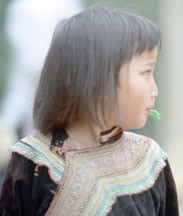

The Hmong Be are a small Hmong subgroup living primarily in southern China, especially in parts of Yunnan Province. They are officially classified within the broader Miao nationality by the Chinese government, though they maintain their own distinct identity, customs, and style of dress. The Hmong Be call themselves "Mountain Hmong," while neighboring Hmong groups use other names to distinguish them from surrounding communities. Their language is closely related to other Hmong dialects, though their separate identity has been preserved through generations of cultural and social separation.
Historically, the Hmong peoples originated in southern China and experienced repeated displacement, migration, and conflict over many centuries. Various Hmong-related groups gradually spread throughout the mountainous regions of southwest China and later into Southeast Asia. The Hmong Be developed as one of many distinct Hmong branches that formed after generations of geographic isolation and cultural separation from other groups.
The mountainous terrain where many Hmong Be communities live helped preserve their language, traditional clothing, oral history, and social customs. Even though modernization has influenced younger generations, many Hmong Be families continue to value ancestral traditions, clan relationships, and inherited cultural identity.
Many Hmong Be families live in mountainous rural areas where agriculture remains central to daily life. Rice, corn, vegetables, and other crops are commonly cultivated on steep hillsides or terraced fields. Livestock raising, small-scale trade, and seasonal labor also provide income for some households. Economic opportunities are often limited in remote mountain communities, causing some younger people to migrate toward cities for work.
Family and clan relationships are highly important within Hmong society. Extended families often live close together, and elders are respected for their wisdom and role in preserving traditions. Weddings, funerals, festivals, and community gatherings continue to play a major role in maintaining cultural identity. Traditional Hmong clothing, embroidery, music, and ceremonial customs remain important markers of identity among many families.
Meals commonly include rice, corn, vegetables, herbs, and locally raised meat when available. In remote areas, daily life may involve physically demanding agricultural work, collecting firewood, caring for livestock, and maintaining hillside farms. Education and healthcare access can vary greatly depending on location and economic conditions.
The Hmong Be traditionally practice forms of animism mixed with ancestor reverence and folk religious customs common among many Hmong groups. Spiritual beliefs often center around unseen spirits, household protection, ancestral influence, healing rituals, and maintaining harmony between the spiritual and physical worlds. Shamans may play an important role in ceremonies intended to heal sickness, guide souls, or protect families from spiritual harm.
In some regions, elements of Buddhism, Chinese folk religion, or local religious customs may also influence spiritual life. Religious practices are often deeply tied to family tradition, clan identity, festivals, and ceremonial obligations passed down through generations.
Although some neighboring Hmong groups in parts of China have responded to the gospel in recent decades, there is little known Christian presence among the Hmong Be specifically. Many have never heard a clear explanation of salvation through Jesus Christ alone.
The Hmong Be face both practical and spiritual challenges. Many families live in isolated mountain regions where access to healthcare, education, transportation, and stable employment opportunities may be limited. Economic hardship and geographic isolation can make long-term advancement difficult for many communities.
Spiritually, the Hmong Be remain largely unreached with the gospel. There is a great need for faithful Christian workers who are willing to learn the language and culture, build long-term relationships, and communicate biblical truth with humility and compassion. Scripture resources, discipleship, and culturally understandable gospel teaching are greatly needed.
Practical ministry involving education support, healthcare assistance, agricultural training, literacy programs, and family encouragement can also help address real-life needs while opening doors for meaningful gospel witness among the Hmong Be people.
Pray that the Hmong Be people would hear the gospel clearly and come to faith in Jesus Christ as Lord and Savior.
Pray for Christian workers to serve among the Hmong Be with humility, wisdom, compassion, and perseverance.
Pray that the Hmong Be people would be adopted through the People Group Adoption program so that ongoing prayer, outreach, discipleship, and future gospel engagement would continue among them.
Pray that believers among other Hmong groups in China would grow in spiritual maturity and faithfully share the gospel with the Hmong Be and neighboring peoples.
Scripture Prayers for the Hmong Be in China.
https://www.peoplegroups.org/explore/GroupDetails.aspx?peid=47387
https://en.wikipedia.org/wiki/Hmong_people
https://www.britannica.com/topic/Hmong
https://www.britannica.com/topic/Miao
https://learnuake.org/articles/hmong-history/hmong-in-china/
| Profile Source: Joshua Project |



